


Families in Dallas–Fort Worth ask us this more than any other question, usually right after a hospital stay, when someone on the unit has said the words "home health is set up." So here is the short version: Original Medicare does not pay for non-medical in-home care. If your mother needs help showering, cooking, remembering her medication or simply should not be alone all day, Medicare will not pay a caregiver for that, in Texas or anywhere else. What it does pay for at home is narrower, medical and usually temporary. Our one-page Medicare summary has the headline; this guide has the details.
Every Medicare rule below is taken from the government's own pages on home health services, long-term care and hospice care on Medicare.gov, read in November 2026.
Why "home care" causes so much confusion
Two very different services share almost the same name.
- Home health is medical care ordered by a doctor: a nurse for wound care or injections, a physical or occupational therapist, a speech-language pathologist. It comes in visits and has a goal. This is what Medicare can cover.
- Home care (non-medical, licensed in Texas as Personal Assistance Services) is help with daily life: bathing, dressing, meals, medication reminders, rides, housekeeping and company. Medicare calls most of this custodial or long-term care, and it does not pay for it.
Families hear "home health is set up" and assume the daily help is covered too. Our guide to home care vs. home health explains the difference in more detail, including why many families end up using both.
What Medicare covers at home in Texas
Medicare Part A and Part B cover home health services when all of these are true, according to Medicare.gov:
- Your parent needs part-time or intermittent skilled care: skilled nursing, physical therapy, speech-language pathology, or continuing occupational therapy.
- Your parent is homebound. Medicare has a specific two-part test for this, shown below.
- A doctor or another provider, such as a nurse practitioner, has seen your parent in person, confirmed the need and ordered the care.
- A Medicare-certified home health agency provides it. The provider should give you a list of agencies that serve your area.
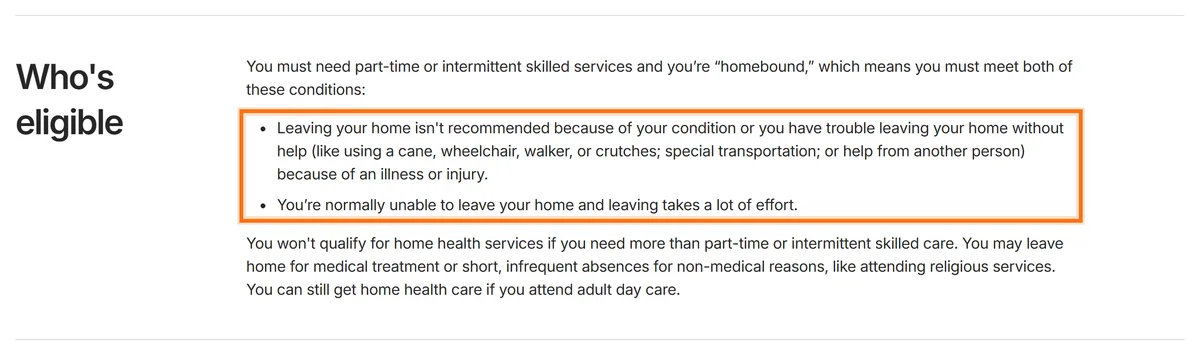
Homebound does not mean your parent can never go out. Medicare.gov says a person can still leave home for medical treatment or for short, infrequent non-medical reasons, such as attending religious services, and can still get home health while attending adult day care.
When those conditions are met, the covered services include part-time skilled nursing (wound care for pressure sores or a surgical wound, injections, intravenous or nutrition therapy, monitoring a serious illness, and teaching the patient and family), physical, occupational and speech therapy, medical social services, durable medical equipment and medical supplies for use at home. You pay nothing for covered home health services; after the Part B deductible, you pay 20% of the Medicare-approved amount for covered medical equipment. Before care starts, the agency should tell you, verbally and in writing, about anything Medicare will not pay for, using a notice called an Advance Beneficiary Notice.
Does Medicare pay for a home health aide to help with bathing?
Sometimes, and this is the line where most of the hope lives, so it is worth reading slowly. Medicare covers part-time or intermittent home health aide care, including help with walking, bathing or grooming, changing bed linens and feeding, only if your parent is also getting skilled nursing or therapy at the same time. The aide is attached to the skilled care. When the nursing or therapy ends, the Medicare-paid aide ends with it.
There is also a ceiling on the hours. If your parent qualifies, Medicare.gov says the number of home health visits is unlimited, but in most cases "part-time or intermittent" means up to 8 hours a day of skilled nursing and aide services combined, for a maximum of 28 hours a week. For a short time, and if the provider decides it is necessary, that can rise to up to 35 hours a week.
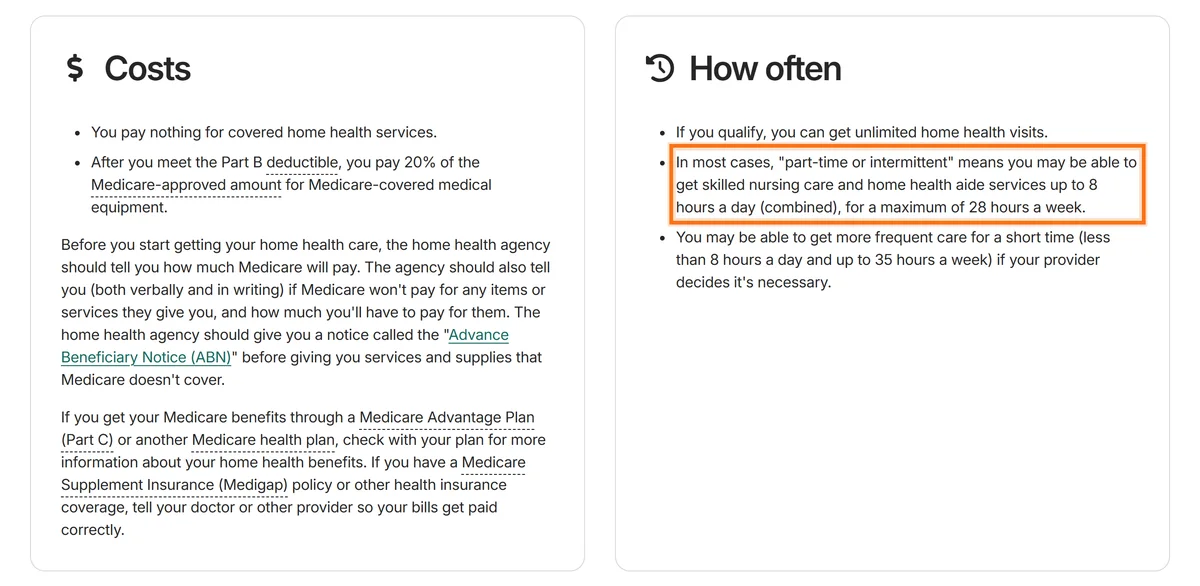
In practice, those hours come as scheduled visits. Nobody from the agency stays for the long afternoon or is there at 3 a.m.; that is how the benefit is designed.
Covered or not: in-home services under Original Medicare
| Service at home | Does Original Medicare pay? | The condition that matters |
|---|---|---|
| Skilled nursing visits (wound care, injections, monitoring) | Yes | Homebound, part-time or intermittent, ordered by a doctor, certified agency |
| Physical, occupational or speech therapy at home | Yes | Same conditions; occupational therapy must start alongside another skilled service |
| Home health aide (bathing, grooming, walking) | Yes, part-time | Only while skilled nursing or therapy is also being provided |
| Durable medical equipment | Yes, with cost sharing | You pay 20% of the approved amount after the Part B deductible |
| Bathing, dressing or toileting help as the only care needed | No | Medicare treats this as custodial or personal care |
| Homemaker services (shopping, cleaning) unrelated to the care plan | No | Not covered |
| Home meal delivery | No | Not covered |
| 24-hour-a-day care at home | No | Not covered |
How to read this table: the top four rows are a medical episode with a beginning and an end, and every "yes" depends on the conditions in the right-hand column. The bottom four rows describe most of what an aging parent needs week after week, and every one of them is a "no." That gap is what a family has to plan around.
What Medicare does not pay for, in plain words
Medicare.gov's long-term care page is unusually direct. It defines long-term care, also called custodial care, as help with the basic personal tasks of everyday life, such as dressing, bathing and using the bathroom, and says that because most long-term care is non-medical, Medicare and most health insurance, including Medicare Supplement (Medigap) policies, do not pay for it, at home or in a nursing home. Its cost line reads simply that you pay all costs for non-covered services, including most long-term care.
When home health ends: planning the handoff
Home health is designed to end. When your parent reaches the goals in the plan of care, or no longer needs skilled care, the visits stop, and the Medicare-paid aide stops with them. The needs that were there before the hospital stay usually have not gone anywhere.
Knowing that, a few steps make the handoff smoother:
- Ask the home health agency early when it expects to discharge your parent, and what it will be checking before it does.
- Use the covered weeks to watch. Note which hours are hard: the morning shower, the late afternoon, the night. That list becomes the schedule for whatever help comes next.
- Line up non-medical help to start before the last aide visit, so there is no gap of days where nobody helps with bathing.
If your parent is coming home from a hospital in the metroplex right now, our post-hospital recovery care page explains how we fit around a home health agency's visit schedule.
A Texas detail: pre-claim review for home health
Texas is one of five states, with Florida, Illinois, Ohio and North Carolina, where Medicare.gov says a home health patient may be affected by a Medicare demonstration program. Under it, the home health agency may ask Medicare for a pre-claim review, so the agency and your parent know earlier whether Medicare is likely to cover the services. Medicare.gov says the benefits themselves have not changed and access to home health should not be delayed by the review. Questions go to 1-800-MEDICARE (1-800-633-4227).
What about Medicare Advantage plans?
Your parent may get Medicare through a Medicare Advantage (Part C) plan instead of Original Medicare. On this point, Medicare.gov's home health page says only that people in a Medicare Advantage or other Medicare health plan should check with their plan for more information about their home health benefits. Call the number on your parent's card and ask:
- "What home health benefits does this plan include, and does it require approval first?"
- "Does the plan include any in-home support or personal care hours that are not home health? How many, and from which providers?"
Note who you spoke to and the date, and get any yes in writing before building a schedule around it.
What about hospice at home?
Hospice is the other Medicare benefit that reaches the home. Medicare Part A covers it when the hospice doctor and your parent's regular doctor certify a terminal illness with a life expectancy of 6 months or less, and your parent chooses comfort care instead of treatment to cure the illness. Medicare.gov says a hospice nurse and doctor are on call 24 hours a day, 7 days a week, and the team may include hospice aides, homemakers, social workers, chaplains and volunteers.
On call is not the same as someone in the house, and Medicare.gov notes that it does not cover room and board when hospice care is given at home. Ask the hospice how often each team member will visit. Many families pair the hospice team with non-medical caregivers for the hours in between; our end-of-life and hospice support page and our guide to what caregivers do alongside hospice at home explain how that works.
Texas Medicaid: STAR+PLUS
Medicare.gov points families who need long-term care toward Medicaid, for those who meet their state's rules, or private long-term care insurance. In Texas, the Medicaid route for older adults is STAR+PLUS, a Medicaid managed care program from Texas Health and Human Services for adults age 65 or older and adults with disabilities. According to Texas HHS, its long-term services and supports include help in the home with basic daily activities, personal assistance services, day activity and health services, and short-term care to give caregivers a break.
A person must first be approved for Medicaid, which has income and asset rules. Texas HHS says your parent can get STAR+PLUS while also on Medicare, with some exceptions, and that it does not change the way they get Medicare services. You can apply online through Texas HHS or by calling 2-1-1.
How Dallas–Fort Worth families pay for non-medical home care
Once Medicare is ruled out for daily help, these are the realistic sources.
| Source | Can it pay for daily help at home? | Where to start |
|---|---|---|
| Original Medicare | No, except an aide alongside skilled home health | Your parent's doctor, if there is a skilled need |
| Medicare Advantage | Depends on the plan | The phone number on the card; get the answer in writing |
| Texas Medicaid (STAR+PLUS) | Yes, for those who qualify | Texas HHS online, or call 2-1-1 |
| Long-term care insurance | Often, under the policy's own rules | The policy itself: benefit triggers and waiting period |
| VA Aid and Attendance | A monthly pension amount the family can put toward care | Eligibility as a wartime veteran or surviving spouse |
| Private pay | Yes, any schedule | A free assessment and a published hourly rate |
How to read this table: read down the middle column for a "yes" that fits your parent today, then go to the right-hand column for the first phone call. If nothing above private pay fits yet, private pay usually carries the first weeks while you apply for the others.
- Long-term care insurance. A policy bought years ago often covers in-home care, but claims involve benefit triggers, a waiting period and care records. Our guide to using a long-term care policy for home care walks through a claim step by step, and we help families with the paperwork.
- VA Aid and Attendance. Wartime veterans and surviving spouses may qualify for a monthly amount on top of a VA pension. Our guide to VA Aid and Attendance in Texas covers who qualifies and how to apply.
- Private pay. Our rate is published: $30–34 an hour, the same for days, evenings, weekends and overnights, with a four-hour minimum visit, so one visit costs $120 to $136. Major holidays are billed at time and a half. On our Dallas–Fort Worth pricing page, 12 hours a week comes to about $1,560–$1,770 a month and 20 hours a week to about $2,610–$2,960. There is a couples discount, no long-term contract and no levels-of-care markup as needs grow.
How Senior Care of North Texas fits alongside Medicare in Dallas–Fort Worth
We are a locally owned, Texas-licensed (License #020448) non-medical Personal Assistance Services agency serving the Dallas–Fort Worth metroplex and the surrounding North Texas counties. We are not a Medicare provider, and we will not pretend Medicare pays for what we do. What we do is cover the hours around a home health agency's visits: personal care such as bathing and dressing, meals, medication reminders from the organizer the family or the pharmacy has filled, rides, and someone in the house when nobody else can be.
Ryan, our co-owner, does a free in-home assessment, usually the same day or the next morning, and care can often start within 24 hours. We match a caregiver to your parent, you meet them first, and you can ask for a different caregiver if the fit is not right. Call (214) 550-6533, answered 24/7, or request a free assessment and we will call you back.
This article is general information, not medical, legal or benefits advice. Medicare and Medicaid rules change; confirm the details on Medicare.gov, with Texas HHS or with your parent's plan, and talk with the physician about medical decisions.
