
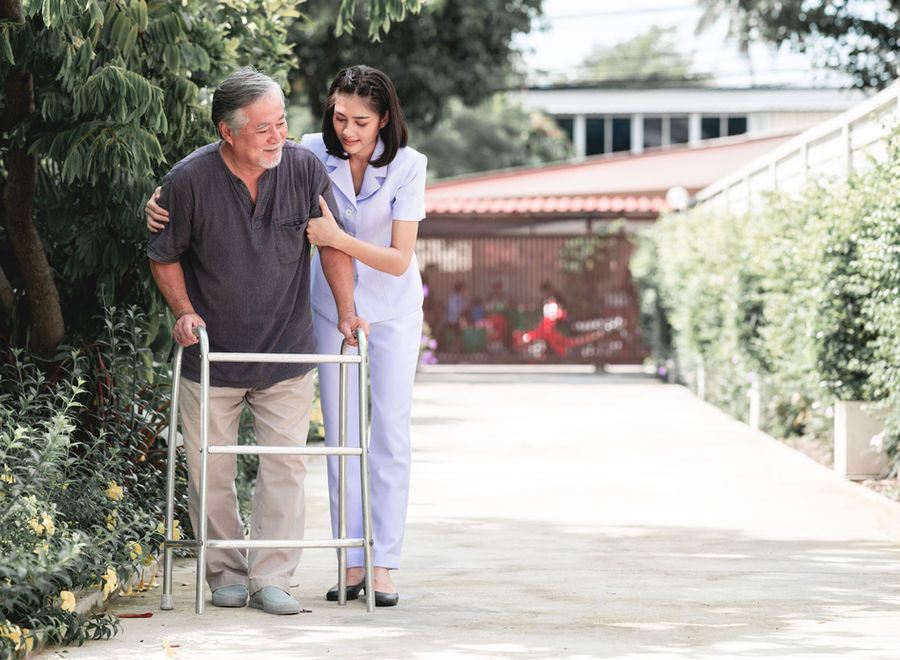

According to the National Institute on Aging, more than one in four people age 65 or older fall each year, and the risk rises with age. Behind that number is a plainer fact: many falls happen at home, during ordinary activities, in places you can inspect this weekend.
As a personal care agency, we walk into homes all over Dallas–Fort Worth, and we see the same hazards again and again — usually invisible to the people who live there, because familiarity hides them. Use this checklist on your next visit to your parent's house. Go room by room, in order of risk. And one promise we won't make: no checklist "prevents falls." The honest goal is to remove the avoidable hazards and add human support where risk stays stubbornly high.
Where should you start? The first fix in each room
If you only have one Saturday, do the first fix in every room before you do the whole list in any one of them:
| Room | Check this first | The fix | Effort |
|---|---|---|---|
| Bathroom | What the hand grabs getting out of the shower | A real grab bar anchored into the wall, plus a non-slip mat | Needs an installer |
| Bedroom and night route | Whether the whole path to the bathroom is lit | Plug-in motion night lights, clear floor | Low cost, ten minutes |
| Stairs and hallways | Handrails on both sides, full length | Add or tighten the second rail; nothing stored on steps | Needs a handyman |
| Living areas | Throw rugs and cords across walking paths | Remove the rugs, route cords along walls | Free |
| Kitchen | Whether a step stool is still in use | Move everyday items between waist and shoulder height | Free |
| Front entry | The handrail and the porch light | Motion-sensor light, thin rubber-backed mat | Low cost |
| Outdoors and garage | Lifted concrete and hoses on the walking route | Coil hoses, mark or repair lifted slabs | Free to start |
How to read this table: the rows are in order of risk, so start at the top. The last column tells you what you can finish today (the rows marked free or low cost) and what needs a phone call. Do today's rows today; a rug removed this afternoon protects your parent tonight, while the grab bar waits for the installer.
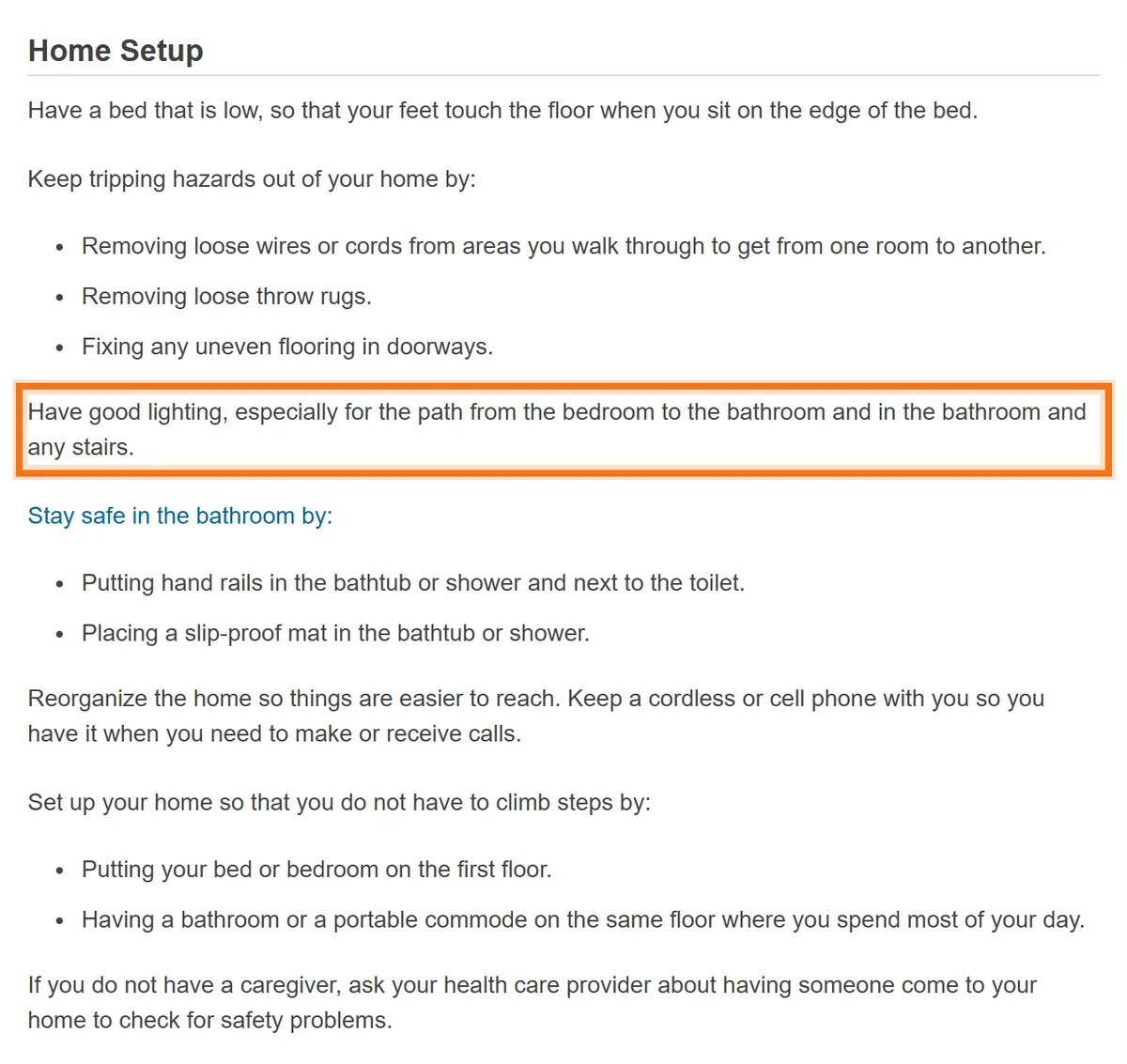
The National Library of Medicine's patient guide to preventing falls gives the same priorities in its home setup section:
Start here: the front entry
The path from car to front door is the first test of every trip out and back — often carrying bags, often in the dark.
- Steps are even, unbroken, and have a solid handrail — one your parent actually uses.
- Walkway is clear of hoses, planters, cracked or lifted concrete sections.
- Porch light works, and the switch (or a motion sensor) means no one crosses the entry in the dark.
- Doormat is thin and rubber-backed — a curled mat edge is a classic trip point.
- A small bench or table sits by the door, so bags get set down instead of juggled while unlocking.
- House numbers are visible from the street, so emergency responders can find the house fast.
The bathroom: highest risk in the house
Hard surfaces, water, and the most difficult movements of the day — standing from a low toilet, stepping over a tub wall on wet tile. If you only fix one room, fix this one.
- Grab bars — real ones, anchored into studs or with proper mounts — beside the toilet and inside and outside the shower or tub. Towel bars and suction-cup bars are not grab bars.
- A raised toilet seat if standing up from the toilet is a visible effort.
- Non-slip strips or a rubber mat inside the tub or shower — and a rubber-backed rug, never a loose towel, on the floor outside it.
- A shower chair and handheld shower head if standing for a full shower is tiring. Sitting to shower isn't giving up; it's what makes showers keep happening.
- Nightlight on, every night.
- Supplies stored between waist and shoulder height — no bending to the floor of the cabinet, no reaching to the top shelf, no step stools. Ever.
- The door can be unlocked from outside, in case help is needed.
One honest note: even a perfectly equipped bathroom leaves bathing risky for someone with real balance or strength problems. That's the point where equipment stops helping and a person standing by does — bathing assistance is among the most common things families hire us for, precisely because it's the risk a grab bar can't finish solving. Our bathroom safety guide goes through the room bar by bar.
The kitchen
- Everyday dishes, pans, and food live between waist and shoulder height. If the step stool is still in the kitchen, the storage isn't fixed yet — retire the stool.
- Spills get wiped immediately; a dish towel hangs within reach of the sink and stove.
- No throw rugs in front of the sink or stove — or only rubber-backed, low-profile ones.
- Good light over the counters and stove, not just the ceiling fixture.
- Heavy items (cast iron, mixers, cases of water) stored at counter height or moved elsewhere.
- A sturdy chair with arms nearby, so peeling and chopping can happen seated on tired days.
The bedroom — and the 2 a.m. route
The single most dangerous trip in the house is bed-to-bathroom at night: dark, half-asleep, sometimes hurried, sometimes dizzy from standing up too fast.
- A lamp or switch is reachable from the bed — no crossing a dark room to make light.
- Nightlights mark the entire route to the bathroom. Motion-activated ones cost little and need no habit change.
- The route is permanently clear — no shoes, laundry baskets, cords, or pet beds, and no low furniture with sharp corners.
- Bed height lets your parent sit with both feet flat on the floor. Beds that are too high or too low make every transfer a small gamble.
- Phone (and glasses) within reach of the bed — reachable from the floor matters too, in case of a fall.
- Slippers have backs and rubber soles. Backless slippers and socks on hard floors are fall footwear.
- Encourage the habit: sit on the edge of the bed for a slow count of ten before standing. Blood pressure that drops on standing is common with age and with many medications — worth mentioning to the doctor.
If nights are the worry, our guide to preventing night-time falls covers the hours between bedtime and breakfast in detail.
Stairs and hallways
- Handrails on both sides, running the full length of the stairs, anchored firmly.
- Light switches at the top and bottom — nobody should climb stairs in the dark to reach a switch.
- Steps in good repair, carpet tight, no loose stair-runner. Mark the top and bottom step edges with contrasting tape if vision is an issue.
- Nothing stored on the steps. The "take it up next trip" pile is a hazard with good intentions.
- Hallways clear and lit; any throw rugs removed or firmly rubber-backed.
- If stairs have become genuinely frightening, consider moving the bedroom downstairs — rearranging rooms is cheaper than a fall.
Stairs deserve extra attention in the older two-story houses of East Dallas and the Park Cities, where the bedrooms and the only full bathroom are often upstairs. We wrote a separate guide to stairs and safety in older Lakewood and Highland Park homes.
Living areas
- Clear, wide walking paths through the room — furniture arranged so no route requires sidestepping.
- Electrical and charger cords routed along walls, never across walking paths.
- Throw rugs gone, or rubber-backed and taped. This is the cheapest meaningful fix in the whole house.
- The favorite chair is firm and high enough to stand up from without rocking for momentum; risers help a too-low sofa.
- Pet toys, food bowls, and the pets themselves accounted for — underfoot pets are a real and awkward-to-discuss hazard.
- A cordless phone or mobile lives next to the main chair, so ringing phones don't get sprinted to.
Outdoors and garage
- Driveway and patio checked for cracks, lifted slabs, and slick algae patches, especially on shaded north sides.
- Garden hoses coiled and hung, tools put away, yard clutter cleared from walking routes.
- Garage floor clear of oil spots and clutter; the path from car to house door is wide and lit.
- On the rare North Texas ice day, the plan is simple: nobody goes out. Groceries can wait; hips can't be un-broken.
- Yard work above shoulder height or on ladders is delegated — to family, a neighbor's teenager, or a service. Ladders and roofs are how careful people fall.
Beyond the house: the other half of fall risk
A safe house occupied by someone dizzy from medications is still a risky situation. The other half of the checklist belongs to your parent's doctor, and it's worth booking a visit to cover: a medication review (several common drug types affect balance), a vision check, footwear, vitamin D, and strength and balance — including whether physical therapy or a balance class makes sense. The CDC's STEADI initiative for preventing falls is built around exactly this combination of home changes plus medical review. Ask the doctor directly: "Do any of her medications increase fall risk?" It's a question with actionable answers.
When is a checklist not enough?
A checklist fixes the house. It does not fix weak legs, dizziness, poor vision or memory loss, and it cannot be in the room. These are the signs that the next step is a person rather than another piece of equipment:
- There has already been a fall, or a near-fall you only heard about weeks later.
- Showers are being skipped because the bathroom has become frightening.
- Your parent holds on to furniture to cross a room, or needs two tries to stand from a chair.
- Nights involve several trips to the bathroom, in a hurry.
- Your parent lives alone, and a fall could mean hours on the floor before anyone knows.
For most families the first step is small: a caregiver for one four-hour morning visit on shower days, which at our published $30–34 an hour is $120 to $136. That visit covers getting up, the shower, dressing and breakfast, the part of the day when help with transfers and mobility matters most. If a fall has already happened, the first two weeks after a fall explains what recovery looks like.
How Senior Care of North Texas helps with this
We are a locally owned, Texas-licensed non-medical home care agency (Personal Assistance Services License #020448) serving Dallas–Fort Worth and the surrounding North Texas counties. Where this checklist meets its limits — bathing, transfers, steadying an arm on the stairs, being present so a fall doesn't mean hours on the floor alone — that's the work our caregivers do every day. Our free in-home assessment includes walking the home with exactly these hazards in mind, and families can start with a single half-day morning visit that covers the shower, breakfast, and the riskiest hours of the day at one flat rate. No levels-of-care pricing, a caregiver matched to your family (with a different match on request), and care can often start within 24 hours.
This article is educational and is not medical advice, and no checklist can eliminate the risk of falling. For guidance specific to your parent — medications, balance, vision, physical therapy — talk with their physician.
