


There's a line families hear from doctors and never quite believe until they live it: the caregiver often ends up sicker than the person they care for. Caregiver strain isn't a character flaw or a scheduling problem. The National Institute on Aging treats it as a genuine health risk: family caregivers are less likely than other people to get preventive care such as annual checkups, and they carry a higher risk of sleep problems and chronic conditions such as high blood pressure.
This article covers the warning signs of burnout, why the people most at risk are the best at hiding it, and what respite care actually covers — including why a break big enough to matter, taken regularly, is what actually works.
What burnout actually is
Burnout isn't "having a hard week." It's the state a person reaches when the demands of caregiving have exceeded their capacity to recover for so long that the system starts failing — body, mood, judgment, and eventually the caregiving itself. It matters for two people, not one: an exhausted caregiver misses medication times, cuts corners on transfers, drives tired, and gets sick. Protecting the caregiver is protecting the person receiving care. That's not a slogan; it's logistics.
What are the warning signs of caregiver burnout?
Run through this list twice — once for yourself, once for the family member doing the daily care. Checking two or three boxes is a signal worth acting on, not a verdict on anyone's love or effort.
- Sleep that never adds up. Up at night helping, then unable to fall back asleep. Running on five or six broken hours as the new normal.
- Their own health sliding. Canceled checkups, refills not picked up, "I'll deal with my knee later." Caregivers routinely defer their own medical care first.
- Getting sick more, healing slower. Colds that linger, blood pressure creeping, weight moving noticeably in either direction.
- A short fuse where there wasn't one. Snapping at the person they care for, then drowning in guilt about it. This cycle is one of the most reliable burnout markers.
- The shrinking life. No church, no friends, no hobbies — every invitation declined so long that invitations stop coming.
- Feeling trapped or numb. Dreading the day at 6 a.m., or moving through it on autopilot without feeling much at all.
- Resentment followed by shame. Dark thoughts like "I can't do this anymore," immediately buried because "a good wife wouldn't think that."
- Mistakes creeping in. Missed medication reminders, a near-miss on the stairs, forgetting appointments — the caregiving itself starting to fray.
If several of these describe you, mention it to your own doctor, plainly, at your next visit — sooner if the ground feels like it's giving way. Physicians take caregiver strain seriously, and some of what it causes is treatable.
A two-minute caregiver burnout assessment
This is not a clinical test, and it does not replace a conversation with your doctor. It is the same eight signs turned into questions you can answer yes or no, alone, in two minutes. Answer for the last month, not for your best week.
| Ask yourself | A yes usually means |
|---|---|
| Am I sleeping fewer than six unbroken hours most nights? | The nights need covering, or the days will not hold |
| Have I canceled or postponed my own doctor or dentist visit? | Your health is now behind the caregiving in line |
| Am I getting sick more often, or taking longer to recover? | The strain has become physical |
| Have I snapped at the person I care for, and felt guilty afterward? | You are past tired; this is the most reliable marker |
| Have I turned down every invitation for a month? | Your own life has shrunk to the caregiving |
| Do I dread the day when I wake up, or feel nothing at all? | Worth raising with your doctor this week |
| Do I think I cannot do this anymore, then feel ashamed of it? | The load is too big for one person, not a flaw in you |
| Have I missed a medication time, an appointment, or had a near-miss on the stairs? | The care itself has started to fray |
How to read this table: count the yes answers. One or two means plan a regular break before you need one. Three or more means two calls this week: one to your own doctor, and one to arrange respite, whether that is a relative, a friend or an agency like ours. If you answered yes to the sixth or seventh question and it feels heavy, call your doctor today rather than waiting for the next visit.
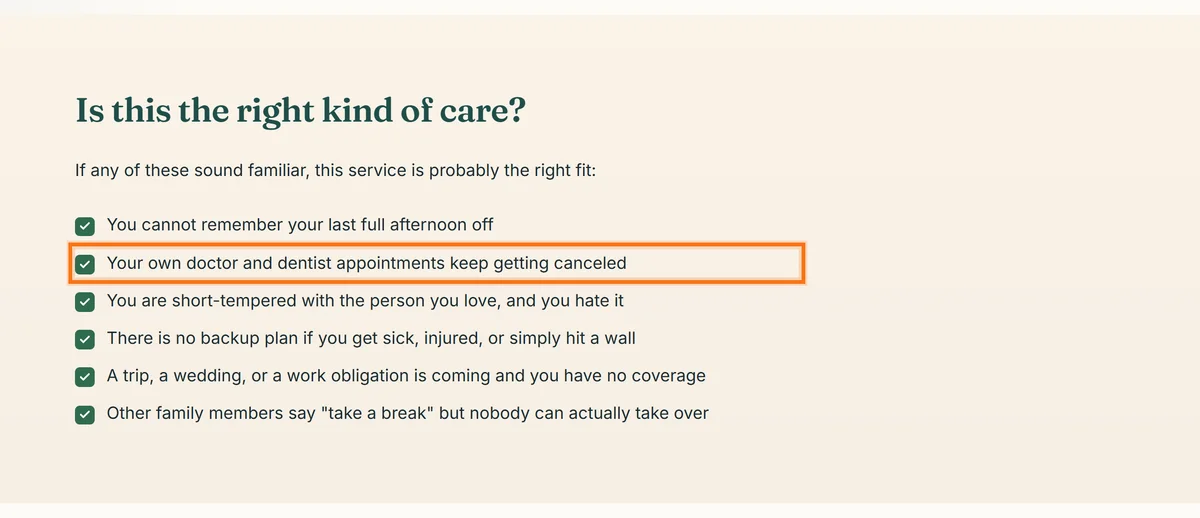
Our respite care page asks a shorter version of the same thing, written for the person who is doing the caring:
Why spouses hide it
Adult children are often stunned to discover how bad things had gotten at their parents' house. That's not an accident. Caregiving spouses conceal strain deliberately, for reasons that make complete sense from inside the marriage:
- They made a promise. "In sickness and in health" is fifty-plus years old and non-negotiable in their minds. Asking for help can feel like breaking it.
- They fear the alternative. Many believe that admitting they can't cope starts a chain that ends with their husband or wife "put in a home." Hiding the struggle feels protective.
- They don't want to burden the kids. "You have your own family" is the sincere, career-long reflex of a parent.
- Pride and privacy. Letting a stranger see the bathing, the accidents, the 3 a.m. confusion feels like exposure — of both spouses.
- The slide was gradual. No single week felt like a crisis, so no single week seemed worth reporting.
The practical consequence: don't rely on asking. "Mom, are you managing okay?" will get "We're fine, honey" every time. Look instead at the observable things: her weight, her sleep, the state of the house, whether she's been to her own doctor this year, whether she can name the last time she left Dad for two hours. If a parent is caring for a spouse with dementia, the load is heavier still — evenings especially, as we cover in our guide to sundowning. And if the conversation itself is the obstacle, our article on talking to a parent who refuses help maps the approaches that work.
What respite care actually covers
"Respite care" sounds institutional. It's simpler than it sounds: a professional caregiver takes over for a defined stretch so the family caregiver can genuinely be off duty. As a non-medical Personal Assistance Services agency, during that stretch our caregiver does what the family caregiver has been doing:
- Bathing, dressing, grooming, and toileting help
- Safe transfers and steadying help walking
- Meals made and dishes done
- Medication reminders (prompting on schedule from the organizer you or the pharmacy filled — we don't fill it, administer or adjust medications; that stays with the family, the doctor and the pharmacist)
- Companionship, conversation, cards, a drive — the day still happens, pleasantly
- Light housekeeping so the house the caregiver returns to is calmer than the one they left
Respite comes in many sizes: a standing half-day break every Tuesday, an afternoon for the caregiver's own medical appointments, a full weekend so an exhausted spouse visits grandchildren, or a week of daily coverage while an adult daughter takes the vacation she's postponed twice. One important note on expectations: respite works when it's regular. A single afternoon off after eight months underwater is a gesture. A protected half-day every week is a system.
What respite is not: it isn't a judgment on the family caregiver, and it isn't the first step of a plot to "take over." The family caregiver stays in charge — the routines, the house rules, the way Mom likes her coffee all come from them. A good respite caregiver learns the household's way of doing things and runs it faithfully, so the person receiving care experiences continuity, not disruption. Most spouses who resist the idea hardest become its firmest defenders within a month, for a simple reason: the first real break in years tells the truth about how tired they were.
The half-day break, and what it costs in Dallas–Fort Worth
Here's the piece of planning that quietly decides whether respite works. Families often imagine buying tiny slivers of relief — an hour here, ninety minutes there — but a sliver barely functions as a break. By the time the caregiver has driven to the store and back, the hour is gone and nothing in her own life got attended to.
Our minimum visit is four hours — a half-day block — and in respite terms that's a feature, not fine print:
- The break is real. One four-hour visit covers groceries, her own doctor's appointment, lunch with a friend, and an hour at home in a quiet house — the whole list, not one item of it.
- Starting is still low-stakes. A reluctant spouse will accept "someone's coming Thursday morning" as a one-time trial. Almost every long schedule we run started as a toe in the water.
- Regularity becomes sustainable. The same half-day, the same caregiver, every week — a rhythm the whole household can plan around, at one flat hourly rate that never changes for evenings or weekends.
Add the rest of our structure — no "levels of care" pricing, a couples discount when both spouses need support, and help with long-term care insurance paperwork (if a policy exists, we help read what it covers and file the claim) — and a weekly break stops being an extravagance. It's just part of how the household runs. Visit minimums are worth understanding before you call any agency; we break them down in our guide to home care hour minimums.
Here is what a standing break costs at the rate on our pricing page, $30–34 an hour, the same on weekdays, evenings and weekends:
| Respite schedule | Hours per month (approx.) | Estimated monthly cost |
|---|---|---|
| One half-day a week (4 hours) | 17 | $520–$590 |
| Three half-days a week (12 hours) | 52 | $1,560–$1,770 |
| Five half-days a week (20 hours) | 87 | $2,610–$2,960 |
How to read this table: the first row is where most caregiving spouses start, and it is the one that prevents burnout rather than treating it. Move down a row only when one half-day stops being enough; because there are no contracts, you can also move back up. Major holidays are billed at time and a half, and the free in-home assessment gives you an exact figure in writing.
What if a weekly break is not enough?
Sometimes the self-check comes back with six or seven yes answers, and one morning a week will not fix that. Three things usually help more than adding scattered hours:
- Cover the nights first. If sleep is the problem, an awake overnight caregiver two or three nights a week does more than any daytime visit. Our guide to what an awake night shift includes explains how it works; the hourly rate is the same as daytime.
- Take the real time off. A weekend away, or the trip postponed twice, needs a full schedule of days and overnights built in advance, and then you actually go.
- Read the companion guide. If you are the husband or wife doing the caring, respite care for the caregiving spouse is written for you rather than for your children.
When you are ready to set up the break itself, our guide to respite care in Preston Hollow, the Park Cities and nearby Dallas neighborhoods covers the weekly four-hour block, a one-time break, a trip out of town and what to tell the caregiver before you leave.
How Senior Care of North Texas helps with this
We are a locally owned, Texas-licensed non-medical home care agency (License #020448) serving Dallas–Fort Worth and the surrounding North Texas counties, from Dallas and the Park Cities to Fort Worth, Plano, Frisco and Denton. Respite is one of the most common reasons families call us, and the setup is deliberately easy: a free in-home assessment with no obligation, a background-checked caregiver matched to your family (with a different match a phone call away if it isn't right), a care plan built around the household's routine that adjusts as needs change, and one flat hourly rate with no long-term contracts. Care can often begin within 24 hours — which matters when the person who needs the break needed it months ago.
This article is educational and is not medical advice. If caregiving is affecting your health, sleep, or mood, please talk with your own physician — your health is part of the care plan too.
