


Here is the conversation most families have. The adult daughter says, "Mom, you need help." The mother says, "I'm fine." Repeat monthly, with rising volume, until something breaks: a hip, or the relationship. Families across Dallas–Fort Worth call us at this stage asking us to talk their parent into care, and the first thing we say is that persuasion is not really the job. Understanding is. Families who get to yes rarely win the argument; they change the question.
Often the easiest first question is not "will you accept a caregiver" but something much smaller. That is why so many of these starts look like companion care, a morning of company and small jobs around the house, rather than anything that sounds like a nurse.
Why "no" is a reasonable answer from her chair
Start by sitting in your parent's chair. She has run a household for fifty years. She raised you. Her competence is not a job she can retire from; it is who she is. Now her child is telling her a stranger should come into the house and help.
From that chair, refusal is not stubbornness. It is a defense of things that are really at stake, and each one needs its own answer.
| What she is protecting | What it can sound like | What tends to help |
|---|---|---|
| Control: her schedule, her kitchen, her way | "I don't want someone telling me what to do." | She picks the day, the jobs and the end date. Say out loud that these are her calls. |
| Privacy: the last place that is fully hers | "I don't want a stranger in my house." | Start with outside jobs: errands, groceries, a ride. Let her meet the caregiver first. |
| Money: protecting savings or an inheritance | "We can't afford that." | Show the real number for one morning, not a monthly worst case. Offer to cover the trial. |
| Meaning: her role as the capable one | "I've managed just fine for years." | Ask her to do it for you. Frame the help as staff for the house, not care for her. |
| Fear of what comes next | "This is how it starts. Next it's a home." | Say plainly that the point is to keep her at home, and that she can stop the trial. |
How to read this table: listen for which sentence in the middle column your parent actually says, then use the answer in the right column. "You need help" attacks every row at once, which is why it fails. Answering one fear at a time is slower, and it works far more often.
None of this means you are wrong about the situation. Everyone in her generation knows someone whose "little bit of help" ended in a facility. She is not wrong that these things can be a sequence. She is wrong that they have to be, and your job is to show her a different path.
Five conversation approaches that actually work
1. Make it about you, not her
"Mom, you can't be alone" invites a rebuttal. "Mom, I can't concentrate at work because I'm worried. Would you do this for me?" invites generosity, and parents are practiced at being generous to their children. It is also the truth. You are not asking her to admit weakness; you are asking her to solve your problem, which she has done all her life.
2. Make it about the house, not her body
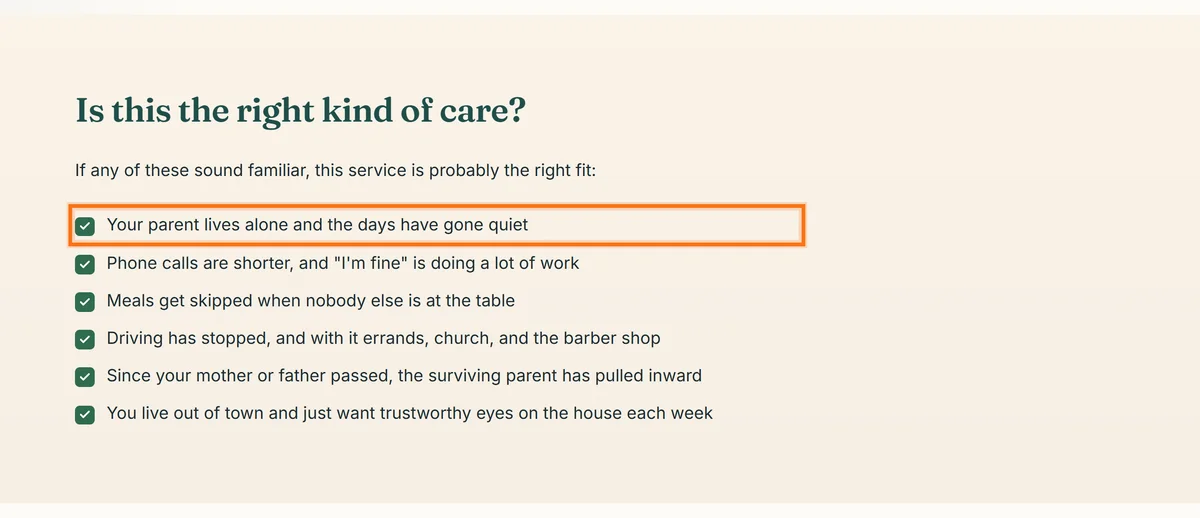
Help for her feels like an insult; help for the house is staff. "Someone to do the heavy cleaning and drive you to Tom Thumb so you're not fighting the parking lot" is a completely different offer from "someone to take care of you." Laundry, meals and light housekeeping and errands are easy to accept. Personal care can be added later, at her pace, once the caregiver is simply a person she likes.
3. Shrink the ask until the no gets awkward
"A caregiver" sounds like forever. One morning a week, as a trial, is hard to refuse with a straight face. So propose the smallest real thing: a single visit, on a day she picks, doing the jobs she names, with an end date she sets. Nobody has to sign up for a life change to try one Tuesday morning.
4. Give her the controls
Every choice you can hand over lowers the threat. She says which day works. She says which jobs she wants done. If the caregiver who comes is not the right fit, she can say so and we match someone else. She can call the whole thing off after a month. None of this is a trick. Those really are her calls, and saying so out loud turns "this is being done to me" into "I am trying something."
5. Pick the right messenger, and stop repeating yourself
Sometimes the message is fine and the messenger is wrong. Parents who wave off their children will often listen to a brother, a pastor, a longtime friend or a doctor. And if a conversation fails, let it fail. The tenth "Mom, please" does not persuade; it hardens the no. Plant the idea, drop it, and come back in two weeks from a different angle. If brothers and sisters are pulling in different directions, settle that first; our guide to when siblings disagree about a parent's care has a plan for it.
Phrases to reach for, and ones to retire
Small changes in wording carry a lot of weight in these talks. The same request can sound like a takeover or like a favor.
| Retire this | Try this instead | Why it works better |
|---|---|---|
| "You can't keep living like this." | "Would you do this for me?" | Asks for a favor instead of a confession |
| "This is permanent, get used to it." | "Just for a few weeks, and you can call it off." | A trial with an exit is easy to say yes to |
| "Someone to take care of you." | "Someone to handle the house so you can do what you like." | Help for the house, not for her body |
| "The agency is sending someone Tuesday." | "If she's not your kind of person, we ask for someone else." | She keeps the final say |
| "Why are you being so difficult?" | "What would make this easier for you?" | Turns a fight into a problem to solve together |
| Comparisons to a declining neighbor | "Dad managed the same thing with help, remember?" | Links help to someone she respected |
How to read this table: you do not need all six. Pick the one or two rows that match the last argument you had, and practice the middle column before the next visit. If the old phrase slips out, stop, and start the sentence again.
What a trial morning looks like in Dallas–Fort Worth
Our minimum visit is four hours, and for a reluctant parent that is a feature, not a hurdle. Four hours is long enough to feel like an ordinary morning instead of an inspection: breakfast, a load of laundry, a grocery run or a ride to the hair salon, and time to sit and talk over coffee. Trust is built in that last part.
- Before the visit: a free in-home assessment, which we keep a conversation, not an intake. Your parent can lead it.
- The match: we match a caregiver to your parent's personality and routine, and she meets them. If the fit is wrong, we match someone else.
- The jobs: the ones she names. A short written list on the counter helps her feel in charge.
- The cost: our published rate is $30–34 an hour, the same day, evening or weekend, so one four-hour morning costs $120 to $136. Four hours a week comes to about $520–$590 a month on our Dallas–Fort Worth pricing table.
- The exit: no long-term contract. Put a review date on the calendar, four weeks out, where she decides whether to keep going.
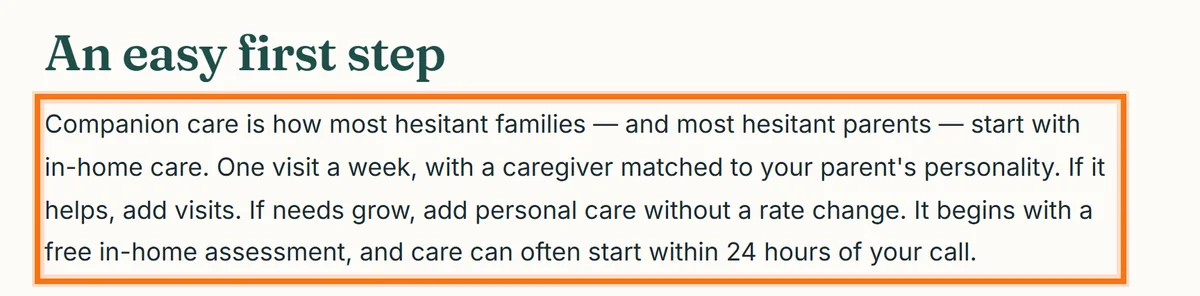
When a maybe finally comes, call while it is still warm. Care can often start within 24 hours, and a first visit that happens this week is easier than one that waits for the next family meeting.
When to bring in the doctor
Two situations move this beyond family persuasion. First, if the refusal comes with the warning signs that need action, such as falls, weight loss, medication mistakes or getting lost, you are no longer negotiating preferences. Read our list of the signs a parent needs in-home help, write down what you have seen with dates, and bring it to her physician. "The doctor says" carries weight with a generation that respects white coats far more than its worried children. Ask the doctor to make home support a medical recommendation, not a family suggestion.
Second, if you suspect the refusal itself is the symptom, that judgment and not preference is what has changed, that is a medical question about memory and thinking. A routine visit is a good place to raise it. Medicare's page on yearly Wellness visits says the provider will do a cognitive assessment to look for signs of dementia, and that you pay nothing for the visit itself if the provider accepts assignment. An early no with sound judgment is normal and workable. A no from a parent who no longer sees the danger she is in is different, and families should not carry that assessment alone.
If you are the one holding everything together
If you are providing all the care while these talks drag on, your own exhaustion is part of the picture. A spouse or adult child who does every bath, every pill reminder and every night alone cannot keep it up forever, and a parent who refuses outside help is often relying on exactly that. Respite care exists for this. Sometimes the easiest yes is help framed as a break for you: "I need Tuesday mornings to myself, would you let someone keep you company?" Our article on caregiver burnout and respite care is the companion piece to this one.
What the first yes should look like
When the maybe comes, do not celebrate by making the plan bigger. That confirms her fear that one morning was a foot in the door for a takeover. Keep the first arrangement exactly as small as promised. Let her be right about having stayed in control.
- One morning a week, on the day she chose.
- The jobs she picked, and nothing she did not agree to.
- The same caregiver each week where the schedule allows, so the visit becomes a person, not a service.
- A review date on the calendar, where she decides what happens next.
If it goes well, the schedule can grow at the speed of trust rather than the speed of fear. Add a second morning when she asks for it, or when the doctor recommends more. Our guide to the first week of home care walks through those early visits in detail.
How Senior Care of North Texas helps a reluctant parent
We are a locally owned, Texas-licensed non-medical home care agency (License #020448) serving the Dallas–Fort Worth metroplex and the surrounding North Texas counties, and reluctant parents are our normal, not our exception. The way we work suits a small start: a free in-home assessment that feels like a conversation, a first schedule as small as one four-hour visit a week, a caregiver matched to your parent with a different match a phone call away, and a care plan built around her routine that can be adjusted as needs change. There is no levels-of-care pricing, so saying yes to a little help never sets a price trap for later, there is a discount for couples, and there is no long-term contract.
If you want to talk it through before you talk to your parent, call us at (214) 550-6533, answered 24/7, or request a free in-home assessment. We will tell you honestly what we would try first.
This article is educational and is not medical or legal advice. If you are concerned about your parent's judgment, memory or safety, talk with their physician.
