


If you just spent a weekend at your parent's house and drove home with a knot in your stomach, this article is for you. Below are the eight changes that, in our work as a licensed personal care agency in Dallas–Fort Worth, mean a family should act, and three that look alarming but can usually wait, watched. One sign is enough to start a conversation. Two or three together usually mean help is overdue.
The 8 signs at a glance
Start with this summary, then read the section for any sign you recognized.
| Sign | What you might notice | Help that usually fits |
|---|---|---|
| 1. A fall, even a small one | Bruises she explains away, a new hesitation on steps | Personal care; standby help with bathing and transfers |
| 2. Weight loss | Loose clothes, expired food, little in the pantry | Meal preparation and company at the table |
| 3. Medication mistakes | Pills left in Wednesday's slot on Friday, late refills | Medication reminders plus a doctor or pharmacist review |
| 4. Stove, locks, smoke alarm | A scorched pan, a door found unlocked, a chirping detector | Regular visits and a home safety walk-through |
| 5. Bathing has become rare | Same clothes for days, a dry shower, a stale smell | Personal care: bathing with someone there |
| 6. Getting lost or repeating | Wrong turns on familiar routes, the same story three times | A doctor's evaluation, then memory care at home |
| 7. Bills and mail | Late notices, duplicate donations, new "friends" calling | Family takes over finances; a caregiver watches the door |
| 8. A worn-out caregiving spouse | Your other parent is tired, short-tempered, skipping their own care | Respite care |
How to read this table: the middle column is what you see on a visit, and the right column is the kind of help that usually matches it. Count the rows you recognized. If two or more rows point to the same kind of help, that is your starting point, and the free assessment can confirm it.
The 8 signs that need action now
1. A fall, even a "small" one
A fall tells you something has changed: balance, strength, eyesight, a medication, or judgment about what is safe. What matters is not how bad the last fall was but what it says about the next one. Tell the doctor about every fall, including the ones your parent calls nothing. If your parent has fallen recently, the time to add support is now, not after the next one. Our room-by-room fall risk checklist helps with the house itself.
2. Weight loss you can see
Loose clothes, a thinner face, food untouched in the fridge. Cooking for one is joyless, appetite fades with age, and some medications make food taste wrong. Whatever the cause, an older adult who stops eating well loses strength quickly. Mention the weight loss to the doctor, and consider a caregiver who cooks a few mornings a week and sits down to eat with your parent.
3. Medication mistakes
Pills still in Wednesday's slot on Friday. Refills picked up late or not at all. A doubled dose "because I couldn't remember." This is one of the easier signs to act on. Ask the pharmacist about a weekly organizer the family or the pharmacy fills, and add a caregiver's reminder at the scheduled times. As a non-medical agency we remind and prompt from that organizer; we do not fill it, give medication or change a dose. That stays with your parent, the doctor and the pharmacist.
4. The stove, the locks, the smoke alarm
A scorched pan. A door found unlocked overnight. A smoke detector chirping on a dead battery for weeks. These are small events with a large downside. If you found one, quietly check the others; they tend to travel together.
5. Bathing has become rare
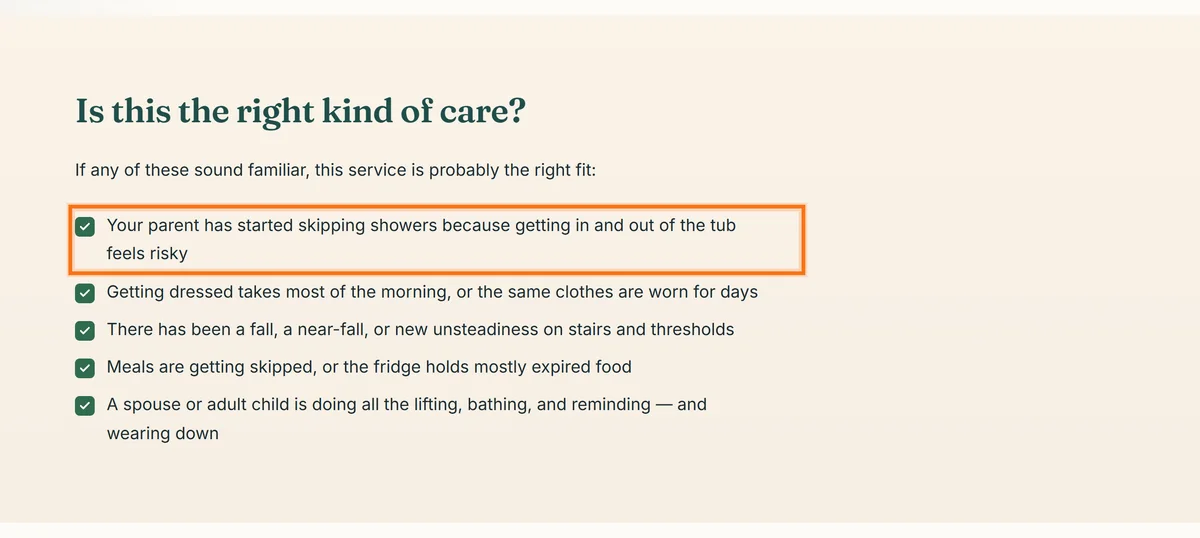
When a parent who was always particular starts skipping showers, it is almost never about hygiene. It is fear. Stepping over a tub wall on wet tile is dangerous, and your parent knows it. Bathing with a caregiver standing by is a large part of what our personal care visits include, and it is often the part parents come to value most once the embarrassment passes.
6. Getting lost, or repeating on a loop
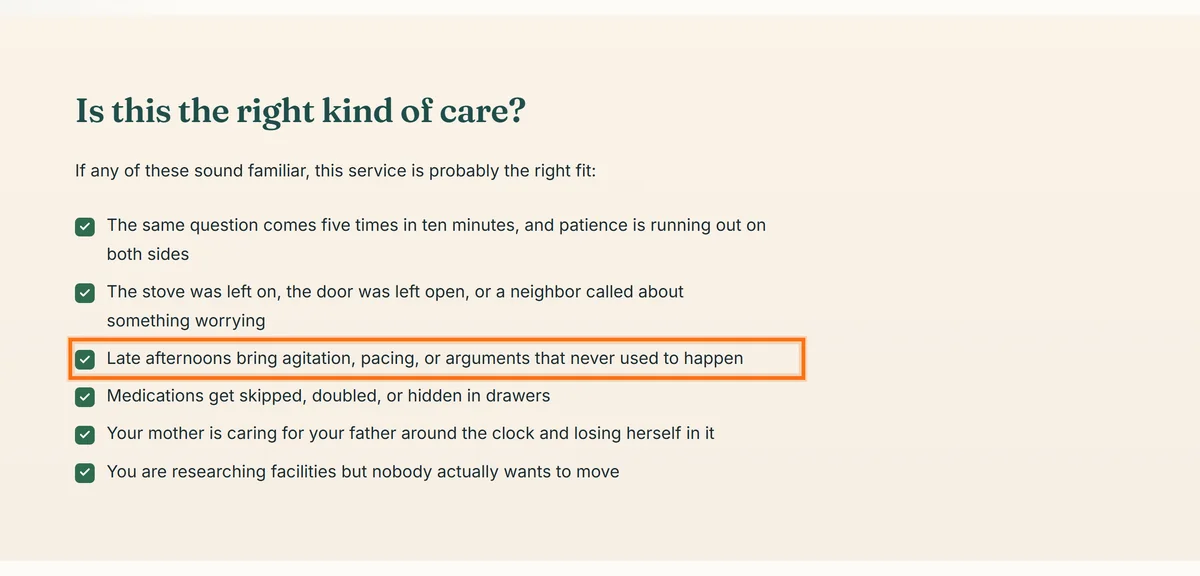
A wrong turn on a familiar route. The same story three times in an hour. Confusion about the day that does not clear. These deserve two responses at once: a medical evaluation from your parent's doctor, and more eyes on daily life while you get answers. If a dementia diagnosis comes, our memory care at home page explains what support looks like.
7. The bills and the mail
Unopened mail piling up, late notices, duplicate donations to the same charity, or a new "friend" calling about money. Financial slips can be an early sign of memory change and are a risk in their own right. Adult children usually take over the finances; a caregiver keeps an eye on the mail, the callers and the front door, and tells the family what they notice.
8. The caregiving spouse is worn out
Sometimes the person who needs help most is the healthy parent. If your father is lifting, bathing and watching your mother around the clock, he cannot keep it up forever, and his own health is at stake. Respite care exists for this. With one flat hourly rate and a discount for couples, a few regular mornings off can be a realistic part of the week.
Is it memory, or just getting older?
Signs 4, 6 and 7 are the ones families worry about most, because they can point to memory changes. The Alzheimer's Association's list of 10 warning signs of Alzheimer's pairs each warning sign with a typical age-related change. A few of those pairs, in their words, show the difference:
| Warning sign | Typical age-related change |
|---|---|
| Memory loss that disrupts daily life | Sometimes forgetting names or appointments, but remembering them later |
| Challenges in planning or solving problems | Making occasional errors when managing finances or household bills |
| Confusion with time or place | Getting confused about the day of the week but figuring it out later |
| Decreased or poor judgment | Making a bad decision or mistake once in a while |
| Withdrawal from work or social activities | Sometimes feeling uninterested in family or social obligations |
How to read this table: the difference is in the words "disrupts," "later" and "once in a while." A forgotten name that comes back an hour later is the right column. A forgotten bill that leads to a shutoff notice, or a day of the week that never comes back, is the left column, and it belongs in front of a doctor. Our guide to early signs of Alzheimer's vs. normal aging goes through all ten.
The 3 signs that can usually wait
A messier house than she used to keep
Standards relax as energy drops. A dusty living room is not a crisis. The pattern to watch is a formerly tidy person living in real disorder, spoiled food, or blocked walkways. That moves into sign territory. Ordinary clutter is just life.
Slower, but steady
Taking longer on the stairs while holding the rail, resting after yard work, walking more carefully: these are adaptations, not alarms. Adapting is a good sign; it means judgment is intact.
Turning down an activity she used to enjoy
One skipped church potluck is a preference. Pulling back from everything over months is worth a doctor's visit; it can signal depression or hearing loss, and both can be treated. Watch the trend, not the single event.
What to do once you have seen a sign
If you counted even one or two of the eight, the next step is not a facility tour and it is not a family argument. It is information. Here is the order that works:
- Write down what you saw. Specific events with dates beat "I'm worried about Mom" in every conversation that follows: with siblings, doctors and your parent.
- Book a medical review. Several of the eight signs have treatable medical causes. Your parent's doctor should hear your list. Medicare's page on yearly Wellness visits says the visit includes a cognitive assessment to look for signs of dementia, so it is a natural place to raise memory concerns.
- Get a professional look at the home. We do free in-home assessments across Dallas–Fort Worth and the surrounding North Texas counties. No obligation and no contract: you leave with a clear picture of what would help, even if you do not use us.
- Start small. One morning visit a week is a real start, and days can be added as needs change. Starting small is also the easiest version for a reluctant parent to accept; more on that in how to talk to a parent who refuses help at home.
What starting help costs in Dallas–Fort Worth
Our rate is published: $30–34 an hour, the same for days, evenings, weekends and overnights, with a four-hour minimum visit, so one visit costs $120 to $136. Major holidays are billed at time and a half. There are no levels-of-care prices, so the rate does not rise if the signs on this list multiply later. On our Dallas–Fort Worth pricing page, four hours a week comes to about $520–$590 a month, 12 hours a week about $1,560–$1,770, and 20 hours a week about $2,610–$2,960.
For one or two signs, a sensible start is the low end of that range, one to three mornings a week, with a review after the first month. There is no long-term contract, so the schedule follows your parent, not a sales plan.
How Senior Care of North Texas helps across Dallas–Fort Worth
We are a locally owned, Texas-licensed non-medical home care agency (License #020448) serving the Dallas–Fort Worth metroplex and the surrounding North Texas counties. Our caregivers handle the problems on this list: bathing with someone there, meals, medication reminders, rides and errands, and steady company, at one flat hourly rate, with a discount for couples. We match a caregiver to your parent, and if the fit is not right, we match someone else.
If you recognized your parent in this list, call us at (214) 550-6533, answered 24/7, or request a free in-home assessment. Care can often start within 24 hours of your call.
This article is educational and is not medical advice. For medical decisions about your parent's health, talk with their physician.
