

Most wandering is not aimless. Your father is going somewhere, usually to work, to his mother's house, or to pick up children who are now in their fifties. That purpose is the key to preventing it, and it is why this guide starts with the reasons before it gets to locks and alarms.
Wandering frightens families more than almost anything else in dementia, and it should. A person who leaves the house on a January night in slippers, or on a July afternoon in North Texas heat, is in danger quickly. But the panic often leads to the wrong response, which is more locks and more scolding. Understanding the purpose behind the walking gets better results than trying to stop the walking itself.
Why do people with dementia wander?
Wandering is behavior with a reason attached, even when the reason is no longer accurate. Once you can name the reason, you usually have a way to meet it.
- An old role. He is going to work, or she is collecting the children. Lifelong duties resurface as present obligations.
- Looking for a person. A spouse, a parent, a childhood home that feels safer than this unfamiliar room.
- Unmet physical needs. Hunger, thirst, pain, constipation, or hunting for a bathroom he can no longer locate.
- Boredom and energy. A body used to eight hours of work with nothing to do all afternoon.
- Fear or overstimulation. Too much noise, too many visitors, a television at high volume; leaving is an escape.
- Late-day restlessness. The agitation many families know as sundowning, which peaks in the hours before and after dark.
- Disrupted sleep. Waking at two in the morning, believing it is time to start the day, and walking out to begin it.
- Medication effects. New restlessness after a medication change is worth a call to the prescriber.
Keep a short log for two weeks: time, where she was headed, what she said, and what happened in the hour before. The pattern is almost always visible on paper before it is visible in memory, and it tells you which of the measures below will actually matter in your house.
Who is at risk of wandering?
Anyone with dementia can wander, including people who have never done it before, and the first episode is often the one nobody planned for. Risk rises with a few specific signs: pacing in the late afternoon, repeatedly asking to go home while at home, standing at the door or looking through windows, talking about obligations from decades ago, getting lost on a familiar route, or waking and dressing in the middle of the night.
Someone who still walks well is more at risk than someone who does not, simply because he can get further. Do not assume a slow, quiet parent is safe; assume instead that if walking is possible, leaving is possible.
How do I make the doors safer?
The aim is not to imprison anyone. It is to make the exit less inviting and to guarantee that if a door opens, somebody knows about it immediately.
- Move the locks out of the visual field. A slide bolt high on the door or near the floor is often not noticed, because attention narrows with dementia. Never use a lock that needs a key from the inside, since that traps everyone in a fire.
- Add an alarm to every exterior door, including the garage door and any sliding door. An inexpensive battery chime that sounds when the door opens is the highest-value purchase in this whole article.
- Make the door boring. A curtain over the glass, or a panel the same color as the wall, removes the cue. Hide coats, keys, purses, and shoes, because the objects themselves suggest going out.
- Give the eye somewhere else to go. A familiar chair, a window with a bird feeder, or a task table set up nearby draws attention away from the exit.
- Secure the garage and the car. Keep keys out of sight; a car in the driveway is an invitation to a lifelong driver.
- Fence and gate the yard if you can, with a latch out of the usual line of sight. A safe place to walk outside beats a locked back door.
- Watch the windows on ground floors, especially in warm weather, and add stops that limit how far they open.
- Light the path at night. Motion-activated lights on the route from bed to bathroom prevent both wandering and falls; see our home fall risk checklist for the rest of the night route.
What should I do in the moment she heads for the door?
Do not block her body and do not argue with the destination. Both raise the stakes and can turn walking into a struggle.
Walk with her instead. Fall in beside her, agree with the goal, and slow the pace: Let's go together. Do you want your jacket first? A few minutes of company usually drains the urgency, and then a redirection lands: Let's have some coffee before we go. Handing her a task that satisfies the same need works even better, especially folding, sorting, or anything that feels like work she used to do.
What do I do if she is already missing?
Speed matters more than dignity here. Do not spend an hour searching alone because you are embarrassed.
- Call 911 immediately and say the words: this person has dementia and is missing. There is no waiting period for reporting a missing person, and the dementia diagnosis is what tells the dispatcher this is urgent.
- Search the house and yard first, fast. People are found in closets, garages, sheds, behind furniture, and in cars more often than you would expect.
- Think about the direction she usually walks. People who wander are often found close to home, along a route they used for years, or stopped by a fence, a creek or a busy road.
- Give police a current photograph and describe exactly what she was wearing, including whether she had shoes.
- Tell them where she used to live and work. Old addresses are the most common destinations.
- Call neighbors and ask them to check their yards, porches, and cameras.
- Register in advance with your local police department's program for vulnerable adults, and ask your county sheriff's office what it offers, so the information already exists before you need it.
How does a Texas Silver Alert work?
Texas has run the Silver Alert program since 2007 to tell the public about missing older adults with a documented mental condition. The family does not request it; the police department handling the report asks the Texas Department of Public Safety to activate it. Two of the criteria on the DPS page matter for you before anything happens:
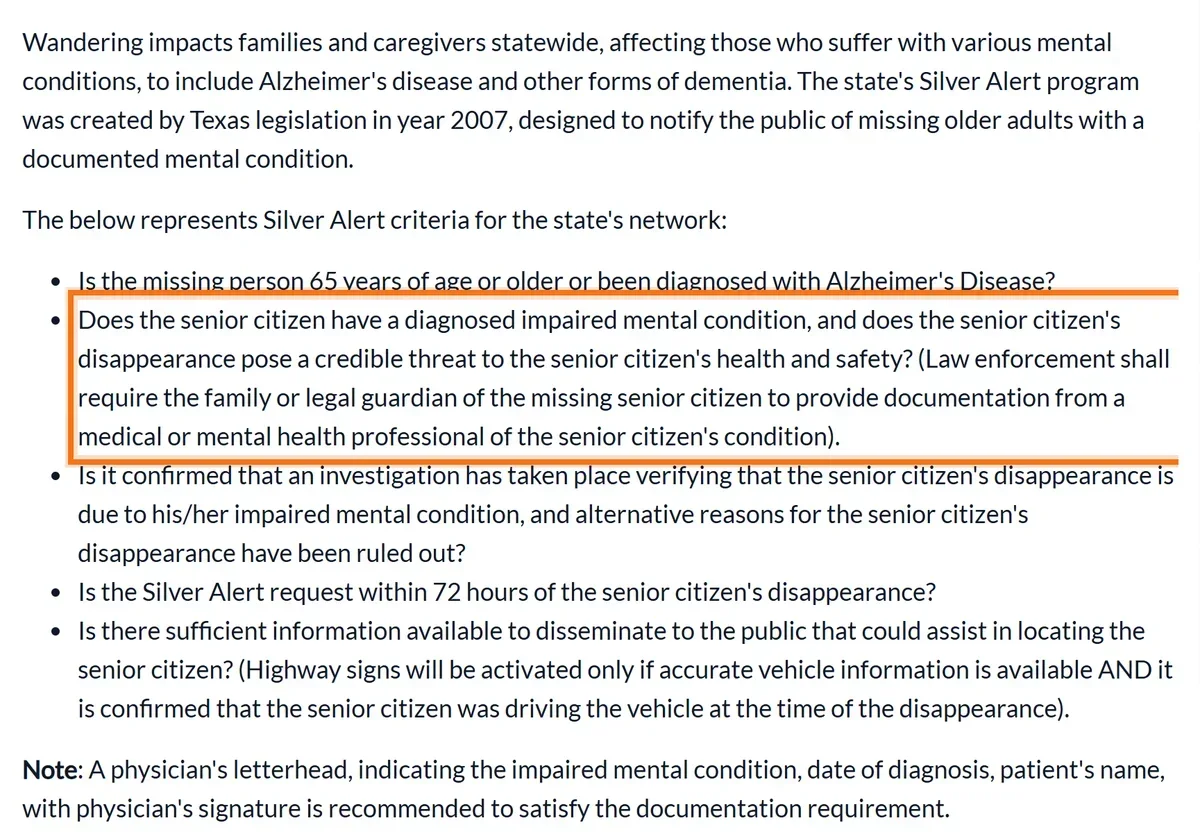
- Proof of the diagnosis. Police must ask the family for documentation from a medical or mental health professional. DPS recommends a letter on the physician's letterhead with the condition, the date of diagnosis, your parent's name and the physician's signature. Ask for it at the next appointment and keep it with a current photo.
- Timing. The request must come within 72 hours of the disappearance, which is one more reason to call 911 at once rather than search alone for an afternoon.
- The car. Highway signs are used only when there is accurate vehicle information and it is confirmed your parent was driving, so write down the make, color and plate if she still has access to a car.
Identification that travels with her
Put identification on her body, not in a purse she may leave behind. A bracelet with her name, condition, and your phone number is the simplest version. A card in every coat pocket helps. GPS options range from shoe insoles to watches and small trackers sewn into a favorite jacket; they are genuinely useful for finding someone faster, but treat them as a way to shorten a search, never as a way to prevent one.
| Measure | What it prevents | What it cannot do |
|---|---|---|
| Door chimes and alarms | Silent exits going unnoticed | Nothing, if no one is awake to hear them |
| High or low slide bolts | Impulsive opening of a door | Stop someone determined and still able to problem-solve |
| Camouflaged doors, hidden coats and keys | The visual cue that starts the idea | Address the underlying need to leave |
| Fenced yard with a hidden latch | Reaching the street from the back door | Cover the front door or the garage |
| ID bracelet and GPS tracker | A long search and a bad outcome | Stop the person from leaving at all |
| Daytime activity and exercise | Restlessness that builds all afternoon | Fix a reversed sleep cycle by itself |
| An awake caregiver overnight | The two a.m. exit, and the fall on the way | Be replaced by any device on this list |
How to read this table: the middle column is what each measure buys you, and the right-hand column is where it stops. Most rows fail in the same place, the hours when nobody is awake, which is why the last row is the only one that covers the others.
How do I reduce the urge in the first place?
Prevention during the day beats management at night. Build a routine with real physical activity in it: a walk after breakfast and another after lunch, in daylight if possible, since light exposure helps the sleep cycle as much as the exercise does. Serve meals at the same times. Keep the late afternoon calm, with lamps on before dusk rather than after. Cut caffeine after noon and keep the evening quiet, with fewer visitors and a lower television volume.
Address the physical basics too, because unmet needs drive a surprising share of wandering. Offer fluids regularly, keep a clear lit route to the bathroom, take pain seriously in someone who can no longer report it, and mention new restlessness to the physician, since it sometimes tracks a medication change or an infection rather than the dementia itself.
How do you stop dementia wandering at night?
Every measure on this page can be defeated by a determined person with time and no supervision. Alarms only help if someone hears them. Locks only help if nobody works out the latch. You cannot solve nighttime wandering with hardware, and you cannot solve it by sleeping lightly for two years, which is how many family caregivers end up ill themselves.
The reliable answer at night is a person who is awake. Our 24-hour care is built on rotating caregivers who stay awake through the night, because someone asleep down the hall cannot help at two in the morning. For daytime hours, structure, redirection, and the techniques trained caregivers use are the core of our in-home memory care, and evening coverage through the restless hours is often where families start.
One flat hourly rate applies to all of it, the same rate day, evening, weekend, and overnight, with no premium for nights and no long-term contract. Visits start at a four-hour minimum, we match the caregiver and you can request a different match at any time, and the in-home assessment is free. If nights are already frightening anywhere in Dallas–Fort Worth, tell us what is happening; care can often begin within about a day of that assessment, and our guide to what an awake night shift includes shows what the caregiver does from bedtime to morning.
Finally, this article is educational and not medical advice. A sudden increase in wandering, confusion, or agitation can signal pain, infection, or a medication problem, and it deserves a call to your parent's physician rather than another lock on the door.
