


The honest answer first, because you deserve one. Most home care agencies in Dallas–Fort Worth will not give a number until after a sales visit. Ours is $30–34 an hour, published openly on our in-home care pricing page, with no form to fill out and no sales call required. The rest of this article explains what drives that number, the hidden costs that never appear in the quoted rate, and how home care stacks up against assisted living and nursing homes in the metroplex.
What does private home care cost per hour, and what does that hour buy?
With us, an hour of private in-home care costs $30–34, and where you land in that range depends on the schedule, not on how much help your parent needs.
Non-medical home care — licensed in Texas as Personal Assistance Services — covers the daily tasks that keep an older adult living at home. One caregiver, in your parent's house, doing whatever that visit calls for:
- Bathing, dressing, and grooming help
- Meal preparation and light housekeeping
- Medication reminders (prompting, not administering)
- Transfers, walking support, and fall-conscious supervision
- Rides to appointments, errands, and steady company
What it does not buy is medical treatment. No injections, no wound care, no skilled nursing. If your parent needs those, Medicare-certified home health handles the medical side — often alongside non-medical care, not instead of it.
The number that matters more than the hourly rate
Here is the part of the price conversation many families skip. The quoted hourly rate is only half the equation. The other half is the minimum visit length — most agencies schedule care in blocks of several hours rather than by the single hour, and that block size, not the rate, is what shapes the monthly bill.
Our minimum visit is four hours. Before that number worries you, price what a four-hour morning actually covers: a safe shower with someone steady in the room, breakfast cooked and cleaned up, medications laid out, laundry running, a ride to the 10:30 appointment, and groceries on the way home. At our published $30–34 per hour, that whole morning runs $120–136 — one visit that replaces the scattered hour of help most families think they need plus the three more they were quietly providing themselves.
The honest budgeting rule: count the visits your parent needs each week, multiply by four hours and the published rate, and you have the real monthly number — no surprises on the first invoice.
The "levels of care" escalator
The second hidden cost shows up months after you sign. Many agencies price by "level of care" — Level 1 for light help, Level 2 when bathing is added, Level 3 for memory care or transfers. Each level carries a higher hourly rate. Since an older adult's needs almost always grow, the rate is designed to climb.
We don't price that way. One rate, whatever the care involves, and it does not go up when your loved one's needs increase. When you compare agencies, ask the question directly and get the answer in writing.
What common schedules cost per month in Dallas–Fort Worth
These are estimates from our published hourly range, using an average month of about 4.3 weeks, the same figures as on our pricing page. Your free in-home assessment produces an exact quote in writing.
| Care schedule | Hours per month (approx.) | Estimated monthly cost |
|---|---|---|
| One four-hour visit a week | 17 | $520–$590 |
| Three four-hour visits a week (12 hours) | 52 | $1,560–$1,770 |
| 20 hours a week | 87 | $2,610–$2,960 |
| 40 hours a week | 173 | $5,190–$5,880 |
| 24-hour care, rotating awake caregivers | 728 | $21,840–$24,750 |
How to read this table: find the row closest to the week your parent needs, then adjust by four-hour visits up or down. The lower figure is the bottom of our range, the higher figure the top; a major holiday in the month adds half the rate for the hours that fall on it.
Home care vs. assisted living vs. nursing home in DFW
Families rarely compare home care against nothing; they compare it against a move. The Genworth Cost of Care Survey figures quoted on our pricing page put assisted living in the Dallas area at about $5,500 a month in base rent, with care add-ons often billed on top, and a nursing home at about $6,600 a month for a semi-private room and $8,800 for a private room.
Three honest observations. First, part-time home care is usually the least expensive option: 20 hours a week costs less than half of a typical assisted living bill, and it is what most families actually need, especially early on. Second, assisted living base rates rarely tell the whole story; communities commonly add care charges on top of rent as needs grow, so compare final numbers, not brochure numbers. Third, around-the-clock home care genuinely does cost more than a facility. We will tell you that plainly, because a family budgeting for 24-hour care deserves real math, not a sales pitch. Our 24-hour care page walks through how those schedules are built and billed.
What actually moves your monthly bill
Once you know the rate and the minimum, four things determine what a month of care costs:
- Hours per week. The biggest lever by far. Many of our families start with one or two half-day visits a week and adjust from there.
- Overnights. Awake-overnight shifts bill hourly at the same flat rate as daytime hours — nights cost no extra with us. Ask any agency you compare whether overnight hours carry a premium.
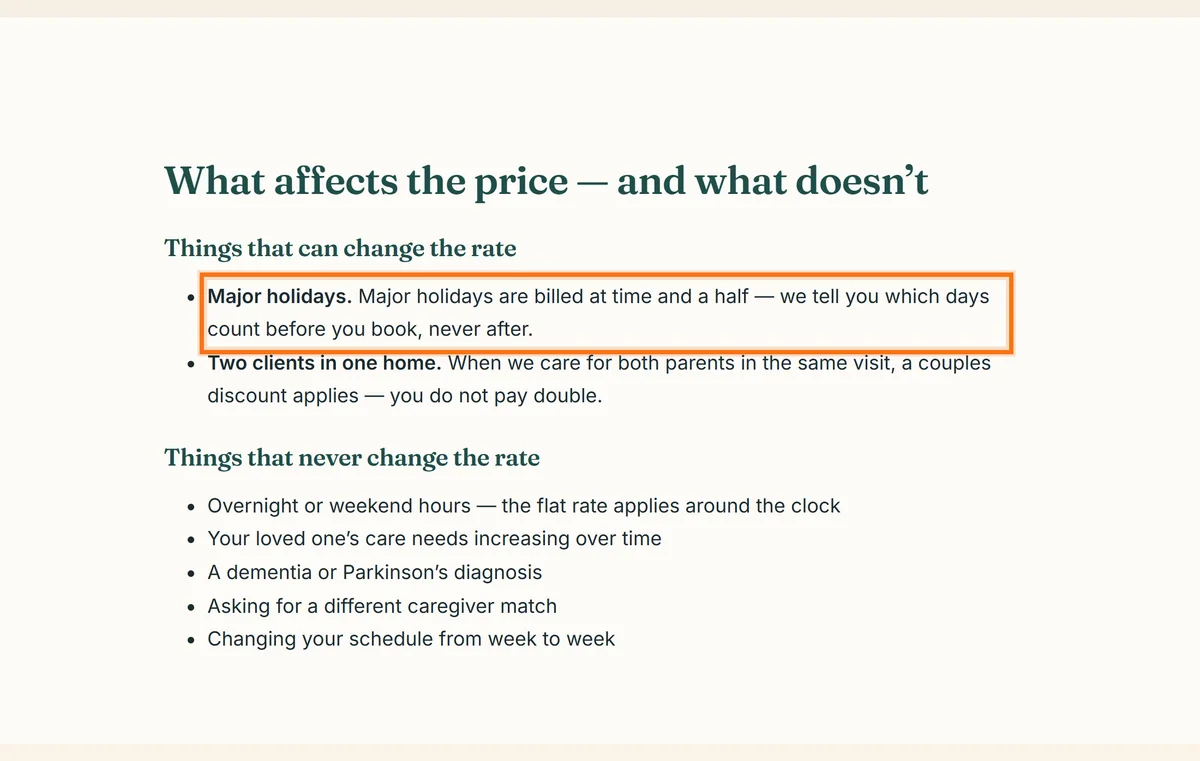
- Holidays. Major holidays are billed at time and a half with us, and we tell you which days count before you book. Ask every agency for its holiday list before you sign anywhere.
- Two people in one home. If both parents need help, ask about couples pricing. We offer a couples discount because one caregiver in one house serving two people should not cost double.
Here is how our pricing page puts it:
Hidden costs to ask about before you sign — anywhere
Minimums and level pricing are the two big ones, but a few smaller line items separate agencies too. Put these questions to every agency you interview, including us, and get answers in writing:
- Is there a deposit or registration fee? Some agencies charge a few hundred dollars up front before the first visit.
- Is there a long-term contract or cancellation penalty? You should be able to stop or change care without paying a fee to leave.
- What do weekends cost? Some agencies bill a premium every Saturday and Sunday, which adds up fast for families who mainly need weekend relief.
- Is mileage extra? If the caregiver drives your parent to appointments, ask whether miles are billed on top of the hourly rate and at what figure.
- What happens when a caregiver calls in sick? A missed shift has a cost too — usually paid in your vacation days. Ask how backup coverage works.
- Does the assessment cost anything? Ours is free and carries no obligation. If an agency charges to tell you what care would cost, keep looking.
None of these items is scandalous on its own. The problem is finding out about them on invoice two. An agency that publishes its rates should be equally direct about every one of these answers.
A realistic way to budget
Skip the abstractions and price your parent's actual week. Write down what a good week looks like — morning help daily? Three longer visits? One long Saturday so you get a break? Then multiply those hours by the published rate. Care is scheduled in half-day (four-hour) blocks, so build the week from visits that each do real work — a morning of personal care, an afternoon of errands and company. Families using our respite care for one four-hour break a week, for example, spend about $520–590 a month, not a few thousand.
To make that concrete, here are three schedules we see constantly, priced at our published $30–34 per hour. A twice-a-week half-day, four hours per visit and often a respite arrangement, runs roughly $1,030–$1,170 a month. A half-day of help three times a week runs about $1,560–$1,770. Daily half-days, the point where many families start comparing against assisted living, run about $3,610–$4,090 a month. Every one of those figures scales visit by visit, up or down, as the situation changes — and with no long-term contracts, you are never locked into a schedule your parent has outgrown or hasn't grown into yet.
Then look at how you'll pay. Most home care in Texas is private pay, but three other sources cover more families than people realize: long-term care insurance, VA Aid and Attendance for wartime veterans and surviving spouses, and — for the medical side only — Medicare home health. We've written plain-English guides to each, starting with what Medicare does and doesn't pay for in Texas.
How Senior Care of North Texas helps with this
We are a locally owned, Texas-licensed (License #020448) non-medical Personal Assistance Services agency serving Dallas–Fort Worth, Gainesville, and the surrounding North Texas counties. On cost, our approach is simple: rates published on our pricing page, one flat hourly rate — days, evenings, and overnights all the same — no levels-of-care pricing that climbs as needs grow, and a couples discount. We offer a free in-home assessment, we match a caregiver to your family (and change the match on request), care plans are built around your loved one's routine, and care can often start within 24 hours. If long-term care insurance is in the picture, we help with the claim paperwork too.
This article is educational and is not medical or financial advice. Cost figures vary by household and change over time; confirm current rates on our pricing page, and talk with your parent's physician about medical decisions.
