


Hospitals discharge patients when they are medically stable — not when the house is ready, the pills are sorted, or the family has a plan. Those parts belong to you. As a licensed agency that provides post-hospital recovery care across Dallas–Fort Worth, we see the same handful of gaps cause most of the bad first weeks. This checklist closes them, one section at a time.
Print it, or keep it open on your phone during the discharge conversation. Every hospital in the metroplex runs discharge a little differently, but the questions below apply whether your parent is at Texas Health Presbyterian Dallas, Medical City Dallas, Baylor University Medical Center or UT Southwestern.
What should a written discharge plan include?
Start with the paper itself, because everything else on this page hangs from it. The National Library of Medicine's MedlinePlus page on leaving the hospital with a discharge plan lists what the plan should contain, and it is worth checking your parent's copy against it line by line:
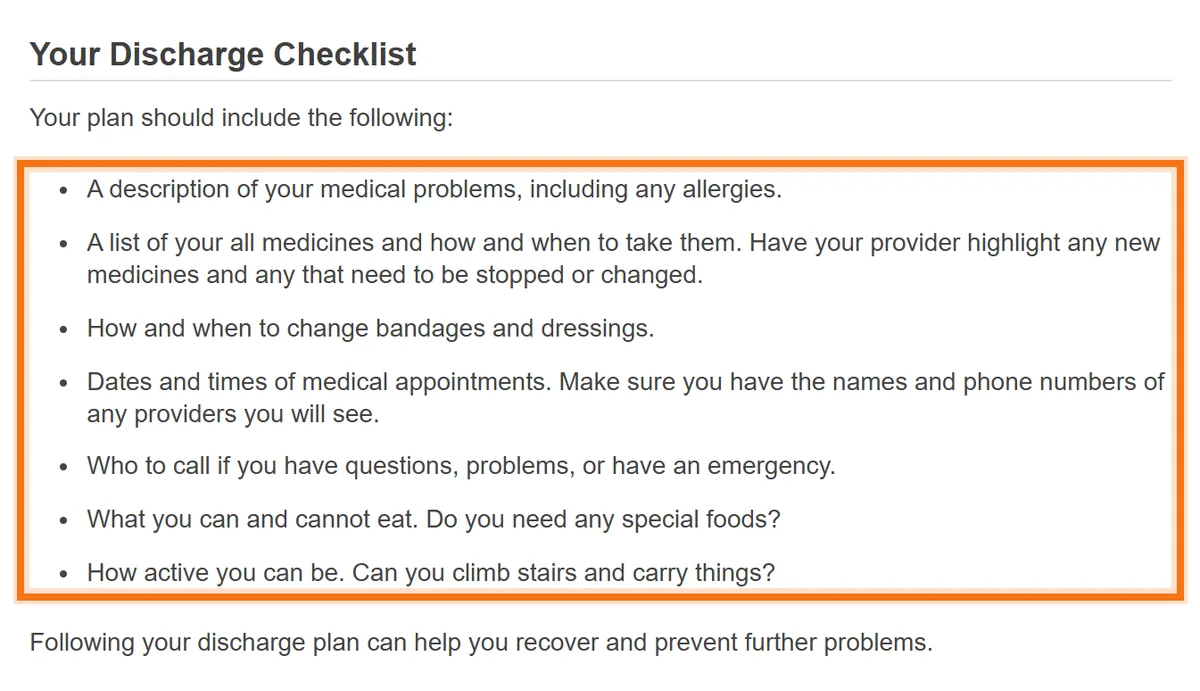
The table below takes those seven items and adds the question to ask about each one, and the section of this checklist that covers it.
| The plan should include | Ask before you leave | Section below |
|---|---|---|
| A description of the medical problems, including allergies | "Can you say that in plain words, and write it down?" | Before discharge day |
| Every medicine, with how and when to take it | "Which of these are new? Which old ones stop or change?" | Medications |
| How and when to change bandages and dressings | "Who is doing this at home: home health, or us?" | Who does what |
| Dates and times of medical appointments | "Can the follow-up be booked before we leave?" | Before discharge day |
| Who to call with questions, problems or an emergency | "Which number, and who answers it at night?" | The first 72 hours |
| What she can and cannot eat | "Any special foods we need in the house tonight?" | Preparing the home |
| How active she can be | "Can she climb stairs, shower, carry things?" | Equipment; Preparing the home |
How to read this table: the left column is the official list, the middle column is the sentence to say out loud to the nurse or the discharge planner, and the right column is where this page helps you act on the answer. If any row of your parent's paperwork is blank, ask for it before the wheelchair arrives, not from the parking garage.
Before discharge day: the questions to ask early
The single biggest mistake families make is treating discharge as an event instead of a process. Planning starts at admission. Every hospital has a discharge planner or case manager assigned to your parent — usually a nurse or social worker. Find out who it is on day one and ask for their direct number.
- Ask the care team for the expected discharge date — then plan for it to move up. A discharge can be moved forward with very little notice.
- Ask: "Discharged to where?" Home, inpatient rehab, and skilled nursing are very different paths. If the team assumes home and you have doubts, say so now — this is negotiable early and rarely negotiable on discharge day.
- Ask what your parent will and won't be able to do — walk to the bathroom alone? Climb stairs? Shower? Cook? Get specifics, because the answers determine everything else on this page.
- Ask whether home health (nurse or therapy visits ordered by the doctor) will be set up, which agency, and when the first visit happens. Note what it covers: scheduled nurse or therapy visits, not daily help.
- Ask for the follow-up appointment to be booked before discharge, ideally within 7 days. "Call the office next week" is how follow-ups get missed.
- Identify one family point person for all discharge communication. Three siblings each getting half the story is a classic failure mode.
- If your parent lives alone, decide now who will be in the house for the first days — family taking time off, or hired help, or both.
One more early question worth asking the case manager: "What usually goes wrong for patients like my mother in the first two weeks?" Discharge planners answer that question honestly, and the answer is your personal risk list.
Equipment: what the house needs before your parent does
Durable medical equipment ordered at discharge can take days to arrive. Confirm what's ordered, who's delivering it, and what you're expected to source yourself. Common needs after a hospital stay:
- Walker, cane, or wheelchair — confirm whether the hospital sends one home or a supplier delivers it, and that it's adjusted to your parent's height before use.
- Raised toilet seat or bedside commode — the single most-requested item in the first week, and the one most often forgotten.
- Shower chair and handheld shower head — a standing shower is usually off the table for a while.
- Grab bars at the toilet and in the shower. Towel bars are not grab bars; they pull out of the wall.
- Hospital bed or bed rail, if ordered — decide which room it goes in before the delivery truck arrives.
- Incontinence supplies, if needed — buy a small pack of two or three types before committing to a case of one.
- Nightlights for the bedroom-to-bathroom route, and a phone or alert button your parent can reach from bed and from the floor.
Ask the discharge team which items insurance or Medicare covers with a doctor's order — coverage rules change, so confirm rather than assume.
Medications: where most bad weeks start
Medication confusion is a common reason a first week at home goes wrong. The discharge list often differs from what your parent took before admission — doses change, drugs get added, and some old prescriptions are quietly discontinued. Do not leave the building until this section is done:
- Get the complete written medication list: every drug, dose, time of day, and what it's for — in plain words.
- Go through it line by line with the nurse and ask: "Which of these are new? Which old ones stop?" Then remove the stopped ones from the house the day your parent gets home.
- Confirm prescriptions were sent to the right pharmacy and that the pharmacy actually has the drugs in stock. Fill them on the way home, not tomorrow.
- Ask which medications have side effects that matter at home — dizziness, drowsiness, blood-pressure drops — because those are fall risks.
- Set up a pill organizer that same day, filled by one designated person. Two people filling one organizer is how double-doses happen.
- Get a phone number to call with medication questions — the discharging unit, the doctor's office, or the pharmacist.
A note on roles: a non-medical caregiver can provide medication reminders — prompting at the right times from the organizer the family or the pharmacy has filled, and reporting missed doses to the family. Administering or adjusting medication stays with your parent, their doctor, and their pharmacist.
Preparing the home
Do a walk-through of the house before discharge day — ideally the same route your parent will actually travel: car to door, door to chair, chair to bathroom, bathroom to bed.
- Clear every walkway of cords, throw rugs, boxes, and pet bowls. After a hospital stay, shuffling feet catch on edges that never mattered before.
- Set up a main-floor recovery space if the bedroom is upstairs — bed or recliner, phone charger, water, tissues, remote, all within arm's reach.
- Stock easy food: soups, yogurt, fruit, ready meals. Appetite is usually poor the first week; the goal is calories and fluids, not cuisine.
- Put water where your parent sits and sleeps. Dehydration is a quiet, common reason recoveries stall.
- Check the bathroom: grab bars installed, bath mat with rubber backing, supplies at reach height so nothing requires bending or climbing.
- Do laundry, empty the fridge of expired food, take out the trash. A parent coming home weak should not come home to chores.
- Write the emergency sheet — doctor's number, pharmacy, family contacts, medication list — and tape it to the fridge.
The first 72 hours at home
The riskiest stretch of a recovery is the first three days; our guide to the first 72 hours home from a Dallas hospital walks through them hour by hour. Your parent is weaker than they think, the new medications are untested at home, and the adrenaline of "I'm finally home" produces exactly the kind of overreach — carrying laundry, standing on a step stool — that ends badly. During these days:
- Someone present for transfers and bathing — the two highest-risk activities of the week. Not necessarily around the clock; present for the hard parts.
- Watch for red flags the discharge papers list: fever, new or worse pain, shortness of breath, confusion, a wound that looks worse, swelling in the legs. Call the doctor's number on the paperwork — don't wait for the follow-up visit.
- Track eating and drinking. A day of almost nothing is worth a call to the doctor, not a shrug.
- Confirm the home health visit happened, if one was ordered — and if nobody has called by day two, chase it.
- Keep visits short. Well-wishers are lovely and exhausting. Guard naps like appointments.
- Write things down — questions for the follow-up visit, symptoms, what got eaten. The follow-up appointment is only as useful as the information you bring to it.
Who does what: sorting out the helpers
Families often confuse the three kinds of help that show up after a discharge. Briefly: home health is medical care ordered by a doctor — a nurse or therapist visiting a few times a week for short visits. Family covers what it can, until work and distance intervene. Non-medical home care — what we do — is the hands-on daily support in between: bathing safely, meals, medication reminders, rides to the follow-up appointment, and a steady presence so a parent isn't alone on day two. The three work best together, and none replaces the others.
| Helper | What they do | What they do not do |
|---|---|---|
| Home health (ordered by the doctor) | Nurse or therapy visits: wound care, medication teaching, exercises | Stay for the shower, cook, or sit with your parent between visits |
| Family | Decisions, the pill organizer, calls to the doctor, being there | Cover every weekday when work and distance get in the way |
| Non-medical home care | Bathing safely, meals, medication reminders, rides to the follow-up, a steady presence | Nursing, injections, wound care, or giving or adjusting medication |
How to read this table: look at the right-hand column first. Whatever is listed there for one helper has to appear in the middle column of another, or nobody is doing it. The gap families find most often is the shower and the stretch of day between home health visits.
How Senior Care of North Texas helps with a Dallas–Fort Worth discharge
We are a locally owned, Texas-licensed non-medical home care agency (Personal Assistance Services License #020448) serving the Dallas–Fort Worth metroplex and the surrounding North Texas counties. Discharge support is one of the most common reasons families first call us, and it's where the first week matters most: a four-hour morning visit covers the shower, the breakfast, the medication reminders and the ride to the follow-up in one block, and the plan can be built heavier for the first week and lighter afterwards. There's no "levels of care" pricing, one flat hourly rate covers days, evenings and overnights alike, and care can often start within 24 hours, which matters when the hospital moves the discharge date up on you. A free in-home assessment — at the house or even at the hospital before discharge — turns this checklist into a concrete plan.
For families in East Dallas, our guide to home care after a hospital stay or a fall in Lakewood shows how this checklist plays out in an older house after Baylor, Presbyterian or Medical City.
What does help at home after a hospital stay cost?
Our rate is published: $30–34 an hour, the same by day, evening, weekend and overnight, with a four-hour minimum visit. One morning visit therefore costs $120 to $136. Major holidays are billed at time and a half, and nothing else changes the rate. For a first week built heavier than the weeks after it, our Dallas–Fort Worth pricing table estimates 20 hours a week at about $2,610–$2,960 a month and 12 hours a week at about $1,560–$1,770; there is no long-term contract, so the hours come down as your parent gets stronger.
Two more guides cover the days around this one: what to do when the discharge lands on a Friday, and why 30-day readmissions happen and what helps prevent one.
This article is educational and is not medical advice. Follow your parent's discharge instructions, and direct all medical questions — medications, symptoms, wound care, activity limits — to their physician or the discharging hospital.
