


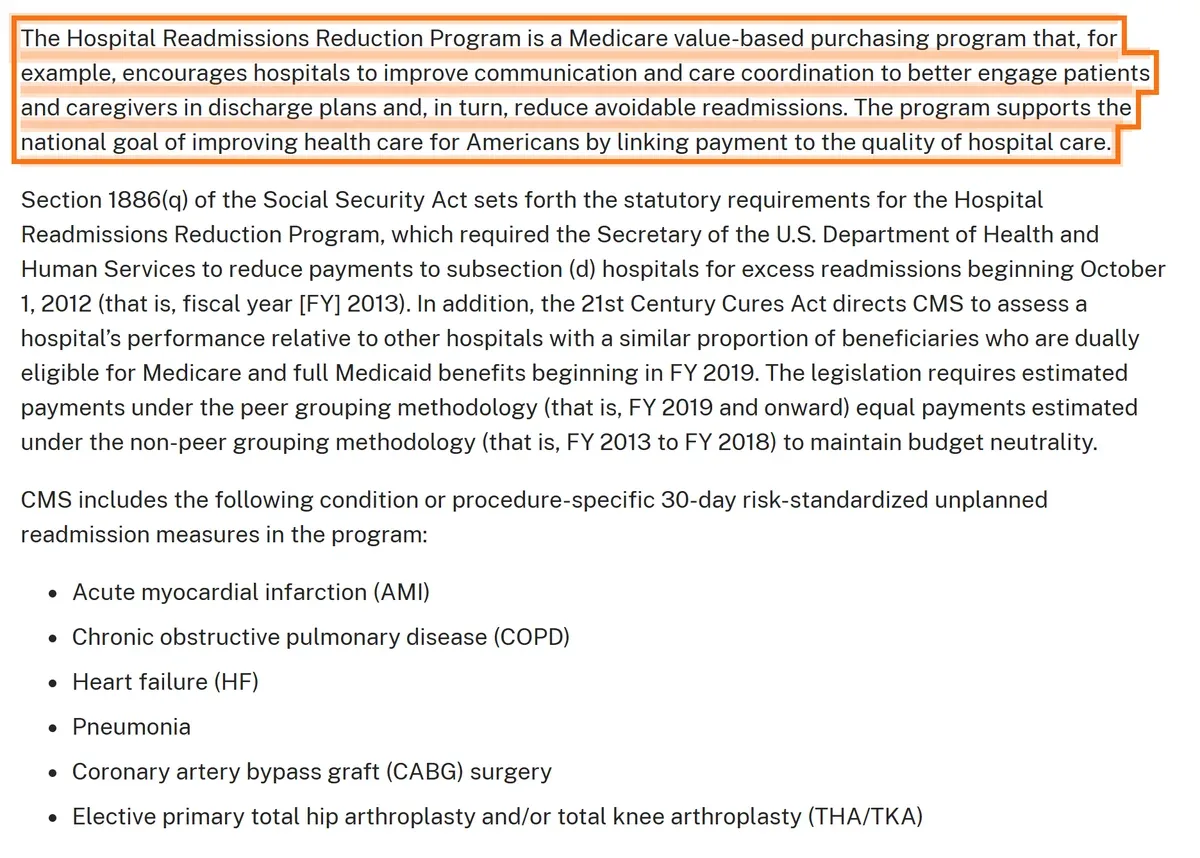
Hospitals track something called the 30-day readmission rate: how many patients end up back in a hospital bed within a month of going home. Medicare watches it closely. Under its Hospital Readmissions Reduction Program, hospitals with excess readmissions have their Medicare payments reduced by up to 3 percent, and six conditions and procedures are measured: heart attack, COPD, heart failure, pneumonia, coronary bypass surgery, and elective hip or knee replacement.
Here's what that program cannot reach: by the time a readmission happens, the hospital part is usually over. The causes live at home — in the kitchen, the bathroom, the pill organizer. That's why families ask us about post-hospital recovery care more in the first week after discharge than at any other time. This article walks through why readmissions actually happen and what daily, non-medical support at home realistically does about each cause. One honest note up front: nobody — no agency, no nurse, no family member — can promise a readmission won't happen. What you can do is remove the preventable reasons.
Why are the first 30 days after a hospital stay different?
A hospital stay takes more out of an older adult than the illness alone. Days in bed cost real muscle strength, sleep is wrecked, appetite is poor, and routines are gone. Researchers have described this vulnerable stretch as "post-hospital syndrome" — a period of generalized risk after discharge, when patients are often readmitted for something different from what put them in the hospital in the first place.
In practice, it means a parent who was "doing fine" before admission comes home genuinely fragile — and the home has not changed to match. Same stairs, same rugs, same empty fridge. The gap between what the discharge papers assume and what actually happens at 7 a.m. on day two is where readmissions come from.
The common causes — and what home support does about each
1. Medication problems
What happens: The discharge medication list is often different from the pre-hospital list — new drugs, changed doses, old prescriptions discontinued. At home, the new list meets the old habits: pills doubled because both the old bottle and the new one got taken, doses skipped, refills never picked up, side effects like dizziness nobody connected to the new prescription. Medication mix-ups are among the most common problems of the first weeks home.
What home support does: A caregiver providing medication reminders prompts at the right times from the organizer the family or the pharmacy filled, watches that each dose is actually taken, and — just as important — notices and reports what a parent won't mention on the phone: "She's been dizzy since Tuesday." As a non-medical agency we don't administer or adjust medications; we make sure the plan the doctor wrote is the plan that actually happens, and we flag problems to family early enough for the doctor to fix them.
2. Missed follow-up appointments
What happens: Discharge instructions almost always name a follow-up visit, often within a week or two. Then reality: your parent doesn't drive right now, doesn't want to bother anyone, and reschedules for three weeks out. The follow-up visit is where a doctor catches a problem while it's small — a wound that isn't healing, a blood pressure medication that needs adjusting. Miss it, and the problem gets caught in an emergency room instead.
What home support does: A caregiver drives, escorts your parent in, and — with the family's blessing — takes notes so the doctor's instructions survive the trip home. Transportation is one of the least glamorous services we offer and one of the most consequential.
3. Falls
What happens: Post-hospital weakness plus new medications plus an unchanged house. The classic version: alone, at night, on the way to the bathroom, three days after discharge. A fall that breaks something turns a recovery into a readmission — and often a much longer story than the original hospital stay.
What home support does: A caregiver is present for the highest-risk activities — transfers, bathing, stairs — during the weakest weeks, and helps keep walkways clear. We help reduce the risk; no one can honestly promise to eliminate it. Our room-by-room fall-risk checklist pairs well with this article.
4. Dehydration and poor eating
What happens: Appetite is low after a hospital stay, cooking feels enormous, and some older adults deliberately drink less to avoid trips to the bathroom. Dehydration causes dizziness, confusion, urinary tract infections, and kidney trouble — each a well-worn path back to the emergency room, and each nearly invisible day to day.
What home support does: This is the least dramatic cause on the list and the one daily help solves most directly: meals prepared and actually eaten with company, water put in reach and refilled, and a caregiver who notices "she barely touched lunch two days running" while it's still a phone call to the doctor rather than a 911 call.
5. Infections and warning signs caught late
What happens: Many readmissions are for infections — urinary, respiratory, surgical-site — that announced themselves quietly for days first. An older adult living alone has no one to notice the early signs, and parents are famously reluctant to "make a fuss" over a low fever or new confusion until it's severe.
What home support does: A caregiver who sees your parent regularly is an early-warning system. We don't diagnose — that's a doctor's job — but a caregiver who reports "more confused than yesterday, and she feels warm" gives the family and the physician a head start measured in days, not hours.
6. Nobody home in week one
What happens: The deepest cause under all the others. Adult children take discharge day off work, sometimes the weekend too — then Monday comes. The parent is alone for the exact stretch when strength is lowest and the new routine is untested. If home health was ordered, it covers a few short visits a week, not daily life.
What home support does: Fills the gap between the nurse's visits and the family's capacity — without forcing an all-or-nothing choice, which brings us to the checklist below.
The six causes at a glance
If you are reading this in a hospital room with a discharge date already set, this is the short version:
| Cause | What it looks like in week one | What a caregiver does | Who to call when it shows |
|---|---|---|---|
| Medication problems | Old and new bottles both in use, doses skipped, new dizziness | Prompts each dose from the filled organizer, reports side effects | Pharmacist or physician |
| Missed follow-up | The visit is rescheduled three weeks out | Drives, walks in, takes notes | The physician's office, to rebook |
| Falls | Alone at night on the way to the bathroom | Present for transfers, bathing and stairs | 911 if hurt; the physician after any fall |
| Dehydration, poor eating | Untouched plates, little to drink | Cooks to the discharge diet, keeps water in reach | Physician if it lasts two days |
| Infection caught late | Low fever, new confusion, a wound that looks different | Notices and reports the same day | Physician or home health nurse |
| Nobody home | Family back at work on Monday | Covers the hours between family and nurse | The agency, before discharge |
How to read this table: the third column is everything a non-medical caregiver can do, and none of it is clinical. The fourth column matters as much: a caregiver's job is to notice and report, and the decision always belongs to the person named there. Write those phone numbers on one sheet before your parent leaves the hospital.
A realistic first-two-weeks support plan
Round-the-clock care after every discharge would be overkill for most families. Coverage aimed at the risky moments usually isn't. A typical plan our clients build for the first two weeks:
- A morning visit daily — up safely, bathed or washed, dressed, breakfast eaten, morning medications prompted.
- An evening visit the first week — dinner, evening meds, safely settled for the night.
- Presence for every shower until strength returns — the single highest-risk activity of the month.
- A ride to the follow-up appointment, booked before discharge, with notes taken.
- A short daily report to the family — eating, drinking, mood, anything off.
- A taper plan — visits shrink as strength returns, instead of a contract that locks the family in.
Care is scheduled in half-day blocks — our minimum visit is four hours — so in practice the morning visit absorbs the shower, the breakfast, the medications and the ride to the follow-up in one stretch, and the plan tapers by dropping days rather than by trimming minutes.
What does that plan cost in Dallas–Fort Worth?
Our rate is $30–34 an hour, the same for days, evenings, weekends and overnights, with a four-hour minimum visit, so one morning visit costs $120 to $136. A morning visit every day comes to $840 to $952 a week at that rate. Most families run it daily for the first week or two and then drop days as strength returns; there is no contract to renegotiate and no charge for changing the schedule. Major holidays are billed at time and a half. The figures behind this are on our pricing page.
Start before discharge day, whichever Dallas hospital it is
The plan works the same whether your parent is leaving Medical City Dallas, Texas Health Presbyterian, Baylor University Medical Center or UT Southwestern, and the best moment to set it up is when the discharge planner first mentions a date. We can meet your family at the hospital or the rehab facility, sit down with the discharge instructions, and turn them into a schedule: who is there when, what gets cooked, which appointments need rides. Two guides cover the days on either side of this one: the hospital discharge checklist for DFW families for the paperwork, and the first 72 hours home from a Dallas hospital for the first three days.
How Senior Care of North Texas helps with this
We are a locally owned, Texas-licensed non-medical Personal Assistance Services agency (License #020448) serving Dallas–Fort Worth and the surrounding North Texas counties. Post-hospital support is core work for us: medication reminders, bathing and transfer help, meals, rides to follow-ups, and honest daily reporting to families — often starting within 24 hours of a call, which matters when discharge dates move. One flat hourly rate for days, evenings and overnights alike, no "levels of care" pricing, a caregiver matched to your parent (with a different match on request), and a free in-home assessment (we can meet you at the hospital before discharge) turns the plan above into a schedule. We'll also help with long-term care insurance paperwork if a policy is paying for part of the care.
This article is educational and is not medical advice. Readmission risk depends on your parent's specific condition — follow the discharge instructions, and bring every medical question, symptom, and medication concern to their physician.
