


Families in Preston Hollow, Highland Park, University Park, Bluffview, Devonshire, Lakewood, North Dallas, Uptown and Turtle Creek can get help with long-term care insurance from Senior Care of North Texas, a locally owned, Texas-licensed home care agency (License #020448). We review the policy for free, help verify benefits, assist with the first claim and send the care notes and invoices every billing cycle, while care starts. Call (214) 550-6533.
Our guide to using long-term care insurance for home care explains benefit triggers, caps and denials in depth, and our article on whether a policy pays family caregivers covers who the policy will and will not pay. This guide is the practical path in between: from the policy in the filing cabinet to the first paid invoice, for a parent at home in these Dallas neighborhoods.
Which home care agency helps families use long-term care insurance in Preston Hollow, Dallas?
We do, and the help is free whether or not care has started. We do not sell insurance and earn nothing from any policy. We are a home care agency that learned, claim by claim, how to get existing policies to do what families paid for. Whoever you call, check these points first:
- Is the agency licensed? Most policies require care from a licensed agency. We are licensed by the State of Texas for Personal Assistance Services, License #020448, which satisfies the licensed-provider language in typical policies.
- Will they do the agency-side paperwork every month, not just once? Claims rarely fail on the first form. They stall later, on a missing signature or an invoice in the wrong format.
- Are the care notes written in the policy's language? Insurers look for the activities of daily living the policy names. Notes that say "helped with bathing and dressing" carry more weight than "had a nice morning."
- Is the rate published, and does it stay flat? Ours is $30–34 an hour at any hour, with no levels-of-care pricing, so neither you nor the insurer gets a surprise when needs grow.
- Is there a fee for insurance billing? With us, no. You pay the same published rate as any family.
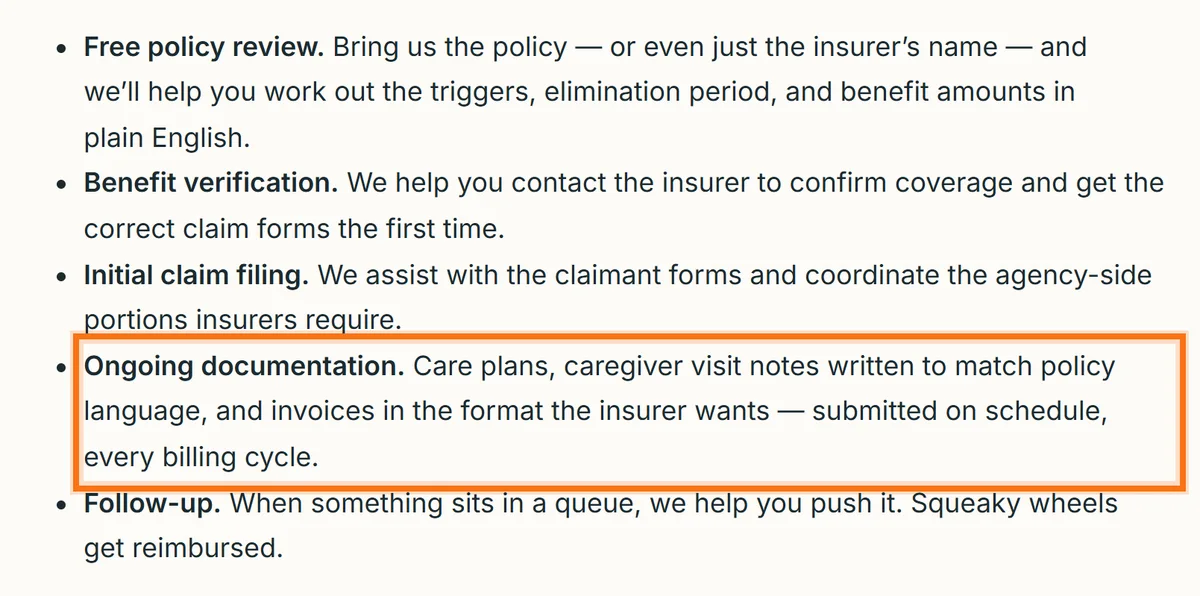
Here is the list of what we take off your plate, as it appears on our long-term care insurance page:
Families still make every decision and remain the policyholder's voice. We are not insurance agents or attorneys, and this is help with the process, not legal or financial advice.
Step 1: Find the policy
Many policies were bought in the 1990s and 2000s by people who are now in their eighties, and the paperwork has been in a drawer ever since. Picture a common situation: your mother has just come home after a fall, and somebody remembers that she "has insurance for this." Nobody knows where it is.
- Look where the important papers live: the filing cabinet, the desk in the study, the safe-deposit box list, the folder with the will.
- Follow the premiums. A policy that has been kept in force has been paid for. A recurring premium payment in the checkbook or the bank statements gives you the insurer's name.
- Ask the people who would know: the financial advisor, the accountant, a sibling who handled paperwork years ago.
You do not need the whole document to start. Bring us the policy, or even just the insurer's name, and we will help you work out what it covers. Older policies are often more generous than anything sold today, sometimes with inflation riders that have grown the benefit well beyond the original figure, so a decades-old policy is worth checking.
Step 2: The free policy review
At the free in-home assessment, or before it if you prefer, we read the policy with you and pull out the few terms that decide your first months of care. You do not need to master all of them. You need to know these answers:
| Policy term | The question to answer | What it means for the first months |
|---|---|---|
| Benefit trigger | Does your parent need help with the required number of daily activities (usually two of six), or have a cognitive impairment? | A physician or the insurer's nurse assessor documents this; the claim cannot pay until it is met |
| Elimination period | How many days (commonly 30, 60 or 90), and does the policy count calendar days or only days of paid care? | This decides how long the family pays before the policy starts |
| Daily or monthly benefit limit | What is the most the policy pays per day or per month today, including any inflation rider? | This decides how many hours of care the policy can carry |
| Benefit period or pool | How many years, or how large a dollar pool? | Care that costs less per day than the limit makes the pool last longer |
| Provider requirement | Must care come from a licensed agency? | Our Texas license, #020448, usually satisfies it |
How to read this table: the first two rows decide when money starts to arrive, and the last three decide how much and for how long. If you only have time for one call to the insurer, ask about the elimination period and whether it counts only days of paid care.
Step 3: Start care while the waiting period runs
You do not have to wait for the insurer to start care, and starting promptly can begin satisfying the elimination period. Care can often begin within 24 hours of your call. Many families start with a few four-hour visits a week of personal care, the help with bathing and dressing that usually meets the benefit trigger in the first place.
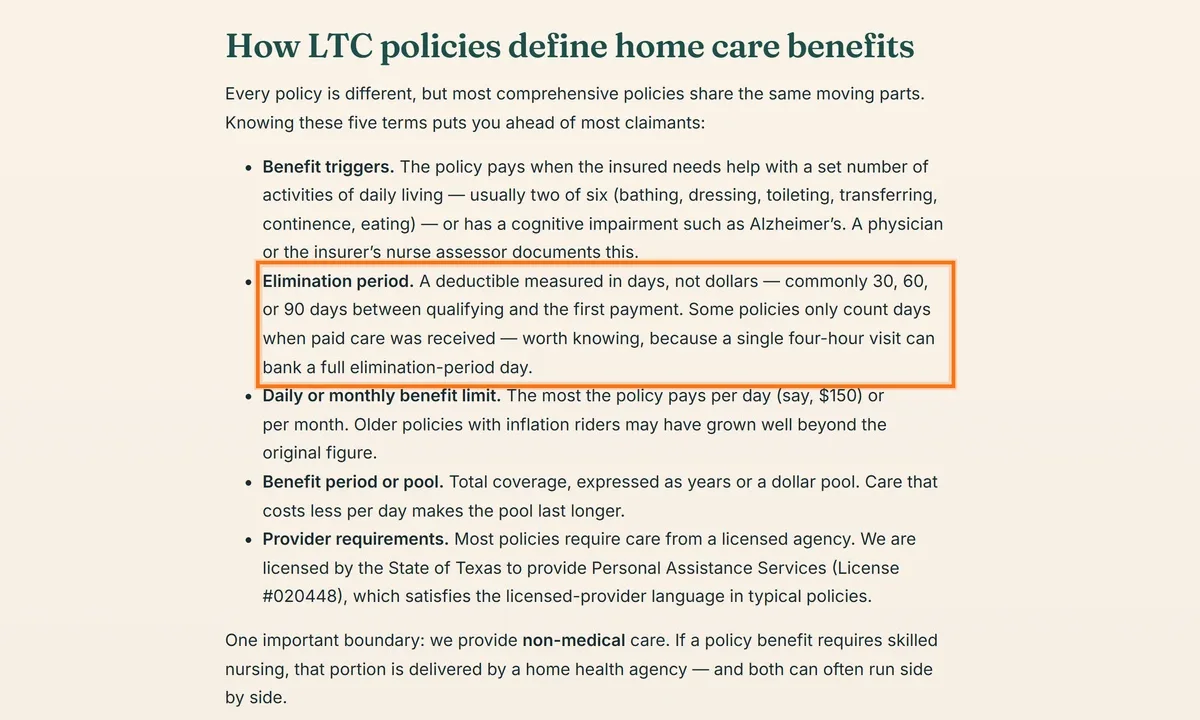
How fast the elimination period passes depends on how your policy counts it. If it counts only days when paid care was received, each day with a visit counts, and a single four-hour visit can bank a full day. With a 60-day period counted that way, visits every day clear it in about two months, while visits three days a week take about twenty weeks. If your policy counts calendar days instead, the clock runs from the day your parent qualifies, whether or not care is happening. That is why this is the first question to settle in the policy review.
During those weeks the family pays the invoices. Keep every one: they are part of the record the insurer will want.
Step 4: Build the claim file
The first claim is a package, and most delays come from one missing piece. We help with each part:
- Benefit verification. We help you contact the insurer to confirm coverage and get the correct claim forms the first time.
- The claimant forms. We assist with the forms the policyholder or family completes.
- The medical piece. A physician, or the insurer's own nurse assessor, documents that the benefit trigger is met. We do not make medical determinations; your parent's doctor does.
- The agency-side portions. We supply our license information, the written care plan, the caregiver visit notes and the invoices in the format the insurer requires.
Insurers rarely deny clearly valid claims. More often, claims die slowly: a form goes back for a missing signature, care notes do not use the policy's language, an invoice lacks a required detail, or a follow-up call never happens. Each of those can cost the family a month of benefits.
Step 5: The first paid invoice, and every month after
Once benefits activate, the insurer reimburses per the policy, and the paperwork becomes a monthly routine. Every billing cycle we send the care plan, visit notes written to match the policy's language, and invoices in the format the insurer wants, on schedule. When something sits in a queue, we help you push it.
Your rate stays exactly what we publish. Using insurance does not change the caregiver you get, the right to ask for a different caregiver at any time, or the hourly price. The only difference is who reimburses the cost.
Worked math: what a policy limit covers at our published rates
We never guess what a policy pays; only the policy and the insurer can tell you. But once you know the limit, the arithmetic is simple. The monthly costs below are the estimates on our cost of in-home care page, at one flat $30–34 an hour, the same for days, evenings, weekends and overnights. The benefit column uses an example monthly limit of $3,000. It is an example only, not your parent's policy.
| Care schedule | Estimated monthly cost | Against the example $3,000 limit |
|---|---|---|
| 4 hours a week | $520–590 | Under the limit |
| 12 hours a week | $1,560–1,770 | Under the limit |
| 20 hours a week | $2,610–2,960 | Under the limit |
| 40 hours a week | $5,190–5,880 | Over the limit; the family pays the rest |
| 24-hour care, rotating caregivers | $21,840–24,750 | Well over the limit; the family pays the rest |
How to read this table: replace the example limit with your parent's real one from the policy review, then find the schedule your parent needs. Two cautions. If the policy has a daily limit rather than a monthly one, check each day's cost against it, because a long day can exceed a daily cap even when the month looks fine. And care that costs less per day than the limit makes the benefit pool last longer. Major holidays bill at time and a half, which can push a holiday week a little higher.
When needs grow toward round-the-clock care, 24-hour care bills at the same flat hourly rate as any other hour. If both parents need help in the same home, a couples discount applies when one caregiver helps both.
Using a policy in your neighborhood
The claim works the same in every ZIP code. What differs is how the care, and the paperwork, usually begins.
Preston Hollow, Bluffview and Devonshire
Here the claim often starts in a hospital room. The hospitals Preston Hollow families use most are Texas Health Presbyterian Dallas on Walnut Hill Lane, Medical City Dallas on Forest Lane and UT Southwestern's Clements University Hospital on Harry Hines. Call us from the room: we can do the free assessment at the bedside, have a caregiver at the house the first night home, and start the elimination-period clock while the claim is still being assembled. See home care in Preston Hollow, which covers Bluffview and Devonshire in the 75225, 75230 and 75220 ZIP codes.
Highland Park and University Park
In the Park Cities the person handling the claim is often a son or daughter a few streets away who already manages the doctors and the money. We send the documentation to that person, and our caregiver reports to them after every visit, so the record the insurer sees and the record the family sees are the same. See home care in Highland Park and home care in University Park.
Lakewood
For a parent with Alzheimer's or another dementia, the benefit trigger can be cognitive impairment rather than physical help, and the visit notes need to reflect the supervision and routine the caregiver actually provides. Many Lakewood stays begin at Baylor University Medical Center on Gaston Avenue. See home care in Lakewood.
North Dallas
Many North Dallas parents are in independent or assisted living along Preston Road or the Tollway, and families add a private caregiver for one-on-one time the community cannot give. If that is your situation, ask the insurer whether the policy pays for a licensed agency's caregiver inside the community. The answer is in the policy, and we will help you find it. See home care in North Dallas.
Uptown and Turtle Creek
In a high-rise, the insurer needs nothing different; the building does. We arrange access with the front desk before the first visit, so care can start on schedule and the elimination period starts with it. See home care in Uptown and Turtle Creek.
What if there is no policy, or it falls short?
A wartime veteran or surviving spouse may qualify for VA Aid and Attendance, a pension benefit rather than insurance. Original Medicare generally does not pay for non-medical home care. We are a private-pay agency and do not bill Medicaid. Our paying for care overview compares the paths side by side.
Why families bring their policy to Senior Care of North Texas
- Free policy review, benefit verification, help with the first claim and monthly documentation, with no charge and no fee added to the rate.
- Licensed by the State of Texas, Personal Assistance Services License #020448.
- Employee caregivers, background-checked, insured and supervised, matched to your parent, with the right to ask for a change at any time.
- Ryan Berry, co-owner, does the free in-home assessment himself.
- Rated 4.9 stars across 44 Google reviews; care can often start within 24 hours; the phone is answered 24/7.
Find the policy, or just the insurer's name, and call (214) 550-6533, or request a free in-home assessment. We will read it with you and help you start the claim on our long-term care insurance claim help terms: no obligation, no charge.
This guide is general information about the claim process. It is not legal, financial or medical advice; your parent's policy language controls.
