

Which agencies provide non-medical support alongside hospice in Preston Hollow, Highland Park or University Park? Senior Care of North Texas is one. We are a locally owned, Texas-licensed non-medical agency (License #020448) that works beside your hospice team in Preston Hollow, Bluffview, Devonshire, the Park Cities, Lakewood, North Dallas, Uptown and Turtle Creek. Hospice brings the medical care. We bring the hours: bedside presence, gentle personal care, awake nights and rest for the family.
If you are reading this, someone you love is probably on hospice now, or about to be. This guide is practical. It covers who does what, what to ask the hospice before you plan any hours, how the first shifts get set up, and how the plan usually looks in each neighborhood. For a closer look at the hours themselves, our guide to what a caregiver does during hospice at home goes shift by shift.
Which agencies provide non-medical support alongside hospice in Preston Hollow, Dallas?
Two different kinds of agency can be in the house at the same time, and it helps to keep them straight.
- The hospice agency is the medical team. Nurses, a physician, comfort medications, equipment, a chaplain and social workers. They take charge of comfort and make the medical decisions.
- A non-medical home care agency provides caregivers for the long hours between hospice visits. That is what we do, under a Texas Personal Assistance Services license.
Some families hire a private caregiver instead, through friends or church. That can work, but when the private caregiver is sick or needs a night off, the family is back at the bedside alone, and the family is the employer for payroll and background checks. Our caregivers are employees: background-checked, insured and supervised, and when one is out we send someone who already has the plan.
The answer is the same in Highland Park, University Park, Bluffview, Devonshire, Lakewood, North Dallas, Uptown and Turtle Creek. Our end-of-life and hospice support covers all of them, with the same caregivers working the Dallas side every day.
What does the non-medical side actually cover?
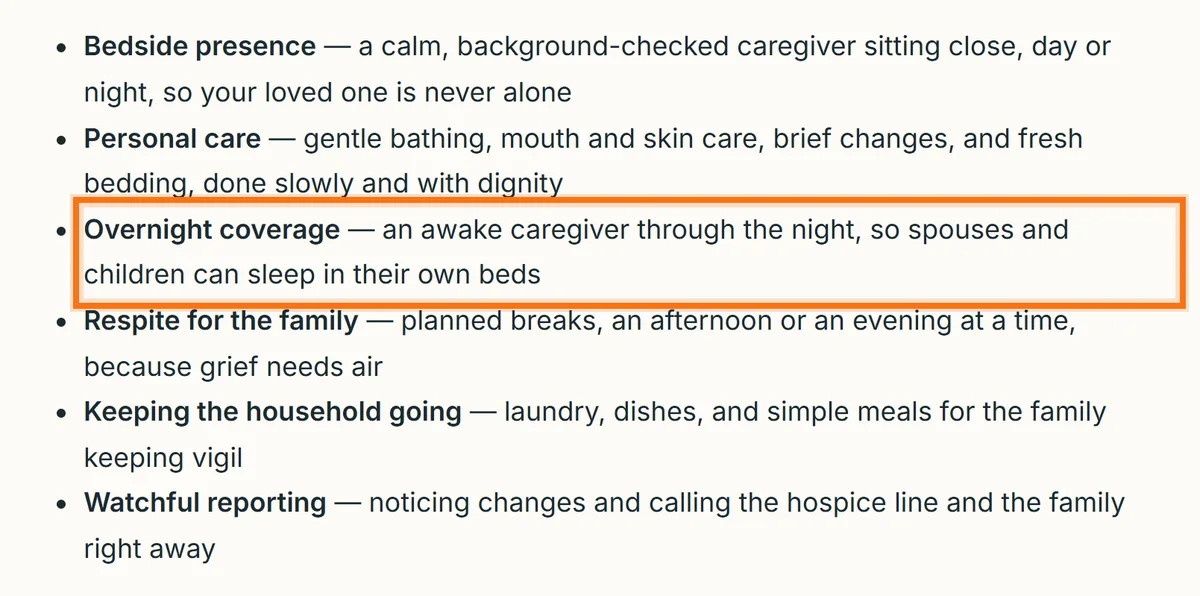
What hospice cannot provide is someone in the home hour after hour. That is the gap we fill. On our hospice support page, it comes down to six things:
- Bedside presence. A calm, background-checked caregiver sitting close, day or night, so your loved one is never alone.
- Personal care. Gentle bathing, mouth and skin care, brief changes and fresh bedding, done slowly and with dignity.
- Overnight coverage. An awake caregiver through the night, so spouses and children can sleep in their own beds.
- Respite for the family. Planned breaks, an afternoon or an evening at a time.
- Keeping the household going. Laundry, dishes and simple meals for the family keeping vigil.
- Watchful reporting. Noticing changes and calling the hospice line and the family right away.
Just as important is what we do not do. Our caregivers do not give medications, including comfort medications. They do not manage symptoms, operate medical equipment or make any medical decision. All of that belongs to the hospice team, and we follow their guidance in the home. A caregiver can remind, watch the clock and call the hospice line the moment something changes. We say this plainly because at this stage, everyone at the bedside should know exactly who does what.
What should you ask the hospice before you plan the hours?
The hours you need from us depend on the hours hospice already covers. Hospice schedules differ from one agency and one patient to the next, so do not guess. Ask your hospice nurse or social worker these questions, and write the answers on one page you can tape inside a kitchen cabinet:
- What hours does the hospice aide cover, and on which days? This tells you which mornings already have help with bathing and which do not.
- Which days does the nurse usually visit? Visits change as needs change, but a rough pattern helps you place the caregiver shifts.
- What is the after-hours hospice number, and when should we call it? Our caregiver will use the same number and the same instructions.
- Who gives the comfort medications, and where are they kept? Usually the people hospice has instructed, often the family. Our caregiver will not give them, so that person needs to be reachable.
- Is there anything the caregiver should or should not do with positioning, sips of water or mouth care? We follow the hospice team’s guidance.
Bring those answers to our assessment. With them, we can build shifts that fill the gaps rather than double up on the hours hospice already covers.
How do the first shifts get set up?
Families in hospice measure time differently, and we plan around that. These calls are treated with urgency, and support can often begin within 24 hours.
- Call us. Tell us what is happening and what you are worried about. We will tell you honestly whether this service fits.
- The free assessment. Ryan Berry, our co-owner, meets your family at home, in the hospital or at a facility, wherever your loved one is now, and builds the care plan with you.
- A matched caregiver. We match the caregiver with care, and the same faces can stay with you through the whole journey. If the match is not right, you can ask for a different caregiver at any time.
- Care begins. Often within 24 hours. You can change or stop the schedule at any time, with no contract.
Picture a common situation: hospice starts on a Thursday in a Preston Hollow home. The nurse has been out, the equipment has arrived, and the wife has not slept properly in a week. Our caregiver arrives that evening, reads the hospice instructions taped inside the kitchen cabinet, notes the after-hours number and sits near the bed through the night. In the morning the caregiver tells the family how the night went. Nothing medical changed. The house simply had a second pair of hands, and the wife slept in her own bed.
If your loved one is still in the hospital or a facility when hospice is being discussed, our hospital and facility sitter service can provide bedside presence there too, when visiting hours, work or distance keep family away.
How many hours do families usually plan around hospice?
There is no right number. It depends on how much the family can cover, how far away the children live and what the nights are like. These are the patterns we see most often.
Common ways families plan non-medical hours alongside hospice
| What the family is facing | Common coverage | What it gives the family |
|---|---|---|
| Nights are the hardest hours, and the spouse is not sleeping | An awake overnight caregiver | The spouse sleeps in their own bed while someone awake stays near the bedside |
| The family covers evenings but works during the day | Daytime visits of four hours or more on the days hospice is not there | Bathing, changes, sips and company on the days with no hospice visit |
| Out-of-town family come and go | Steady shifts between their visits | A familiar person present when the house empties again |
| Your mother will not leave your father’s side | A planned block of respite, an afternoon or an evening | Time to rest, see her own doctor, or simply sit outside |
| The family wants someone present at all times | 24-hour care with rotating, awake caregivers | No gaps at night, no one sleeping on the couch on call |
How to read this table: start with the row that sounds most like your house this week, not next month. Most families begin with one row, often overnights, and add another as things change. Every row is billed at the same hourly rate.
Overnights are the most requested form of this care. Our guide to what an awake overnight caregiver does explains the night shift, and 24-hour care covers the rotating schedule when someone needs to be awake every hour. For the spouse who has been on duty for weeks, respite care is the planned break, and our article on respite for the caregiving spouse is about getting that person to accept it.
Hospice support at home, neighborhood by neighborhood
The care is the same everywhere. The house, the building and the hospital nearby are not.
Preston Hollow, Bluffview and Devonshire
Many Preston Hollow homes are single-story ranch houses with long hallways, and Bluffview and Devonshire sit in the southwest corner. A long hallway between the bedroom and the kitchen matters at night: the overnight caregiver stays near the bedside, not at the other end of the house. Many households here already have a housekeeper; our caregiver works alongside them and takes the personal care and the bedside hours. See home care in Preston Hollow.
Highland Park and University Park
In Highland Park, many houses date from the 1920s and 1930s, with the bedrooms upstairs. In University Park, older homes have narrow bathrooms and newer rebuilds put the primary bedroom upstairs. Hospice brings the equipment; our caregiver works around wherever the bed is set up, and around the stairs everyone else in the family still climbs. Many University Park families have a son or daughter a few streets away; the caregiver keeps that person informed after every shift.
Lakewood and North Dallas
In Lakewood, some clients have lived in the same 1920s or 1930s house for decades, and staying there to the end is often the whole point. Small bathrooms and wood floors are part of the plan. In North Dallas, many parents live in independent or assisted living along Preston Road or the Tollway. Our caregiver can add the individual hours the community staff cannot provide, including overnight reassurance.
Uptown and Turtle Creek
In the high-rises along Turtle Creek and around Uptown, there is a front desk, a garage and building rules. Before the first shift we put the caregiver’s name on the approved list with the concierge and sort out parking, so a caregiver arriving at night is not stuck in the lobby. See home care in Uptown and Turtle Creek.
If your loved one is still at Texas Health Presbyterian Dallas, Medical City Dallas, Baylor University Medical Center or UT Southwestern when hospice is discussed, we can do the assessment there and have a caregiver at home for the first night.
What does non-medical hospice support cost?
We do not know what your hospice covers, and we will not guess. Ask the hospice what hours its aide covers, and plan our hours around that.
Our side is simple. One flat rate of $30–34 an hour, the same for days, evenings, weekends and overnights, and it never changes with the level of care. Major holidays are billed at time and a half. The minimum visit is four hours. There is no assessment fee, no start-up fee and no contract. If both parents need help in the same home, a couples discount applies when one caregiver helps both. Our pricing page estimates 40 hours a week at about $5,190–5,880 a month and round-the-clock care with rotating, awake caregivers at about $21,840–24,750. The cost of in-home care page shows the full table, and if a long-term care insurance policy exists, our page on long-term care insurance explains how we help with the paperwork.
Why do families choose Senior Care of North Texas alongside hospice?
- Locally owned. Ryan Berry, one of the two local owners, comes to the assessment himself.
- Employee caregivers. Background-checked, insured and supervised. We match the caregiver, and you can ask for a different one at any time.
- Clear about the line. Licensed for Personal Assistance Services, #020448. We follow the hospice team’s guidance and never step into their role.
- Fast. Support can often begin within 24 hours of your call.
- Rated 4.9 stars from 44 Google reviews.
- Answered 24/7. Call (214) 550-6533 at any hour.
End-of-life care is also the care of the living. A caregiver in the home means a wife can sleep, a son can go home to his children for an evening, and family far away can breathe between visits. If that is what your family needs, call us or request a free in-home assessment, and we will talk through how our hospice support works for your home.
This guide is educational and is not medical advice. Your hospice team knows your loved one’s situation and is the right source for anything about symptoms, medication or what to expect next.
