


If you're comparing three or four agencies in one evening — and most families are — you need questions that separate them fast. The twelve below are the ones we'd ask if we were hiring care for our own parents. Because readers fairly wonder how the agency publishing the list would answer it, we've included our own answers under each question. You can see the fuller version of our answers on our why families choose us page, but the questions work on any agency in Texas.
A tip before you dial: write the answers down as you go. After the third call, agencies blur together, and the one detail you forget will be the one that mattered.
The 12 questions, with what a good answer sounds like
1. What is your minimum visit length?
Licensed agencies in Dallas–Fort Worth schedule care in blocks rather than by the single hour, and that block size shapes your monthly bill as much as the hourly rate does. Ask for the number early, because two agencies quoting the same rate can land in very different places once the minimum is applied.
A good answer: a specific number of hours, stated without hedging. A bad answer: "it depends on the schedule" — that usually means the minimum is negotiable only in the agency's favor.
Our answer: four hours. That's the whole answer. A four-hour morning covers the things families actually call about — bathing, breakfast, medication reminders, light housekeeping, an errand or a ride to an appointment — at one flat hourly rate.
2. Does your rate go up as my parent's needs increase?
Many agencies use "levels of care" pricing. A client starts at Level 1, and after a fall or a dementia diagnosis is reassessed to Level 2 or 3 — at a higher hourly rate for the same caregiver. Families rarely learn this until the letter arrives.
A good answer: "No, the rate is the rate," ideally in writing. A bad answer: anything that mentions levels, tiers, acuity, or reassessments.
Our answer: no. We have no levels-of-care pricing. Your rate does not increase when your loved one's needs increase.
3. Are you licensed by the State of Texas, and what is your license number?
Non-medical home care agencies in Texas must hold a Personal Assistance Services (PAS) license from Texas Health and Human Services. A legitimate agency can recite its number from memory. If you want the full background, we wrote a plain-English guide to what a Texas PAS license actually means.
A good answer: the number itself, offered immediately. A bad answer: "we're fully certified" with no number, or confusion about what license they hold.
Our answer: License #020448, licensed by the State of Texas to provide Personal Assistance Services.
4. How do you match caregivers — and can we change ours?
The relationship between your parent and the caregiver is the service. An agency that sends whoever is available, with no thought and no recourse, is treating caregivers as interchangeable. They are not.
A good answer: the agency explains how it matches on needs, personality and schedule, tells you who is coming before the first visit, and lets you request a different match at any time without an awkward negotiation. A bad answer: "we assign based on availability."
Our answer: we match the caregiver to your loved one's needs and temperament, and if the match isn't right you can request a different one any time, no explanation required.
5. How do you screen your caregivers?
You are inviting a stranger into your parent's home. Ask exactly what screening happens before that first visit.
A good answer: criminal background checks on every caregiver, described specifically. A bad answer: vague talk of "careful vetting" with no specifics.
Our answer: every personal assistant we send is criminally background-checked. Texas licensing rules also require PAS agencies to run state-mandated background checks on employees who work with clients — ask any agency to confirm they comply.
6. What happens when my caregiver is sick or on vacation?
This is the question private-hire families can't answer at all, and weak agencies answer badly. If the Tuesday caregiver is out, does anyone come Tuesday?
A good answer: a concrete backup process — the agency staffs a replacement and tells you who is coming. A bad answer: "we'll do our best."
Our answer: coverage is the agency's job, not yours. When your regular caregiver is out, we arrange a backup and let you know who to expect.
7. How flexible is the schedule once care starts?
Some agencies build schedules around their staffing needs and ask families to fit in. The care plan should be built around your parent's day instead.
A good answer: the plan is written around the routine your parent already keeps, and days or hours can be adjusted as needs change. A bad answer: rigid weekly commitments or penalties for changes.
Our answer: care plans are built around your loved one's routine, and schedules can be adjusted as needs change. Start with a morning visit a couple of days a week and add days if the situation calls for it.
8. What is the hourly rate, and what does it include?
"Call for pricing" is a red flag in this industry. Agencies that won't publish or state rates plainly usually have a reason. Also ask what's inside the rate: Is mileage extra? Weekend surcharge? Assessment fee?
A good answer: a clear hourly figure and a clear list of what's included. A bad answer: "every situation is different, let's schedule a consultation first."
Our answer: $30–34 an hour, one flat rate for days, evenings, weekends and overnights; major holidays are billed at time and a half, and we tell you which days count before you book. The rate is published on our cost of in-home care page, and the assessment, the written care plan, caregiver matching and schedule changes are included at no extra charge.
9. Is there a long-term contract, deposit, or cancellation penalty?
Care needs change. A parent recovers, moves in with family, or needs more help than home care can provide. Your agreement should be able to change with them.
A good answer: plain terms you can exit without penalty. A bad answer: multi-month commitments or fees to stop service.
Our answer: there are no long-term contracts, no assessment fees and no start-up fees. You can change or stop care as your family's situation changes, and the free assessment obligates you to nothing.
10. How quickly can care actually start?
Families usually call agencies after something happened — a fall, a discharge date, a bad weekend. "We can assess you in two weeks" is not an answer to a Thursday discharge.
A good answer: a concrete timeline in days, not weeks. A bad answer: a waitlist, or an assessment calendar three weeks out.
Our answer: care can often start within 24 hours of your call, including after a hospital discharge.
11. Do you help with long-term care insurance paperwork?
If your parent holds a long-term care policy, the paperwork — care logs, invoices in the carrier's format, plan-of-care documentation — is a real job. Some agencies hand you a receipt and wish you luck.
A good answer: the agency prepares and submits documentation in the format the carrier needs. A bad answer: "you'd handle the insurance side yourself."
Our answer: yes. We assist with long-term care insurance paperwork as part of the service, because a policy your parent paid into for decades should actually get used.
12. Are your caregivers your employees, and who supervises them?
This matters for taxes, liability, and quality. If the "agency" is really a registry that connects you with independent contractors, you may be the legal employer without knowing it — the risks are big enough that we wrote a separate article on agency versus private caregivers.
A good answer: caregivers work for the agency, which handles payroll, taxes, and supervision, with a named person you can call when something's off. A bad answer: "we just make the match."
Our answer: our caregivers work for us, and supervision and problem-solving are our responsibility — you call one number and it gets handled.
The short list, with what to listen for
Here is the same list stripped down for the phone call, with the answer that should reassure you and the one we give:
| Question | A good answer | Our answer |
|---|---|---|
| Minimum visit length? | A number of hours, stated plainly | Four hours |
| Does the rate rise with care level? | No, in writing | No levels-of-care pricing |
| Texas license number? | The number, offered at once | #020448 |
| How is the caregiver matched, and can we change? | A matching process and a change on request | We match; ask for a change any time |
| How are caregivers screened? | Criminal background checks, named specifically | Every caregiver is background-checked |
| Backup when the caregiver is out? | The agency staffs it and tells you who is coming | We arrange the backup |
| How flexible is the schedule? | Built around your parent's routine | Adjusted as needs change |
| Hourly rate, and what is included? | A figure and a list | $30–34, flat; extras included |
| Contract, deposit or cancellation penalty? | Plain terms, no exit fee | No long-term contracts |
| How fast can care start? | Days, not weeks | Often within 24 hours |
| Help with long-term care insurance paperwork? | The agency prepares it | Yes |
| Employees or contractors, and who supervises? | Employees, with a named supervisor | Our employees; we supervise |
How to read this table: print it, keep it next to the phone, and write each agency's answer in the margin of the middle column. Two answers that do not match the middle column are worth a follow-up question; three are usually a reason to call the next agency.
Questions to ask before signing a home care contract
The phone call tells you who to invite for an assessment. The agreement is what you actually buy, so read it at the kitchen table before anyone signs, and ask these questions about it:
- Is the rate in the agreement the rate you quoted? Check it covers evenings, weekends and overnights, and that it does not say "subject to reassessment."
- Which days are holidays, and what do they cost? Ours are billed at time and a half; the list of days should be in writing before the first holiday, not on the invoice after it.
- What does it take to change or stop care? A notice period is reasonable. A minimum term or a fee to leave is not something a family should need.
- Is anything billed outside the hourly rate? Assessment fees, start-up fees, schedule-change fees, mileage on errands. Ask for each by name.
- Is the care plan attached? You should approve a written plan before care starts, listing the tasks, the days and the hours, so everyone works from the same page.
Nothing on that list should make a good agency uncomfortable. Our answers are on our pricing page before you call, and the same page is the one we hand over at the assessment.
Is a home health care agency asked different questions?
Yes, because it sells a different thing. A home health agency provides medical care at home, such as nursing and therapy, on a doctor's order and usually for a set period. A home care agency like ours provides non-medical help with daily living for as long as it is needed. If the doctor has ordered home health, ask that agency whether it is Medicare-certified, which nurses and therapists will visit and how often, and who to call between visits. Many families end up with both, and our guide to home care vs. home health explains how the two fit together.
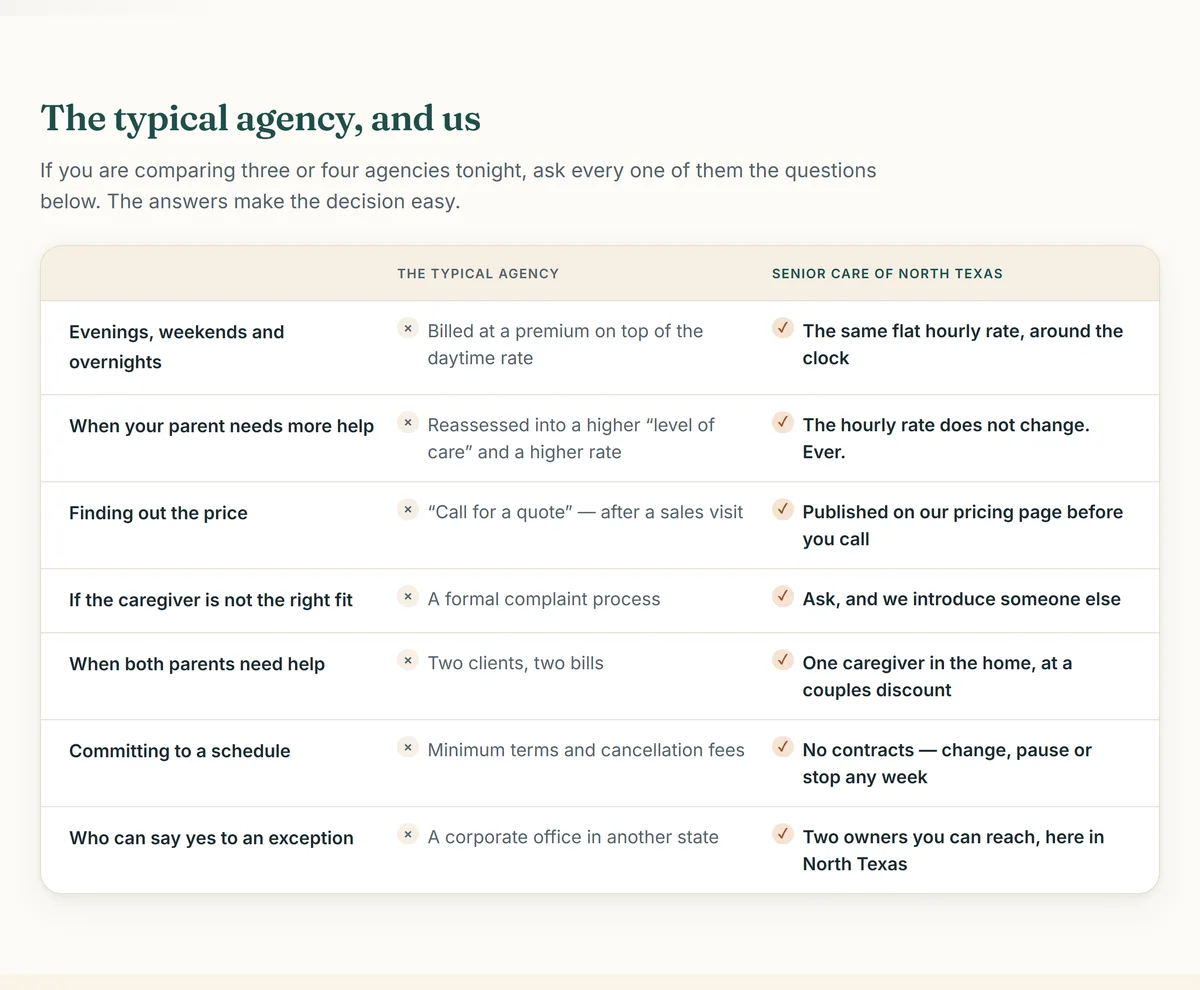
How the answers look side by side
When families compare agencies in Dallas–Fort Worth, the differences tend to show up in the same few rows. This is how we answer them on our own why families choose us page:
How to read the answers
No single answer should decide this. What you're listening for across all twelve is a pattern: does the agency answer plainly, with specifics, or does every question route to "let's set up a consultation"? An agency that is vague on the phone will be vague when there's a problem at 7 a.m. on a Saturday. And trust your parent's read after meeting the caregiver — they're the one opening the door.
How Senior Care of North Texas helps with this
We're a locally owned, Texas-licensed (License #020448) non-medical Personal Assistance Services agency serving Dallas–Fort Worth, Gainesville, and the surrounding North Texas counties. We wrote this list knowing we'd have to answer it ourselves: a four-hour minimum visit at one flat hourly rate, no levels-of-care pricing, published rates, a couples discount, background-checked caregivers, and help with long-term care insurance paperwork. The in-home assessment is free, and care can often start within 24 hours. Ask us all twelve — we like this list.
This article is educational and is not legal, financial, or medical advice. For medical decisions about your parent's care, talk with their physician.
