

When you see "Texas License #020448" in our footer, that number refers to a Personal Assistance Services license issued by Texas Health and Human Services. If you're comparing agencies, that phrase — Personal Assistance Services, or PAS — is worth understanding, because it defines both what the state has checked about an agency and what the agency is legally allowed to do in your parent's home. It's also, frankly, part of the story of who we are: you can read more about the people behind the license on our about us page, but this article is about the license itself, for any agency, not just ours.
Texas regulates home care in categories — PAS is the non-medical one
Texas Health and Human Services (HHS) licenses home and community support services agencies under state law, and the license comes in categories that define what an agency may provide. The categories run from Personal Assistance Services at the non-medical end, through Licensed Home Health (which involves nurses and skilled services), up through hospice.
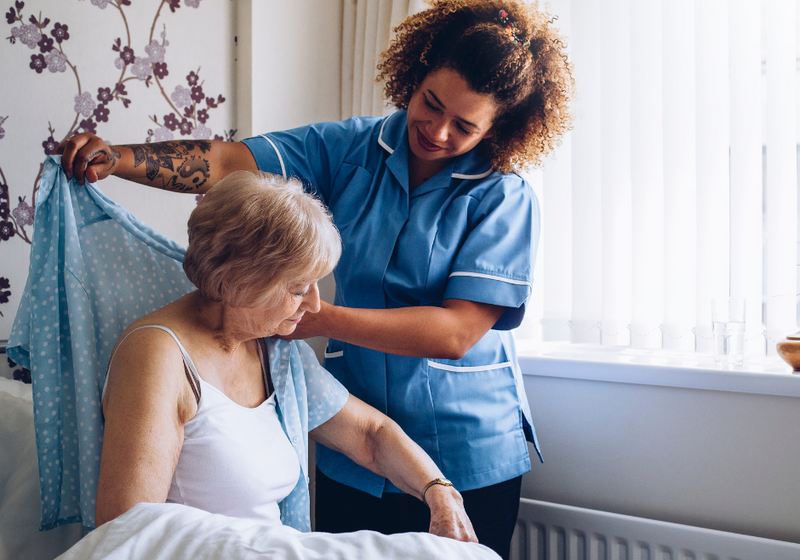
Personal Assistance Services is the category for non-medical help with the activities of daily living. Under a PAS license, caregivers can help with things like:
- Bathing, dressing, and grooming
- Getting safely from bed to chair, and steadying a walk to the bathroom
- Meal preparation and light housekeeping
- Medication reminders — prompting and cueing, not administering
- Errands, transportation, and escort to appointments
- Companionship and supervision through the day
What a PAS agency may not do is medical care. No wound care, no injections, no adjusting medications, no nursing judgment. When we say we're a non-medical agency, that isn't modesty — it's the legal boundary of the license, and any PAS agency that blurs it should worry you. If your parent needs skilled nursing at home, that's a different license category and typically a doctor's order; your parent's physician is the right starting point.
PAS, home health and hospice side by side
Families in Dallas–Fort Worth often hear all three in the same week, usually around a hospital discharge. Here is how they differ in plain terms:
| Personal Assistance Services (PAS) | Licensed home health | Hospice | |
|---|---|---|---|
| What it is | Non-medical help with daily living | Skilled care: nurses and therapists | Comfort care for a terminal illness |
| Typical tasks | Bathing, dressing, transfers, meals, reminders, errands, company | Wound care, injections, therapy exercises, clinical checks | Pain and symptom management, family support |
| How it starts | The family calls the agency directly | Usually a doctor's order | A physician's referral |
| Visit pattern | Blocks of hours, up to round the clock | Short visits a few times a week | Visits by the hospice team, on call |
| Can run alongside the others? | Yes | Yes | Yes |
How to read this: the license category tells you what an agency is allowed to do in the home. Many families use two at once, for example a home health nurse twice a week for a wound and a PAS caregiver every morning for the shower, breakfast and the rest of the day. The exact rules sit with Texas HHS; this table is a plain summary, not legal advice.
Non-medical is not a lesser product — it's a different one
Families sometimes hear "non-medical" as a downgrade. In practice, the two kinds of home care solve different problems, and most aging parents need the non-medical kind first and longest. Home health — the medical kind — typically arrives by doctor's order after a hospitalization, sends a nurse or therapist for short visits a few times a week, and ends when the treatment goal is met. It does not cook dinner, and it is not there Tuesday afternoon when your mother needs steadying on the way to the bathroom.
PAS care is the Tuesday-afternoon layer: the daily, ongoing help with living that keeps a household running between (and after) any medical episodes. The two often run side by side, and a good PAS caregiver makes the medical side work better — she's the one who notices the swelling ankle, hears the new cough, and flags it to the family so the doctor hears about it early. Noticing and reporting is squarely within a PAS caregiver's lane; diagnosing and treating never is.
The medication line trips families up most, so here it is precisely: under a PAS license a caregiver can remind, prompt, open the weekly organizer your family or a pharmacist filled, and note whether the dose was taken. She cannot fill the organizer with judgment calls, change doses, or administer medications. If that boundary matters for your parent's situation, raise it with the doctor and pharmacist — they, plus a reminder system, cover what a non-medical caregiver lawfully can't.
What the state checks before it issues the license
A PAS license is not a form you print off the internet. Broadly, an agency applying to HHS goes through an application with fees, names a qualified administrator and alternate, submits its ownership and management for review, and adopts required written policies covering how clients are admitted, how services are supervised, and how complaints are handled. Agencies must run state-mandated background checks on employees who provide services in clients' homes, and the license must be renewed on a recurring cycle rather than held forever. HHS also conducts surveys — inspections — and investigates complaints against licensed agencies, with the power to cite deficiencies and, ultimately, to revoke a license.
Two things on that list matter most to families:
Background checks are a legal requirement, not a marketing claim. When an agency says its caregivers are screened, licensing rules are the reason you can expect it rather than merely hope for it. (We go further than the minimum — every caregiver we send is criminally background-checked — but the floor exists because of the license.)
There is a referee. If something goes wrong with a licensed agency and the agency won't fix it, you can complain to the state, and the state is required to care. A private caregiver arrangement has no referee at all — a difference we cover honestly in agency vs. hiring a private caregiver.
What the license does not tell you
Honesty requires the other half: a license is a floor. It tells you the agency cleared the state's bar — real ownership, required policies, screened employees, subject to inspection. It does not tell you whether the caregivers are kind, whether the office answers the phone on Saturday, whether the schedule bends to your family or the other way around, or what happens to your rate when your mother's needs grow. Two agencies with identical licenses can deliver wildly different care.
So treat the license as a pass/fail screen, then interview past it. Our 12 questions to ask a home care agency picks up exactly where the license check leaves off.
How to verify any agency's license — including ours
Never take "we're licensed" on faith; verification takes minutes. Here's the process:
- Ask the agency for its license number and the license category. Hesitation on either is your first data point.
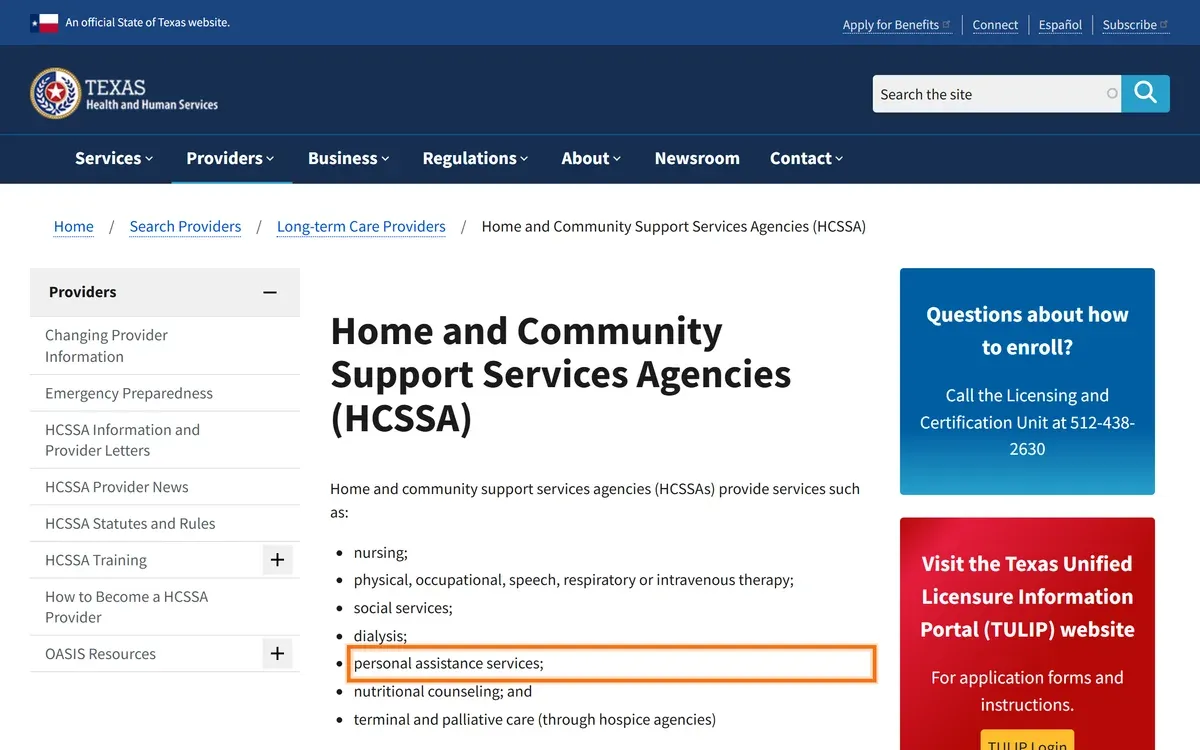
- Check it with the state. Texas HHS publishes the rules for home and community support services agencies on its HCSSA page at hhs.texas.gov, and that page lists a phone number for the Licensing and Certification Unit if you cannot confirm a license yourself.
- Search by the agency's legal name or license number and confirm three things — the license exists, the status is current, and the category is Personal Assistance Services (or the medical category the agency claims).
- Check that the name on the license matches the name on the contract you're signing. Marketing names and legal names sometimes differ; they should connect.
- If anything doesn't line up, ask the agency to explain — and if the explanation is fog, move on. There are agencies whose paperwork simply checks out.
- Ours, for the record: Senior Care of North Texas, License #020448, Personal Assistance Services. We'd rather you verify it than believe our footer. Our personal care and companion care pages show exactly what that license lets us do.
Why an unlicensed operator is a different kind of risk
Around any metro area you'll find operators in a gray zone: "companion" businesses, caregiver registries, and individuals advertising agency-like services without holding an agency license. Some are well-meaning. But everything in this article — vetted ownership, required policies, mandated background checks, state inspections, a complaint process — applies only to licensed agencies. With an unlicensed operator you get none of it, and often you've accidentally become an employer on top of that. The hourly rate may look attractive for reasons that only become clear later.
The fix costs you one question: "What is your Texas license number, and under which category?" It is the single highest-value question in home care, because every legitimate agency answers it instantly and identically, and everyone else improvises.
What should you ask a Dallas home care agency on the first call?
Three questions sort out most agencies in a few minutes, and none of them is about price:
- “What is your Texas license number, and which category?” For non-medical care the answer should be Personal Assistance Services.
- “Are the caregivers your employees, and are they background-checked?” Licensing rules require checks for staff who provide services in clients' homes.
- “What will the caregiver not do?” A licensed PAS agency answers this plainly: no injections, no wound care, no medication administration. Vagueness here is a warning.
After that, the questions that tell good agencies from adequate ones are about people and schedules, and they are in our list of questions to ask a home care agency. If you are weighing a private hire instead, read agency vs. private caregiver in Texas first.
How Senior Care of North Texas helps with this
We are Senior Care of North Texas — locally owned and licensed by the State of Texas to provide Personal Assistance Services, License #020448. Within that non-medical scope we handle the daily-living work families actually call about: bathing, dressing, transfers, meals, light housekeeping, medication reminders, errands, and steady companionship, across Dallas–Fort Worth, Gainesville, and the surrounding North Texas counties.
The license is the floor; on top of it we add the things the state doesn't require — published rates, one flat hourly rate for days, evenings and overnights alike, no levels-of-care pricing, a couples discount, a caregiver matched to your family with a different match on request, and help with long-term care insurance paperwork. The in-home assessment is free, and care can often start within 24 hours.
This article is educational and is not legal or medical advice. Licensing rules summarized here should be confirmed with Texas Health and Human Services, and medical decisions about your parent's care belong with their physician.
