


Who provides in-home support after a stroke in Preston Hollow, Highland Park or University Park? Usually two teams. Home health or outpatient therapy brings the nurses and therapists. Senior Care of North Texas, a locally owned, Texas-licensed non-medical agency (License #020448), covers the hours in between in Preston Hollow, Bluffview, Devonshire, the Park Cities, Lakewood, North Dallas, Uptown and Turtle Creek: bathing, transfers, meals, reminders and rides, done the way the therapy team recommends.
This guide is about that support side: who does what, how to judge an agency, how the help fits the house your parent actually lives in, and how the hours step down as strength returns. If you want to understand the recovery itself (weakness on one side, speech changes, swallowing, fatigue), our guide to stroke recovery at home in the first 90 days covers it. We do not repeat it here.
Who provides in-home support after a stroke in Preston Hollow, Dallas?
When a parent comes home after a stroke, the help usually comes from three places. Knowing which is which saves a lot of confused phone calls in the first week.
- The medical team. The physician sets the plan. Home health is medical care: nurses and physical, occupational and speech therapists sent under a doctor’s order, usually for short visits a few times a week. Later, many people move on to outpatient therapy.
- A non-medical home care agency. That is us. Our caregivers fill the daily hours between those visits with bathing, dressing, meals, transfers, supervision and rides. We are licensed by the State of Texas for Personal Assistance Services, #020448.
- The family. Someone still holds the medication list, talks to the doctors and makes the decisions. The caregiver supports that person, not the other way around.
Most recovering families need both the medical team and a caregiver, and we work alongside home health teams every day. The therapy team comes for a short visit. Recovery happens in all the hours after they leave, and that is the part stroke recovery care at home is built for.
The same answer holds in Highland Park, University Park, Bluffview, Devonshire, Lakewood, North Dallas, Uptown and Turtle Creek. What changes from one neighborhood to the next is the house, the hospital your parent comes home from and the errands, and we cover those below.
What does a non-medical caregiver do after a stroke?
After a stroke, the medical team handles the medicine and the therapy. Someone still has to handle the bathing, the meals, the stairs and the long afternoons. On our stroke recovery page, that work is six things:
- Personal care with one-sided weakness in mind. Bathing, dressing and grooming done patiently, with the affected side supported and nothing rushed.
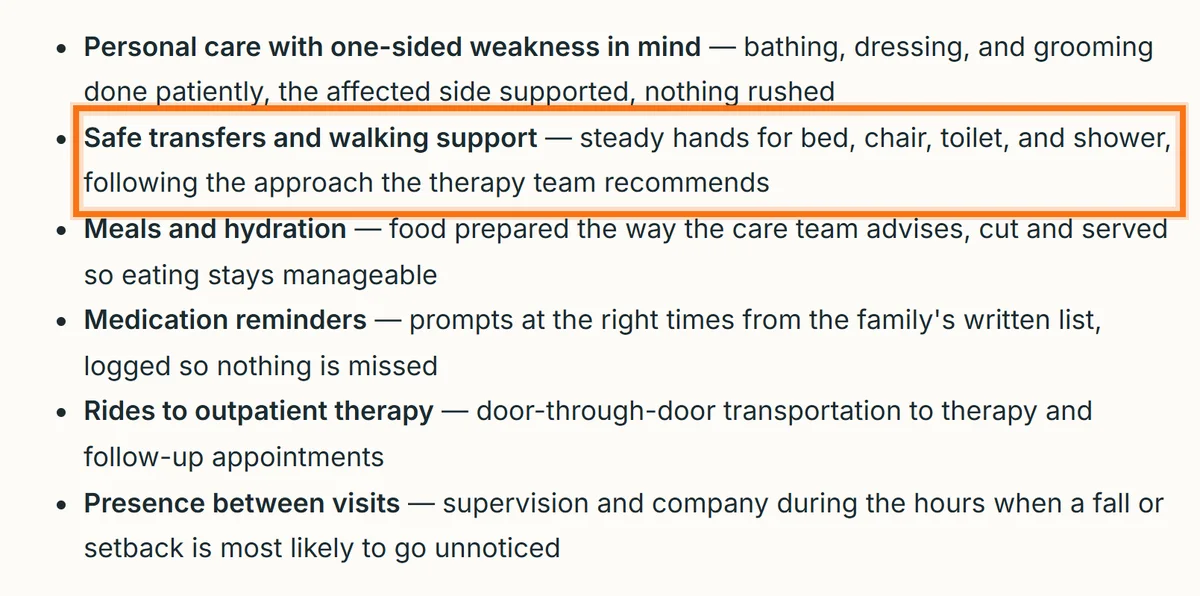
- Safe transfers and walking support. Steady hands for bed, chair, toilet and shower, following the approach the therapy team recommends.
- Meals and hydration. Food prepared the way the care team advises, cut and served so eating stays manageable.
- Medication reminders. Prompts at the right times from the written list or pill organizer the family or pharmacy filled, logged so nothing is missed.
- Rides to outpatient therapy. Door-through-door transportation to therapy and follow-up appointments.
- Presence between visits. Supervision and company during the hours when a fall or a setback is most likely to go unnoticed.
Home exercises are a common question. The caregiver is an encourager, not an instructor: they can remind your parent it is exercise time, set up the space and stay close for steadiness during the walking the therapist assigned. They do not teach, correct or progress exercises. That is the therapist’s job.
When speech or memory has changed, the same caregiver comes each visit, learns how your parent communicates now, allows time for words and never talks over or around them. Anything new or worrying goes to the family the same day, so you can raise it with the care team.
What the caregiver does not do
We are a non-medical agency and we are plain about the line. Our caregivers do not provide nursing, wound care, injections, swallowing evaluations, or any form of physical, occupational or speech therapy. They do not fill pill organizers or give medication; they remind. Those medical services come from your doctor and a home health agency. We support their plan rather than replace it, and we report changes to your family so the medical team hears about them fast.
How does a caregiver help with transfers and walking at home?
Most falls at home happen during a transition: getting out of bed, up from the toilet, in or out of the shower. After a stroke, with one side weaker than the other, those moments are where families feel least sure of themselves. Transfer and mobility assistance is the part of the service that covers them:
- Safe transfers from bed, chairs, the toilet, the shower bench and the car, slow and planned, using proper body mechanics.
- Walking support, a hand or standby spotting on stairs, thresholds and longer walks, with the walker or cane actually in use.
- The high-risk hours covered: mornings, evenings and bathroom trips, when unsteadiness is worst.
- Clear pathways: rugs, cords and clutter moved out of walking routes on every visit.
- Repositioning in bed or a chair for someone who sits or lies for long stretches.
The caregiver follows the approach your parent’s therapist recommends. They are not physical therapists, and they do not design exercise programs or assess gait. No honest agency can promise that a fall will never happen. What we provide is trained support at the moments that matter, alongside the therapy team.
If your father needs two people or a mechanical lift, we will say honestly at the assessment whether we can safely help, and point you to the right resource if we cannot. For the step-by-step technique at each spot in the house, see our guide to safe transfers at home: bed, chair, toilet and car.
How is stroke support different in each Dallas neighborhood?
The caregiver’s job is the same everywhere. The house is not. A step-down living room, a staircase to the primary bedroom or a high-rise elevator each changes where the caregiver needs to be standing, and when.
Stroke recovery support by neighborhood
| Neighborhood | Common home layout | Hospitals families often come home from | What the caregiver plans around first |
|---|---|---|---|
| Preston Hollow, Bluffview, Devonshire | Single-story ranch homes with long hallways, sunken living rooms and a step to the patio; newer two-story homes with the primary bedroom upstairs | Texas Health Presbyterian Dallas, Medical City Dallas, UT Southwestern’s Clements University Hospital | The step-downs, the long hallway at night, the walk to the car on a long driveway |
| Highland Park | Homes from the 1920s and 1930s and rebuilds that keep the pattern: two stories, bedrooms upstairs; high-rises along Turtle Creek | UT Southwestern’s Clements University Hospital, Baylor University Medical Center, Texas Health Presbyterian Dallas | Stairs: setting up the day so the climb happens once, with someone beside your parent |
| University Park | Compact older homes with narrow bathrooms and a step at the back door; large rebuilds with the primary bedroom upstairs | Texas Health Presbyterian Dallas, UT Southwestern, Baylor University Medical Center | The narrow bathroom and a shower bench that fits; stairs and distance in the rebuilds |
| Lakewood | Tudors, Spanish revivals and colonials from the 1920s and 1930s with wood floors, small bathrooms and often a staircase | Baylor University Medical Center, Texas Health Presbyterian Dallas, Medical City Dallas | Stairs, polished floors and a bathroom too narrow for a walker |
| North Dallas | Single-story homes from the 1970s and 1980s, patio homes and townhomes, many senior living communities | Medical City Dallas, Texas Health Presbyterian Dallas | Transfers and the bathroom; a step at the garage door; extra hours inside a senior community |
| Uptown and Turtle Creek | High-rises and condominiums with a concierge, an elevator and a parking garage | Baylor University Medical Center, UT Southwestern’s Clements University Hospital, Parkland | Building access, parking and the walk from the unit to the car |
How to read this table: find your parent’s neighborhood and read across. The last column is where the first week of care is usually spent, so it is worth raising at the assessment. The hospitals are the ones our neighborhood pages list, not a complete list.
Preston Hollow, Bluffview and Devonshire
Much of Preston Hollow was built from the 1950s through the 1970s on wide lots, and Bluffview and Devonshire sit in its southwest corner. A step-down living room needs a caregiver on the transfers until the physical therapist signs off. Long driveways mean the mail, the trash cans and the walk to the car become part of the plan. Many households here already have a housekeeper or a longtime yard crew; our caregiver works alongside them and takes the personal side. See home care in Preston Hollow.
Highland Park and University Park
In the Park Cities the first question is usually stairs. In Highland Park, where most bedrooms are upstairs, the caregiver sets up a downstairs day so the climb happens once, with someone beside your parent. In University Park, the older houses bring narrow bathrooms, so the shower happens with a caregiver in the doorway and a bench that actually fits. Many University Park parents have a son or daughter a few streets away, and the caregiver reports to that person after every visit.
Lakewood, North Dallas, Uptown and Turtle Creek
In Lakewood, the 1920s and 1930s houses mean wood floors, a step between rooms and a staircase; the caregiver’s first job is often just to be beside your parent on the stairs and in the shower until the therapist says otherwise. In North Dallas, single-story homes help, and the work after a stroke is usually transfers and the bathroom. If your parent lives in independent or assisted living along Preston Road or the Tollway, our caregiver can add the individual hours the community staff cannot provide. In Uptown and Turtle Creek, there are no stairs, but there is a front desk, a garage and building rules, so we arrange access and parking with the concierge before the first visit.
How do you choose an agency for stroke support at home?
Families in Preston Hollow and the Park Cities tend to compare three options: a privately hired caregiver found through friends, a national franchise, or an independent licensed agency like ours. A private hire looks cheaper on paper until that person is sick or on vacation, and then the family becomes the employer for payroll, insurance and background checks. Whoever you call, these questions sort out the agencies that can carry a stroke recovery plan:
- “Are your caregivers employees?” Ours are: background-checked, insured, supervised, and replaced by us when one is out.
- “Will the caregiver follow what the therapist recommends?” The right answer is yes, without trying to take over the therapy.
- “Will my father see the same caregiver?” After a stroke, especially with speech changes, a familiar face matters. We match a caregiver to your parent, and you can ask for a different caregiver at any time.
- “Does the rate go up for heavier care?” Transfers, hygiene help and close supervision are exactly what levels-of-care agencies charge extra for. We have no care levels.
- “Can the hours drop as he gets stronger?” With us, yes. There is no contract, so you drop hours, not agreements.
- “Can you be ready by discharge day?” Usually. We can do the free assessment at the hospital or rehab before discharge.
Our guide to coming home from a Dallas hospital: the first 72 hours walks through the discharge itself, from the ride home to the first follow-up visit.
How does stroke recovery care taper, and what does it cost?
Many families start heavy: mornings, evenings, maybe overnight presence for the first week or two. Then they step down as strength returns. A full day becomes a morning visit, and a morning visit becomes a few days a week. Because there are no contracts, the taper is painless.
A common shape for the heavy stretch is a morning visit (out of bed, bathroom, dressed, breakfast) and an evening visit to reverse it, since those are the windows when unsteadiness is worst. Every visit is at least four hours, so a morning visit really is a whole morning of help, not a rushed drop-in.
Picture a common situation: a father in University Park comes home from Presbyterian with a weak left side. For two weeks he has a caregiver every morning and every evening. As he gets steadier on the walker, the evening visits stop. A month later he has three mornings a week, mostly for the shower and the ride to outpatient therapy. The rate never moved. Only the hours did.
Our rate is one flat $30–34 an hour, the same for days, evenings, weekends and overnights, and it does not rise with the level of care. Major holidays are billed at time and a half. Our pricing page estimates 40 hours a week at about $5,190–5,880 a month, 20 hours a week at about $2,610–2,960 and 12 hours a week at about $1,560–1,770. If the first nights need someone awake every hour, 24-hour care with rotating, awake caregivers is estimated at $21,840–24,750 a month. The cost of in-home care page shows how those numbers add up. There are no assessment or start-up fees, and if both parents need help in the same home, a couples discount applies.
What should happen if new stroke signs appear at home?
Someone who has had one stroke is at higher risk of another, so everyone in the house, the caregiver included, should know the signs and act without waiting. MedlinePlus, from the U.S. National Library of Medicine, lists the sudden symptoms and the F.A.S.T. test: face drooping, arm weakness, speech that is slurred or strange, and time to call 911.
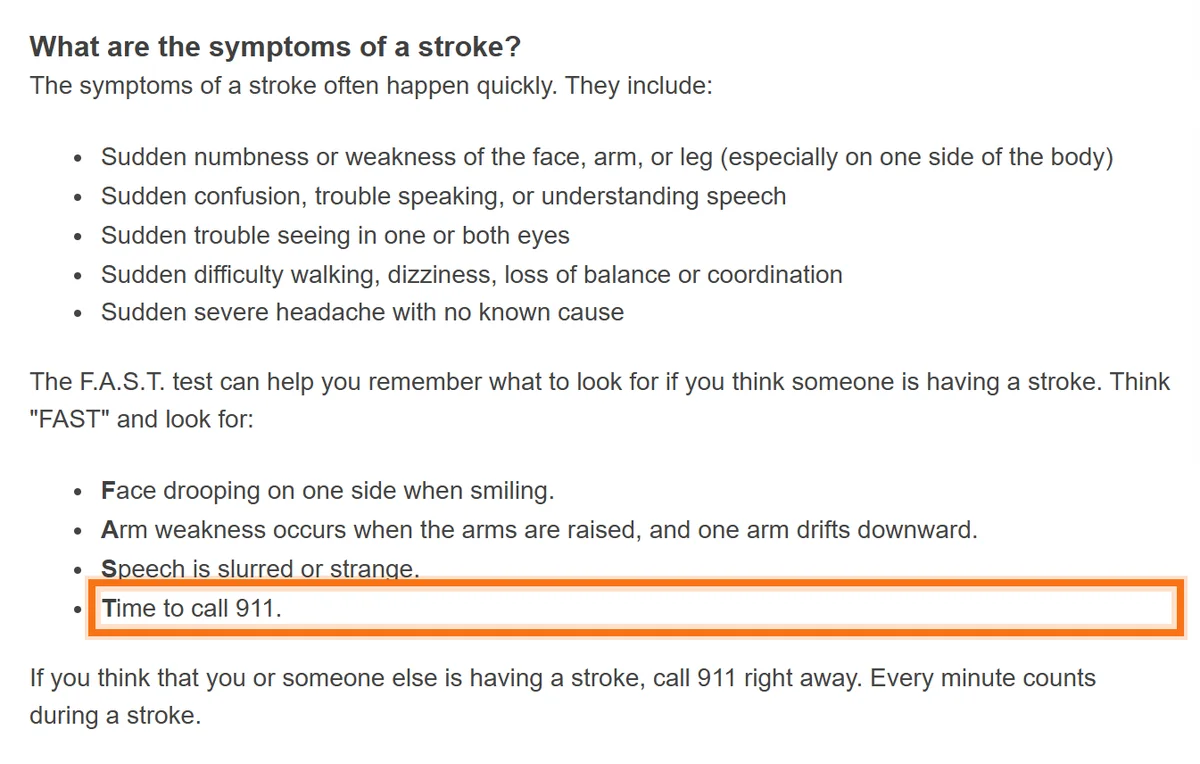
For our caregivers the rule is simple. If those signs appear, they call 911 right away, then the family. They do not wait to see if it passes, and they do not try to judge it themselves. For the full list of what to watch for in the months after a stroke, the first 90 days guide has it.
Why do families choose Senior Care of North Texas after a stroke?
- Locally owned. Ryan Berry, one of our two owners, does the free in-home assessment himself, at the house, the hospital or the rehab.
- Employee caregivers. Background-checked, insured and supervised, matched to your parent rather than pulled from a rotation. You can ask for a different caregiver at any time.
- Licensed. Texas Personal Assistance Services, License #020448. Discharge planners and home health nurses are comfortable seeing us in the same house because we are clear about the line.
- Fast. Care can often start within 24 hours, so the caregiver can be at the house on the first night home.
- Rated 4.9 stars from 44 Google reviews.
- Answered 24/7. A real person picks up at (214) 550-6533.
The same stroke recovery support covers post-hospital recovery care more broadly, for families whose parent is coming home after a fall, a surgery or another hospital stay. If you are planning the weeks after discharge in Preston Hollow or the Park Cities, our guide to recovery care at home in Preston Hollow and the Park Cities goes week by week.
How do you get started?
Call (214) 550-6533 from the hospital room if a discharge is coming, or request a free in-home assessment online. Tell us what happened and what worries you. We will tell you honestly whether our stroke recovery care fits, meet your parent where they are, listen to what the therapy team recommends, and write the first plan with you. There is no contract and no assessment fee. See how it works for the steps.
This guide is educational and is not medical advice. Questions about therapy, medication, swallowing or new symptoms belong with your parent’s physician and therapy team.
