


Veterans and surviving spouses in Preston Hollow, the Park Cities, Lakewood, North Dallas, Uptown, Turtle Creek, Bluffview and Devonshire usually need two kinds of help with Aid and Attendance. A VA-accredited representative, free at the Dallas County Veterans Service Office, files the claim. Senior Care of North Texas, a Texas-licensed home care agency (License #020448), starts the care now and supplies the care plan, invoices and records the claim needs. Call (214) 550-6533.
What Aid and Attendance is and who qualifies is covered in our guide to VA Aid and Attendance in Texas. The care itself is described in in-home care for veterans and their spouses and, for the Park Cities, in home care for veterans in Highland Park and University Park. This article is about who does what: how a Dallas family gets the claim filed, the care started and the paperwork lined up, without paying anyone for help that is free.
Who helps veterans use Aid and Attendance benefits for home care in Preston Hollow, Dallas?
No single office does all of it, and anyone who says otherwise, especially for a fee, deserves a second look. Federal rules require that help preparing VA claims come from VA-accredited attorneys, claims agents or Veterans Service Officers. We are a licensed non-medical home care agency, not accredited claims agents, and we do not file claims. Here is how the work divides.
| Who | What they do | What they do not do |
|---|---|---|
| A VA-accredited representative, such as the Dallas County Veterans Service Office | Prepares and files the claim with you; free at a county office | Should not charge a fee to "guarantee" the benefit |
| The veteran's or spouse's physician | Completes the medical examination section that documents the need for help | Does not decide the claim |
| Senior Care of North Texas | Starts care, often within 24 hours; supplies the written care plan, invoices and records of care the application uses to show unreimbursed care costs | Does not file claims, give accredited advice or make medical determinations |
| The family | Gathers the DD-214, a marriage certificate for a surviving spouse, and a list of income, assets and monthly care costs; keeps every invoice | Does not need to pay for claim help |
| The VA | Applies the rules and decides the claim | Does not promise an outcome in advance |
How to read this table: the left two columns are your to-do list, and the right column is your protection. If someone in the first row asks for money to prepare an initial claim, stop and call the county office. If a home care agency offers to file the claim for you, it is offering something it is not accredited to do.
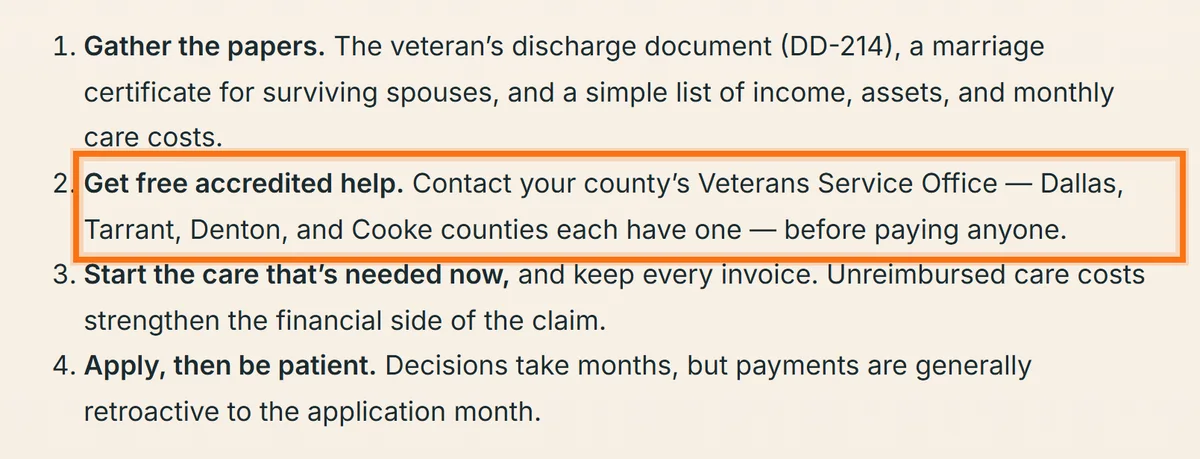
All of the neighborhoods in this article are in Dallas County, so the Dallas County Veterans Service Office is the natural first call. The step list on our VA Aid and Attendance page puts that call second, right after gathering the papers and before paying anyone.
What does va.gov say about who qualifies?
We do not make VA decisions, so the eligibility rules here come straight from the VA's own page, "Aid and Attendance benefits and Housebound allowance" on va.gov. Aid and Attendance is a monthly payment added to a VA pension. The page says you may be eligible if you get a VA pension and at least one of these is true:
- you need another person to help with daily activities such as bathing, feeding and dressing;
- you have to stay in bed, or spend a large part of the day in bed, because of illness;
- you are a patient in a nursing home because of the loss of mental or physical abilities related to a disability; or
- your eyesight is limited to the degree the page describes.
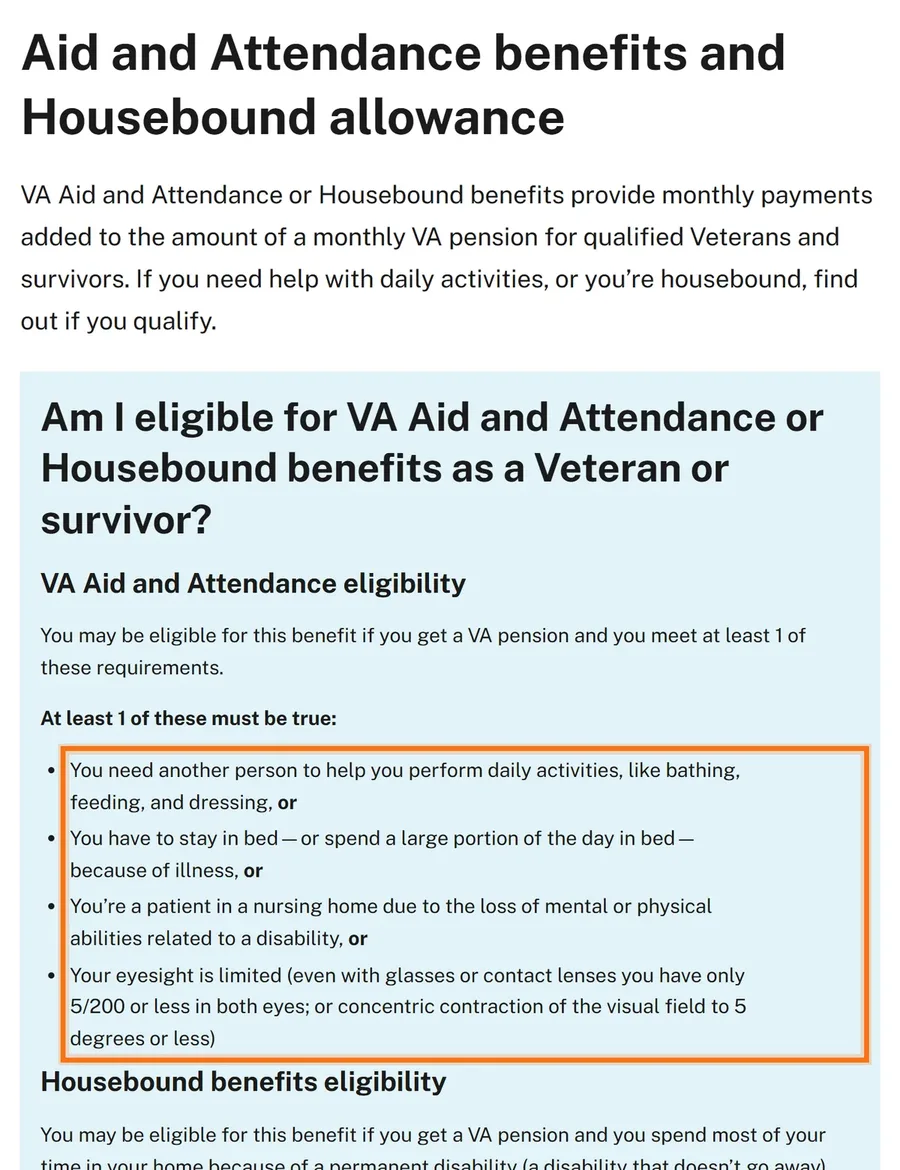
The same page explains two things families often miss. Housebound benefits are a separate allowance for someone who spends most of their time at home because of a permanent disability, and, in the VA's words, "You can't get Aid and Attendance benefits and Housebound benefits at the same time." It also says a medical examiner must complete the examination section of the application, which is VA Form 21-2680 when applying by mail.
The pension itself has its own tests for wartime service, discharge and finances. Our Aid and Attendance guide for families outlines them in plain English, and the accredited representative applies them to your case.
What does Aid and Attendance pay?
The VA publishes its numbers on the "Current pension rates for Veterans" and survivors pension rates pages on va.gov. For the rate table with a cost-of-living increase dated December 1, 2025, the Maximum Annual Pension Rate (MAPR) with Aid and Attendance is:
- $29,093 a year for a veteran with no dependents;
- $34,488 a year for a veteran with one dependent, such as a spouse;
- $18,697 a year for a surviving spouse with no dependents.
Those are ceilings, not checks. In the VA's words, it will "base your payment amount on the difference between your income for VA purposes and a limit that Congress sets," and it pays monthly. The rates page also says that medical expenses may be deducted only "above 5% of your MAPR amount," and it lists a net worth limit of $163,699 for the period beginning December 1, 2025. The VA adjusts these figures, so check the current rates on va.gov before you rely on them.
What can the benefit buy at our rates? Divide the annual maximum by twelve and compare it with our published cost of in-home care, one flat $30–34 an hour. For a single veteran at the maximum, the monthly figure falls between our estimates for 12 hours a week ($1,560–1,770 a month) and 20 hours a week ($2,610–2,960 a month). In practice, that is a few four-hour visits a week. Your parent's actual award depends on income and care costs, and only the VA decides it.
Why start care before the VA decides?
VA decisions commonly take months. A veteran who is unsafe in the shower does not get safer while a file is in review, so most families start care when it is needed and apply alongside it. There are two practical reasons this works:
- Payments are generally retroactive to the application month, so a granted claim can reach back over the months of waiting.
- Paid care is part of the evidence. Unreimbursed payments for in-home personal care can count as medical expenses when the VA calculates income, which is often what makes a family eligible when they assumed they earned too much.
Picture a common situation. A Navy veteran's widow in Lakewood has a fall and comes home from Baylor unsteady on the stairs. Her son calls the Dallas County Veterans Service Office, and the earliest appointment is a few weeks out. He calls us the same day. Ryan does the free assessment, a caregiver starts mornings that week for bathing, breakfast and the stairs, and every invoice goes into a folder. By the time the son sits down with the representative, he has the DD-214, the marriage certificate, a list of income and assets, and several weeks of paid care already on paper. The claim then takes as long as it takes, but his mother has not waited for it.
Care can often start within 24 hours of your call. Keep every invoice from the first visit on. If the budget is tight while the claim is pending, start with a few four-hour visits a week and add hours when the award arrives. If your parent also has a long-term care insurance policy, that can help in the meantime; we handle that paperwork ourselves.
What paperwork do we provide for the claim?
We supply the care side of the record. The accredited representative decides how to use it.
- A written care plan describing the help your parent actually receives: bathing, dressing, meals, mobility, medication reminders.
- Invoices showing what the family paid for care, month by month.
- A record of hours and tasks that matches the plan.
- A clear monthly cost estimate before you commit to anything, so the representative can work the income math with your care costs included.
The benefit is paid to your family, not to us, so you stay in control of how it is spent. Our rate does not change because a benefit is involved, and it does not rise as needs grow.
Aid and Attendance, neighborhood by neighborhood
The claim is the same in every ZIP code. The care around it is shaped by the house and the family.
Preston Hollow, Bluffview and Devonshire
Many Preston Hollow homes were bought in the 1950s through the 1970s and still belong to the people who bought them. Single-story ranch homes and two-story houses with the bedroom upstairs both go into the care plan, and that plan is the document the claim relies on. We serve the 75225, 75230 and 75220 ZIP codes, including Bluffview and Devonshire; see home care in Preston Hollow.
Highland Park, University Park and the Park Cities
Here the paperwork often sits with a son or daughter a few streets away who handles the doctors and the money. We send the invoices and the care plan to that person each month, so the folder for the representative builds itself. See home care in Highland Park and home care in University Park.
Lakewood
Lakewood's older houses bring stairs, small bathrooms and wood floors, which is exactly the kind of daily help with bathing and moving safely that the claim documents. Many Lakewood stays begin at Baylor University Medical Center on Gaston Avenue, and care can start the first night home while the claim is prepared. See home care in Lakewood.
North Dallas
Many North Dallas veterans and widows are in independent or assisted living along Preston Road or the Tollway, and families add a caregiver for the one-on-one time the community cannot give. Those payments are care costs too, so keep the invoices. See home care in North Dallas.
Uptown and Turtle Creek
For a veteran in a high-rise, we arrange access with the front desk before the first visit, and the caregiver can walk your parent to the building's dining room, to lunch on McKinney or to appointments at Baylor or UT Southwestern. See home care in Uptown and Turtle Creek.
What does the care itself look like for a veteran?
The same as for anyone we serve, matched to the veteran rather than to the benefit. Most begin with personal care at home, help with bathing, dressing and moving safely, plus meals, medication reminders from the organizer the family or pharmacy filled, and rides to appointments and errands. A veteran who mostly needs company and a driver may start with companion care. A married couple who both need help can be cared for in the same visit, with our couples discount.
For a veteran who no longer drives, the ride is often the part that matters most. The caregiver drives in your parent's car or her own, helps with check-in at the doctor's office or a VA clinic, waits, and brings notes back for the family. We take notes; we do not give medical advice.
Why veterans' families call Senior Care of North Texas
- We tell you plainly what we do and do not do on a VA claim, and we send you to free accredited help first.
- Care can often start within 24 hours, before the VA decides.
- One flat $30–34 an hour, a four-hour minimum visit, no contract and no levels-of-care pricing.
- Employee caregivers, background-checked, insured and supervised, matched to your parent, with the right to ask for a change at any time.
- Ryan Berry, co-owner, does the free in-home assessment himself; we are rated 4.9 stars across 44 Google reviews and licensed by the State of Texas, #020448.
Call (214) 550-6533, answered 24/7, or request a free in-home assessment. We will explain how the benefit fits with home care, point you to the county office, and start the care.
This guide is general information, not legal, financial or medical advice. Only the VA decides a claim, and an accredited representative should review your case.
