


Sooner or later, almost every family living with dementia asks the memory care vs. home care question: can we keep doing this at home, or is it time for a facility? It usually arrives after a bad week — a fall, a wandering scare, a night nobody slept — and it usually arrives loaded with guilt in both directions.
So let's take the guilt out and look at the actual trade-offs. We provide in-home memory care across North Texas, which means we have an obvious interest in one answer. We also sit at kitchen tables across Dallas with families making this exact decision, and we tell some of them a facility is the better fit. Here is how we'd walk a friend through it.
What each option actually is
Dementia care at home means your person stays in their own house (or yours), and support comes to them: family, plus professional caregivers for anywhere from a few hours a week to around-the-clock coverage. A non-medical agency like ours helps with bathing, dressing, meals, medication reminders, supervision, redirection, and companionship. Medical care still comes from the person's own doctors.
A memory care facility (often called dementia residential care, or a secured memory care facility, in Texas) is a residential community — usually a secured wing or building — designed for people with dementia. Staff are on site 24/7, doors are secured against wandering, meals and activities are built in, and the environment is designed for cognitive impairment. Your person moves there and lives there.
The honest comparison
| Factor | Care at home | Memory care facility |
|---|---|---|
| Familiarity | Stays in a known place. Familiar rooms and routines genuinely help many people with dementia stay calmer and oriented longer. | New environment. Most residents adjust, but the transition itself is often rocky for weeks or months. |
| Attention | One-on-one. The caregiver in the home is there for one person. | Shared staffing. Even good facilities divide each staff member's attention among multiple residents. |
| Security against wandering | Depends on the home and the hours covered. Door alarms and supervision help; an unstaffed 3 a.m. is still a risk. | Purpose-built. Secured exits and 24/7 staff presence — this is the facility's core strength. |
| Cost structure | Hourly. Inexpensive at light hours; costs climb steadily as hours grow. | Flat monthly rate regardless of how much attention is needed — though many facilities add fees as care levels rise. |
| Flexibility | High. Change the schedule, the caregiver, or the plan as needs change. | Low. The routine is the community's routine. |
| Social contact | Caregiver, family, and whatever the family arranges. Isolation is a real risk with thin coverage. | Built-in activities and other residents, though engagement varies person to person. |
| Family role | You remain the manager of care — real control, real ongoing work. | The facility manages daily care; your role shifts to visiting and advocacy. |
| Couples | Both spouses stay together at home; one agency visit can support both. | Typically separates the couple unless both move, at significant cost. |
How to read this table: neither column wins every row. Count the rows that matter most for your person today; for most families in the early and middle stages that is familiarity, attention and flexibility, and for a person who leaves the house at night it is the security row alone.
What do the numbers look like in Dallas?
Cost is usually the deciding factor families are most embarrassed to say out loud, so let's say it plainly.
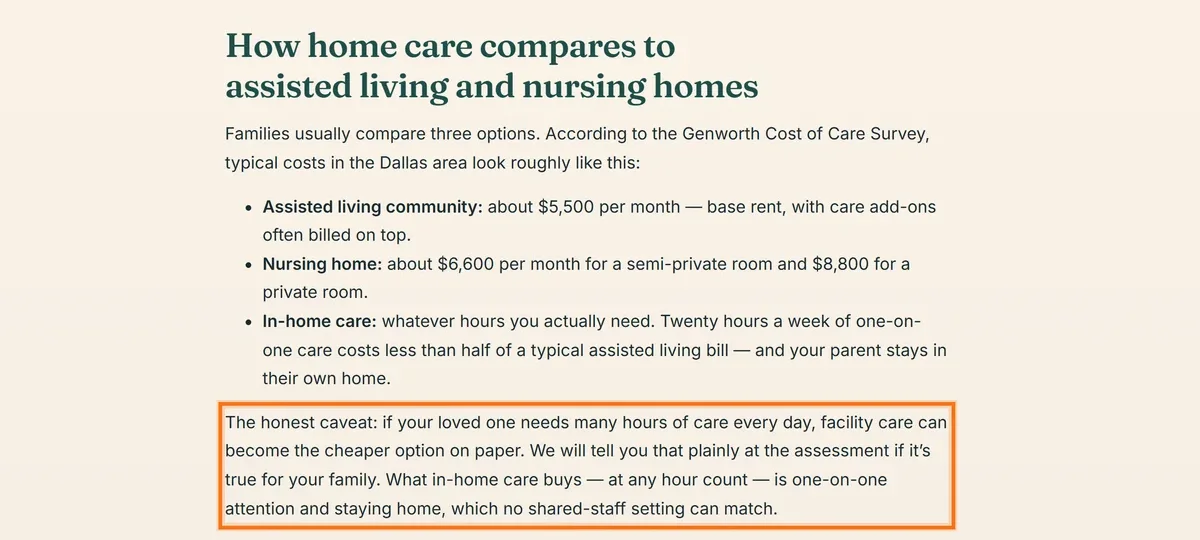
Our pricing page publishes our rate, $30–34 an hour, one flat rate day or night, and quotes the Genworth Cost of Care Survey for the Dallas area: about $5,500 a month for an assisted living community (base rent, with care add-ons often billed on top) and about $6,600 a month for a semi-private nursing home room. Memory care is priced community by community, so ask each one for its all-in monthly figure, including any care-level fees.
Here is what dementia care at home costs at the schedules families most often start with:
| Schedule | Hours a month (about) | Monthly cost at home | Next to a typical Dallas assisted living bill (about $5,500) |
|---|---|---|---|
| 4 hours a week | 17 | $520–590 | About a tenth |
| 12 hours a week | 52 | $1,560–1,770 | Under a third |
| 20 hours a week | 87 | $2,610–2,960 | About half |
| 40 hours a week | 173 | $5,190–5,880 | About the same |
| 24-hour care, rotating awake caregivers | 728 | $21,840–24,750 | About four times |
How to read this table: find the row closest to the hours your person needs now, not the hours you fear later. The lines cross at around 40 hours a week; below that, home usually costs less, and above it you are paying for one-on-one attention and staying home. Monthly figures use our published rate and about 4.3 weeks a month, as on our pricing page.
The pattern that matters more than any single number:
- At light-to-moderate hours, home wins on cost. Twenty hours a week of professional home care costs about half of a typical Dallas assisted living bill.
- As hours climb toward around-the-clock, the lines cross. True 24-hour home coverage with awake caregivers typically costs more than a facility's monthly rate. Families choosing it are paying for one-on-one attention and staying home — a legitimate choice, but an eyes-open one.
- Watch the fine print on both sides. Many facilities charge move-in fees and raise rates as "care levels" increase. On the home care side, ask about visit minimums so you can price a schedule accurately. (Our minimum visit is four hours, and our rate never rises with care level.)
When home is the better choice
- Your person is in the early or middle stages and is calmer and more capable in familiar surroundings — which describes most people with dementia for most of the disease.
- The main needs are supervision, personal care, meals, and engagement rather than intensive medical management.
- A spouse or family is present and just needs real support and real breaks, not replacement.
- You're caring for a couple. Keeping two people at home with shared support is often dramatically cheaper — and kinder — than two facility placements.
- Nights are still mostly settled, so coverage can focus on daytime hours where the dollars go furthest.
When a facility is genuinely the better choice
This is the section most home care companies won't write. There are situations where we tell families, respectfully, that a secured memory care community is the safer and saner option:
- Repeated wandering or exit-seeking. Our guide to preventing dementia wandering at home covers what helps first. If your person has left the house and been found by neighbors or police more than once, they need a secured environment or true 24-hour awake supervision at home. If round-the-clock home coverage isn't financially sustainable, a secured facility is the responsible choice — full stop.
- Safety behaviors no home setup can absorb. Persistent aggression that puts a spouse at risk, turning on the stove at night, or unsafe behavior that continues despite good caregiving and a doctor's involvement.
- The primary caregiver is collapsing. When a spouse's own health is failing under the load — and they've genuinely used respite and still can't recover — placement protects two people, not one. A facility chosen by a functioning family beats home care run by a hospitalized one.
- Medical complexity beyond non-medical care. As a Personal Assistance Services agency we do not provide nursing, wound care, or medical treatment. When daily needs become genuinely medical, the right setting may be one with clinical staff. Your person's physician should drive that judgment.
- The math has flipped. If needs have reached round-the-clock and the budget can't sustain 24-hour home staffing, a facility stretches the same dollars further. Running out of money mid-course serves no one.
Choosing a facility in these situations is not abandonment. It is matching the environment to the disease. Families who visit often and advocate hard remain caregivers — the job changes shape, it doesn't end.
What does Texas require of a memory care community?
If you start touring communities in Dallas, Plano or Fort Worth, two Texas details help you compare them. Texas Health and Human Services licenses assisted living facilities as Type A or Type B. A Type A license is for residents who do not need routine attendance during sleeping hours; a Type B license is for residents who need staff help to leave the building in an emergency. A person with moderate dementia who wakes at night usually belongs in a Type B setting.
Texas HHS also runs a separate Alzheimer's certification for assisted living facilities, with its own inspection checklists. Ask each community, in writing:
- Is the building licensed Type A or Type B, and is the memory care unit Alzheimer's certified by Texas HHS?
- How are the exits secured, and what happens when a resident tries to leave at night?
- How many staff are awake on the memory care unit at 2 a.m.?
- What is the all-in monthly cost today, and what raises it: care levels, medication management, incontinence supplies?
- Can a private caregiver visit to add one-on-one hours, and what does the community need from the agency?
Visit at four in the afternoon and again at a mealtime, not only on the scheduled tour. That is when staffing and sundowning show.
A middle path most families skip
This decision is rarely all-or-nothing, and it doesn't have to be made once. Many families use home care to delay placement by a year or more, adding hours as the disease progresses and reassessing honestly at each stage. Others use home care after choosing a facility — a private caregiver who visits the community as a facility sitter, adding one-on-one attention the staffing ratio can't provide. Our guide to adding a private caregiver inside assisted living explains when those hours earn their cost. And if you're weighing round-the-clock coverage at home, read our plain-English explainer on 24-hour home care first, because round-the-clock coverage is staffed and priced differently than most families expect.
How Senior Care of North Texas helps with this
We are a locally owned, Texas-licensed non-medical home care agency (License #020448) serving Dallas–Fort Worth and the surrounding North Texas counties. If you're weighing this decision, our free in-home assessment gives you the missing ingredient: real numbers for your actual situation, meaning what a workable schedule would look like and exactly what it would cost.
Our rates are published: one flat hourly rate around the clock, no levels-of-care pricing as dementia progresses, and a couples discount when we care for both parents. We match a caregiver to your family, with a different match a phone call away if it isn't right, build the plan around your loved one's routine, and help with long-term care insurance paperwork if you have a policy. And if the assessment tells us a secured facility is what your family needs, we'll say so. There's no obligation either way, and care can often start within 24 hours when home is the answer.
This article is educational and is not medical advice. Decisions about dementia care settings should be made with your loved one's physician.
