
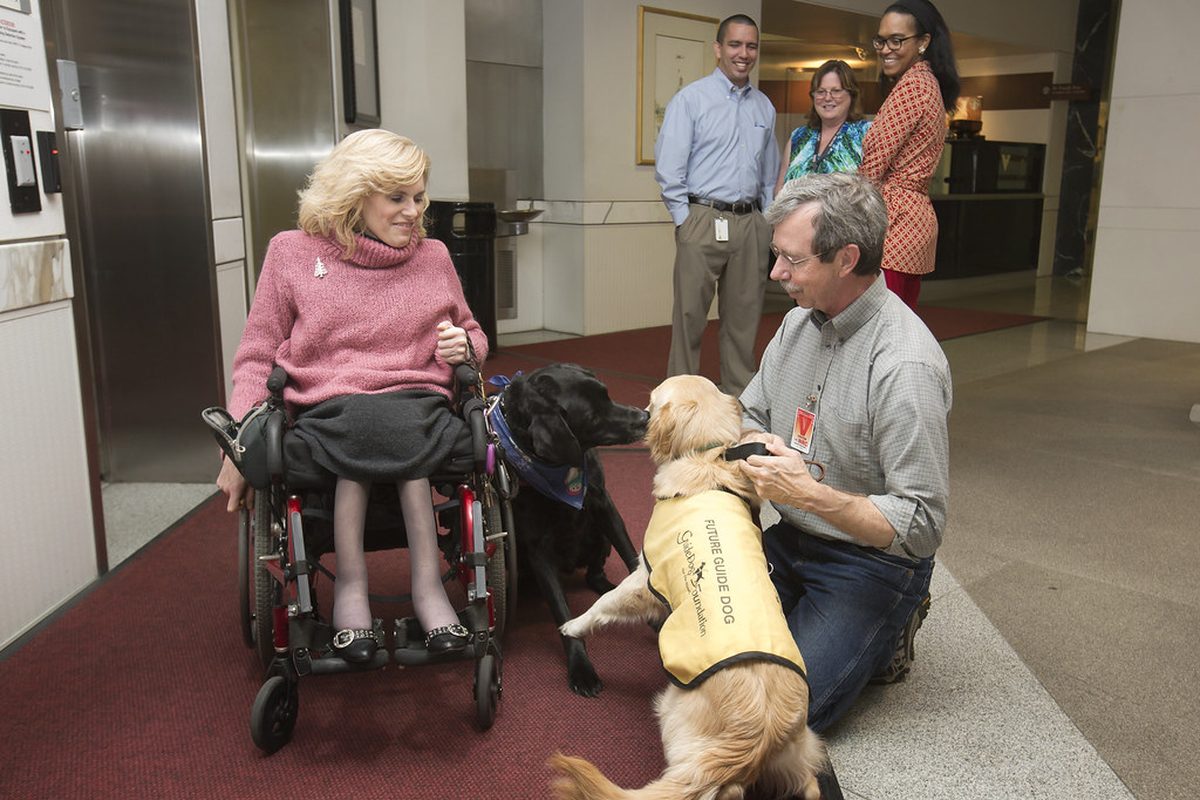

If your parent is coming home to Uptown or Turtle Creek after a hospital stay or a fall, Senior Care of North Texas provides reliable non-medical help at home: the ride from Baylor or UT Southwestern, a steady arm from the car to the unit, showers, meals, medication reminders and help with every transfer while strength comes back. We are a locally owned, Texas-licensed agency (License #020448), care can often start within 24 hours, and (214) 550-6533 is answered 24/7.
Many parents in this part of Dallas sold the family house in Preston Hollow or Highland Park and moved into a building for the elevator, the concierge and the view. After a hospital stay, that building does part of the work for you. There are no stairs to climb and no yard to keep. But the walk from the car to the bed now runs through a garage, a lobby, an elevator and a corridor, and in the first days home every one of those steps is harder than it was a week ago.
This guide is for the family who has just heard a discharge date, or just picked a parent up from the emergency room after a fall. It covers who helps with what, the first trip home into a building, the moments in a condo when falls tend to happen, and what the help costs.
Who can help an older parent at home after a fall in Uptown Dallas, Dallas?
Senior Care of North Texas can. A parent is home from the ER, shaken and sore, and should not be alone for a while. We can send a caregiver for mornings, meals and steady support, starting with a four-hour visit, our minimum, and adding hours if the first days show they are needed.
Picture a common situation. Your mother catches her foot on the edge of a rug on the way to the kitchen in her Turtle Creek unit. The front desk calls the ambulance, she spends the afternoon at Baylor, and by evening she is home with no broken bones, a deep bruise, a borrowed walker and instructions to have someone with her for the next few days. You live across town and have work in the morning. That is exactly the gap a caregiver fills.
In the first days after a fall, the caregiver:
- Stands by for every transition. Out of bed, up from the toilet, into and out of the shower, up from the sofa. These are the moments when most falls at home happen.
- Helps with the shower. Standby or hands-on, with the bathroom ready before your mother steps in.
- Makes sure the walker is actually used. A new walker often ends up parked by the door while your parent grips the furniture instead.
- Clears the path. Rugs, cords and clutter come out of the walking routes on every visit, starting with the rug that caused the trip.
- Cooks and keeps water within reach. A sore, tired parent skips meals.
- Tells you what changes. New pain, swelling, confusion or a different way of walking gets reported to the family the same day, so you can call the doctor early.
The caregiver does not decide whether the fall needs more tests, and does not design exercises. Those questions belong to the physician and, if one is ordered, the therapist. Our page on transfer and mobility assistance explains this hands-on help in more detail, and our guide to transfers from the bed, chair, toilet and car shows how each one is done.
Who can provide reliable post-hospital senior care at home in Turtle Creek, Dallas?
Senior Care of North Texas provides post-hospital recovery care across Uptown, Turtle Creek, Oak Lawn, the State Thomas district and the blocks around the Katy Trail, in ZIP codes 75201, 75204 and 75219. The word "reliable" matters more after a discharge than at almost any other time, because the first two weeks home are when the help is needed most and planned least.
Here is what reliable should mean in practice, from any agency you call:
- Someone is in the unit when your parent arrives. Not "we will start on Monday." The plan is made before discharge day.
- A sick caregiver does not mean an empty unit. Our caregivers are employees, background-checked, insured and supervised. When one is out, we send a replacement who already has the care plan and the building instructions.
- The price does not jump on the hardest days. Our rate is one flat $30–34 an hour. It is the same on the first day home, when your parent needs help with everything, as on the last, when a morning check is enough.
- The plan can shrink. There is no contract, so hours come down as strength returns without renegotiating anything.
Ryan Berry, our co-owner, does the free assessments himself, and hospital discharge planners and social workers across North Texas know him by name. We are rated 4.9 stars across 44 Google reviews.
Which hospital is your parent coming home from?
Most discharges in this part of Dallas come from two places. Baylor University Medical Center is just east of downtown on Gaston Avenue. UT Southwestern's Clements University Hospital and Parkland are northwest on Harry Hines. Texas Health Presbyterian Dallas is a longer drive north on Central.
Whichever one it is, call us from the hospital room. Ryan can do the free assessment at the bedside, listen to what the therapists recommend, arrange building access, and have a caregiver in the unit when your parent arrives home. Meeting before discharge means the care plan matches what the discharge planner actually ordered, and your parent meets the caregiver as part of coming home rather than as a stranger at the door.
If the family cannot be at the bedside around the clock while your parent is still admitted, our hospital and facility sitters can cover those hours. And because the follow-up visits are often back at the same hospital, the caregiver can drive your parent there too, through our transportation and errands service. For a day-by-day look at the first three days, read coming home from a Dallas hospital: the first 72 hours.
What is the trip home into a building actually like?
In a house, the trip home ends at the front door. In a high-rise it has more stages, and each one is a place where a tired parent on a new walker can tire out or lose balance. The caregiver plans each stage before the car leaves the hospital:
- The pickup. The caregiver meets your parent at the discharge door, helps with the transfer into the car and folds the walker into the trunk.
- The arrival. Front entrance or garage, whichever is shorter on foot for your parent. The walker comes out first, and your parent stands up only when it is in place.
- The lobby door and the elevator. One hand for the door, one arm for your parent. Nobody hurries for an elevator that is about to close.
- The corridor. In some buildings the walk from the elevator to the unit is the longest walk of the day. If your parent needs a rest, they take it.
- The unit. The bed is made, the walking routes are clear, the phone, glasses, water and remote are within reach, and the first meal is ready.
Building access is settled before any of this: the caregiver's name on the front desk list, where to park and how deliveries come up. We wrote a separate guide to how home care works in a Turtle Creek or Uptown building, so here we only note that it is done in advance, not in the lobby on discharge day.
New prescriptions are the next errand. The caregiver can pick them up at your parent's usual pharmacy, whether that is near Lemmon Avenue or in the West Village, and then remind your parent of each dose from the discharge list or the organizer your family or pharmacy has filled. Caregivers give reminders only. They do not fill organizers, hand out pills or change anything a doctor prescribed.
What does recovery care include in the weeks after?
A recovery caregiver covers the practical work the discharge instructions assume someone will do. Our service page lists it plainly:
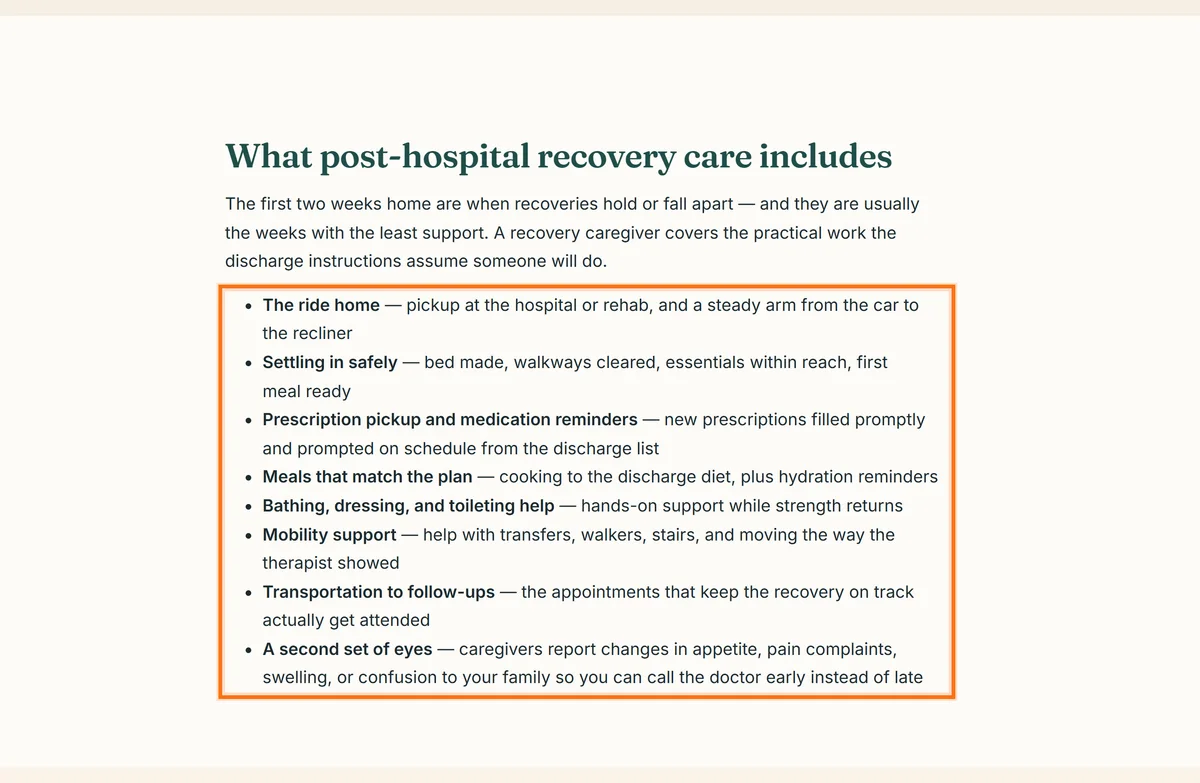
How much of that list your parent needs depends on why they were in the hospital or the ER, and on who else is coming to the unit. This is how the work usually divides.
| Situation | What the caregiver does | What belongs to the medical team |
|---|---|---|
| Home from the ER after a fall, not admitted | Stands by for transfers and showers, clears walking routes, cooks, reports new pain or confusion to the family | Deciding whether more tests or a follow-up visit are needed |
| Discharged from Baylor, UT Southwestern or Parkland after a stay | Ride home, first night set up, prescription pickup, medication reminders, meals to the discharge diet | Medication changes, wound care, reading the warning signs on the discharge papers |
| Home health nurse or therapist ordered by the doctor | Has your parent up, dressed and fed before the visit; encourages the walking the therapist assigned | Nursing visits, vital signs, wound checks and the therapy exercises themselves |
| Rehab ending, therapist says someone should be home for the first weeks | Covers the high-risk hours (mornings, evenings, bathroom trips) and drives to follow-up appointments | When stairs, the shower or walking outside without help are cleared |
How to read this table: find the row that matches how your parent came home, then read the middle column for what you can hand to a caregiver and the right column for what still goes to the doctor, nurse or therapist. If a question falls in the right column, call the medical team; the caregiver's job is to notice it and tell you.
The hands-on parts of the day, the shower, dressing and toileting, are part of our personal care at home, and they are often where families feel the most relief. A parent who would never ask a son for help in the bathroom will often accept it from a trained caregiver who does it matter-of-factly every day.
Where do falls tend to happen in a condo, and what does the caregiver do?
A unit on one floor removes the staircase, which is one reason the move to a building made sense. The risky moments do not disappear, though. Most falls at home happen during a transition, and a condo has the same transitions as a house:
- Getting out of bed in the morning, while still stiff and half awake.
- Standing up from the toilet, especially without a grab bar.
- Stepping into and out of the shower.
- Rising from a deep, low sofa or a favorite armchair.
- Getting into and out of the car in a tight garage space.
The caregiver is there for exactly those moments, with steady, unhurried help and proper body mechanics, following the approach your parent's therapist recommends. Many families set the schedule around them: a morning visit for getting up, washed, dressed and fed, and an evening visit for dinner and getting into bed. Both are billed at the same flat rate.
We will not tell you that a caregiver ends the chance of another fall. No honest agency can promise that. What a caregiver does is reduce the number of risky moments your parent faces alone, and report anything worrying to your family the same day. If you want to look at the unit itself, our room-by-room fall risk checklist works just as well in a two-bedroom condo as in a house.
How does this fit with Medicare home health?
Families are often told at discharge that "home health has been ordered" and assume that means someone will be with their parent. It usually does not. According to our page on whether Medicare covers home care, Medicare pays for intermittent skilled home health when a doctor orders it and the patient is considered homebound: nursing visits, physical or occupational therapy, and a bath aide for a limited time while the skilled care is active. The visits are short, a few times a week, and they end when the skilled need ends.
Original Medicare generally does not pay for non-medical help such as bathing, meals, housekeeping or companionship when that is the only care someone needs. That is the help we provide. The two work side by side: the nurse handles wounds and vitals, and our caregiver makes sure your parent is up, fed and ready when the nurse or therapist arrives. Our guide to home care versus home health sets out the difference in full.
If your parent owns a long-term care insurance policy, it may cover what Medicare does not, and we help families file the claim and handle the paperwork.
How many hours, for how long, and what does it cost?
Families commonly keep recovery care for two to six weeks, long enough to get through the early period and regain strength. The usual pattern is to start with longer days and step down: full days at first, then a morning visit, then a couple of mornings a week. Some families find a small amount of ongoing help is worth keeping. If there is a setback, hours go back up just as simply.
Our rate is $30–34 an hour, one flat rate for days, evenings, weekends and overnights. It does not rise as your parent needs more hands-on help, because we do not price by levels of care. The minimum visit is four hours. Major holidays are billed at time and a half. There is no assessment fee, no start-up fee and no long-term contract, and when one caregiver helps both parents in the same unit, a couples discount applies.
Our published cost of in-home care in Dallas-Fort Worth puts common schedules at these monthly estimates:
- 12 hours a week (three four-hour mornings): about $1,560–1,770 a month.
- 20 hours a week: about $2,610–2,960 a month.
- 40 hours a week: about $5,190–5,880 a month.
- 24-hour care with rotating awake caregivers: about $21,840–24,750 a month, for the stretch when a parent cannot be alone at any hour.
Recovery care rarely stays at the same level for a full month, so the real figure is usually a mix: a heavier first week or two, then less. The free assessment gives you an exact quote in writing for your parent's schedule. If the hospital stay was for a hip or knee replacement, our guide to recovery at home after hip or knee replacement covers the precautions and the week-by-week arc for that surgery.
Why families in Uptown and Turtle Creek call Senior Care of North Texas
Some buildings can recommend a private caregiver who already works with other residents. That is convenient until that person is sick or takes another job and there is no one behind them, which is a hard thing to discover in the second week of a recovery. With us:
- Caregivers are our employees, background-checked, insured and supervised, and a replacement arrives with the care plan and the building instructions.
- We match the caregiver to your parent, and you can ask for a different match at any time.
- Ryan does the assessment himself, at the bedside, in rehab or in the unit, usually the same day or the next morning.
- Care can often start within 24 hours, and the phone is answered 24/7.
- We are licensed by the State of Texas for Personal Assistance Services, License #020448, and rated 4.9 stars across 44 Google reviews.
We serve families across Dallas-Fort Worth. Our in-home senior care in Uptown and Turtle Creek page covers this part of the city, and the same team also covers nearby Preston Hollow and the Park Cities.
What should you do if the discharge date is already set?
- Call (214) 550-6533 from the hospital. Tell us which hospital, the discharge date and what the discharge planner has said.
- Book the free assessment at the bedside. Ryan listens to the therapy team and turns the discharge instructions into a real schedule: who is there when, what gets cooked and which appointments need rides.
- Let us settle the building. Access at the front desk, parking and deliveries are arranged before the ride home.
- Meet the caregiver. We match the caregiver, and your parent meets them as part of coming home.
- Review after the first week. We look at the hours together and step them down as your parent gets stronger.
If the call is about a fall rather than a discharge, the steps are the same, only faster: call us tonight and we can often have someone in the unit tomorrow. You can also request a free in-home assessment in writing and we will call you back. To see the full scope of the service first, read our page on recovery care after a hospital stay.
This article is educational, not medical advice. Questions about your parent's health, medications, wounds or exercises belong with the physician, the home health nurse or the therapy team.
