


The medication mistakes that harm older adults at home are rarely dramatic. They are duplicates from two different prescribers, an over-the-counter sleep aid nobody mentioned, a pill organizer that gets filled correctly and then taken twice, and a drug that was supposed to stop three months ago and never did. Almost all of it is found by putting every bottle on the kitchen table and taking them to one pharmacist.
What is polypharmacy, and why is it risky?
Polypharmacy means taking multiple medications at once — commonly defined as five or more. It is not automatically wrong. Someone with heart failure, diabetes, and arthritis may genuinely need eight prescriptions, each defensible on its own.
The risk is that the list grows and never shrinks. Each drug is added by a different doctor for a good reason. Nobody is assigned to ask whether the whole collection still makes sense together.
Older bodies also handle medication differently. Kidneys and liver clear drugs more slowly, so the same dose builds to a higher level. Body composition changes. Sensitivity to sedating drugs rises sharply. A dose that was fine at sixty can be too much at eighty without anything else changing.
And side effects get misread as aging. New confusion becomes "she's slipping." Dizziness becomes "he's unsteady now." Constipation, incontinence, low appetite, and daytime sleepiness all get filed under old age when a medication is the cause. The rule worth remembering: any new symptom in an older adult should raise the question of whether a medication started or changed recently.
Why do duplicate prescriptions happen?
Picture a common situation. A woman sees a cardiologist, a rheumatologist, a primary care physician, and a urologist. She was in the hospital in the spring and saw two hospitalists there. She fills prescriptions at a supermarket pharmacy and picks up occasional ones at a big chain near her daughter's house.
Nobody in that picture sees the full list. The cardiologist sees the cardiology drugs and whatever she remembers to mention. The hospital added something and changed a dose, and the discharge paperwork went into a drawer.
Two specific traps:
- Brand and generic duplicates. The same drug under two names, taken as if it were two different medications.
- Same-class duplicates. Two drugs doing the same job from different prescribers, each unaware of the other.
Over-the-counter products are the invisible half of the list. People do not think of them as medication, so they do not mention them. Pain relievers, antacids, sleep aids, cold remedies, herbal supplements, and vitamins all interact with prescriptions, and many nighttime and PM formulas contain sedating antihistamines that are a poor choice for older adults.
What is a brown-bag review?
A brown-bag review is exactly what it sounds like: put every single thing the person takes into a bag and bring it to the physician or pharmacist so a professional can see the whole list at once. It is one of the most useful medication-safety exercises a family can arrange. Ask the pharmacist your parent already uses when they can sit down with the bag.
- Collect from everywhere: the kitchen counter, the bathroom cabinet, the nightstand, the purse, the car, the kitchen drawer.
- Include everything — prescriptions, over-the-counter products, vitamins, supplements, herbal remedies, eye drops, inhalers, patches, and creams.
- Bring bottles, not a list. Labels show prescriber, date, and dose, and the fill dates reveal whether refills match how the pills are actually being taken.
- Bring the expired and stopped ones too. Those are exactly the bottles that cause accidental doses.
- Ask about each one: what is this for, is it still needed, is the dose still right for her age and kidney function, and can anything be stopped or simplified?
- Ask specifically about anything sedating, anything for sleep, and anything anticholinergic, a class known to worsen confusion in older adults.
- Leave with one printed, current list, and take it to every appointment thereafter.
Using one pharmacy for everything makes this dramatically easier, because the pharmacy's software then screens the whole list for interactions automatically. Reducing or simplifying medication is called deprescribing, and it is a legitimate medical goal. It is also a decision only a prescriber can make. Never stop anything on your own, especially heart, blood pressure, blood thinner, seizure, steroid, or psychiatric medication.
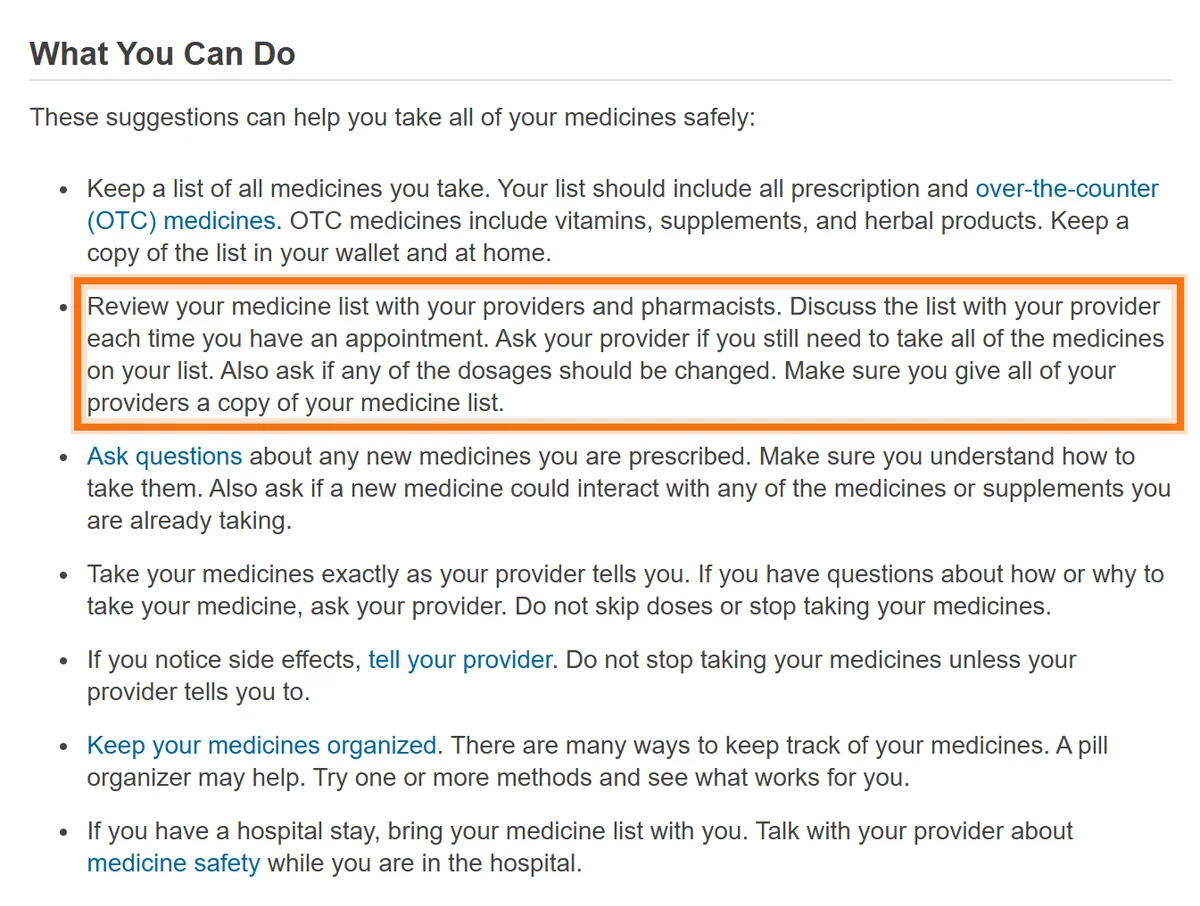
MedlinePlus, the National Library of Medicine's patient site, gives the same advice in its guide to taking multiple medicines safely. It names the people most likely to run into problems: anyone prescribed five or more medicines, anyone whose medicines come from more than one provider, older adults, and people in the hospital. Most of the parents we meet in Dallas–Fort Worth are in at least two of those groups.
Timing, food, and other practical traps
Instructions on a label are shorthand for something specific, and getting them wrong quietly wastes the medication or causes harm.
| Instruction | What it usually means | Why it matters |
|---|---|---|
| Take on an empty stomach | An hour before food or two hours after | Food can block absorption substantially |
| Take with food | With a meal or a solid snack, not just water | Reduces stomach irritation and nausea |
| Take in the morning | Early, and before other pills if specified | Diuretics taken late mean night-time bathroom trips and fall risk |
| Do not lie down for 30 minutes | Sit or stand upright afterward | Some pills injure the esophagus if they linger |
| As needed | Only for the stated symptom, within the stated limit | The most commonly overused instruction in the house |
| Do not crush | Swallow whole; ask about a liquid form instead | Crushing an extended-release tablet releases the whole day's dose at once |
How to read this table: find the wording on the label in the left column, then read across. If the label on your parent's bottle says something that is not here, or two labels seem to conflict, that is a question for the pharmacist, not a guess for the family.
Other practical points. Grapefruit juice interferes with a surprising number of common medications, so ask the pharmacist rather than assuming. Alcohol amplifies sedating drugs. Antacids and calcium can block absorption of other pills taken at the same time. Missed-dose rules differ by drug and are worth writing down in advance, because the decision is otherwise made at eleven at night by someone guessing.
Which combinations deserve a specific conversation?
This is general education, not a list of rules to apply at home. Every one of these is worth raising by name with the pharmacist or physician, who can judge the actual situation.
- Blood thinners together with over-the-counter pain relievers such as ibuprofen or naproxen, or with some supplements, because bleeding risk rises
- Two or more sedating medications — a sleep aid, an anxiety medication, a muscle relaxant, a strong pain medication — stacked together
- Over-the-counter nighttime and PM formulas in someone with memory problems, since many contain sedating antihistamines
- Several blood pressure medications together with a diuretic, particularly where dizziness on standing is already an issue
- Anything new added to a stable diabetes regimen, where low blood sugar can look exactly like confusion
- Anything added while a person is dehydrated or eating poorly, since both change how drugs behave
Bring the whole list to any new prescription conversation. The most useful question a family can ask is short: "Given everything else she takes, is this still the right choice?"
Why do pill organizers fail with memory loss?
A weekly organizer is an excellent tool for someone whose memory is intact and who simply has a complicated schedule. For someone with memory loss it can create the exact problem it was meant to solve.
The failures repeat:
- The person takes a dose, forgets, and takes another. The organizer cannot say no.
- They take Thursday's compartment on Tuesday because a compartment looked full.
- They rearrange or refill it themselves between family visits, undoing the sorting.
- Nobody checks it, so a week of empty compartments is assumed to mean a week of doses taken, when the pills may have gone into a drawer or a bin.
- The organizer gets moved and forgotten in a new spot.
- Loose pills in the organizer lose the label, so nobody can identify them later.
What works better when memory is failing is a person, not a device. Locked or timed dispensers help. Pharmacy blister packs sealed by date and time help more than a self-filled box. Simplifying to fewer daily doses helps most of all, and only a prescriber can do that. But the reliable answer, when someone can no longer track what they have taken, is having somebody there at the time.
That is what medication reminders are for: a caregiver present at the scheduled hour who prompts, brings water, stays while the dose is taken, and writes down the time so the family and the physician can see what actually happened. Where memory loss is the underlying problem, this usually sits inside broader memory care at home rather than standing alone.
What is the legal line between a reminder and administering a dose?
This distinction is not a technicality. It is the boundary of what a non-medical agency is licensed to do in Texas, and it protects the client.
We are licensed for Personal Assistance Services, License #020448. That license covers non-medical support. It does not cover nursing tasks, and medication administration is a nursing task.
What a caregiver can do:
- Remind the person that it is time to take medication
- Read the label aloud and confirm what the instructions say
- Bring the organizer or the bottles to the person, and bring water
- Open a container when arthritis makes it impossible, at the person's request
- Stay present while the dose is taken and observe that it was
- Write down the time and note it for the family
- Report a missed dose, a refusal, or a new symptom to the family right away
- Pick up refills and keep the supply from running out
What a caregiver cannot do:
- Decide which medication to give, or when
- Fill or sort a pill organizer
- Place pills in someone's mouth or hand-feed a dose
- Give an injection, including insulin, or manage an insulin pump
- Apply prescription patches or medicated dressings
- Adjust a dose, skip a dose, or double one to catch up
- Decide whether an as-needed medication should be taken
Where actual administration is needed, that is home health nursing, which is a different service ordered by a physician. Home health and non-medical home care frequently run in the same house, and that combination works well. Our how care works page explains how a plan is set up, and the Texas Personal Assistance Services license guide explains what licensing does and does not cover.
What does a medication reminder visit cost in Dallas?
Reminders are part of a visit, not a separate product. Our rate is published: $30–34 an hour, the same by day, evening, weekend and overnight, with a four-hour minimum, so one visit costs $120 to $136. Major holidays are billed at time and a half. On our Dallas–Fort Worth pricing table, three four-hour visits a week come to about $1,560–$1,770 a month. In those four hours the caregiver also makes the meal the morning dose is taken with, helps with the shower and keeps the refill list. Our guide to medication reminders vs. administration covers the legal line in more detail, and the medication reminders page shows what a visit includes.
A simple system that holds up
- One pharmacy, one prescriber who reviews the whole list, one printed current list.
- A brown-bag review at least once a year and after every hospital stay, when medications change most.
- Everything stored in one place, out of heat and humidity — a bathroom cabinet is the worst common choice.
- Expired and discontinued bottles removed from the house entirely.
- Refills tracked so nothing runs out on a weekend.
- A written note of any new symptom, with the date, to take to the next appointment.
This article is educational and is not medical advice. Never start, stop, or change a medication without the prescriber's direction. Questions about interactions, dosing, and timing belong with the physician or pharmacist who knows the full picture.
If medication management is the reason a parent in North Texas is no longer safe alone, talk to our care team. The in-home assessment is free, visits are four hours or longer at one flat hourly rate day or night, and care can often start within twenty-four hours.
